
In Terminator 2: Judgment Day, the T-800 cyborg portrayed by Arnold Schwarzenegger reveals to John Connor the hidden origin of his combat adaptability: nestled inside his armored chassis sits a neural net processor — a computational unit capable of learning from novel experiences and executing complex tactical decisions in mere fractions of a millisecond. Decades earlier, in the foundational anthology I, Robot, Isaac Asimov envisioned positronic brains: quantum-neural mechanisms capable of sustaining autonomous reasoning without requiring massive electrical sub-stations or industrial power plants tethered to robotic chassis.
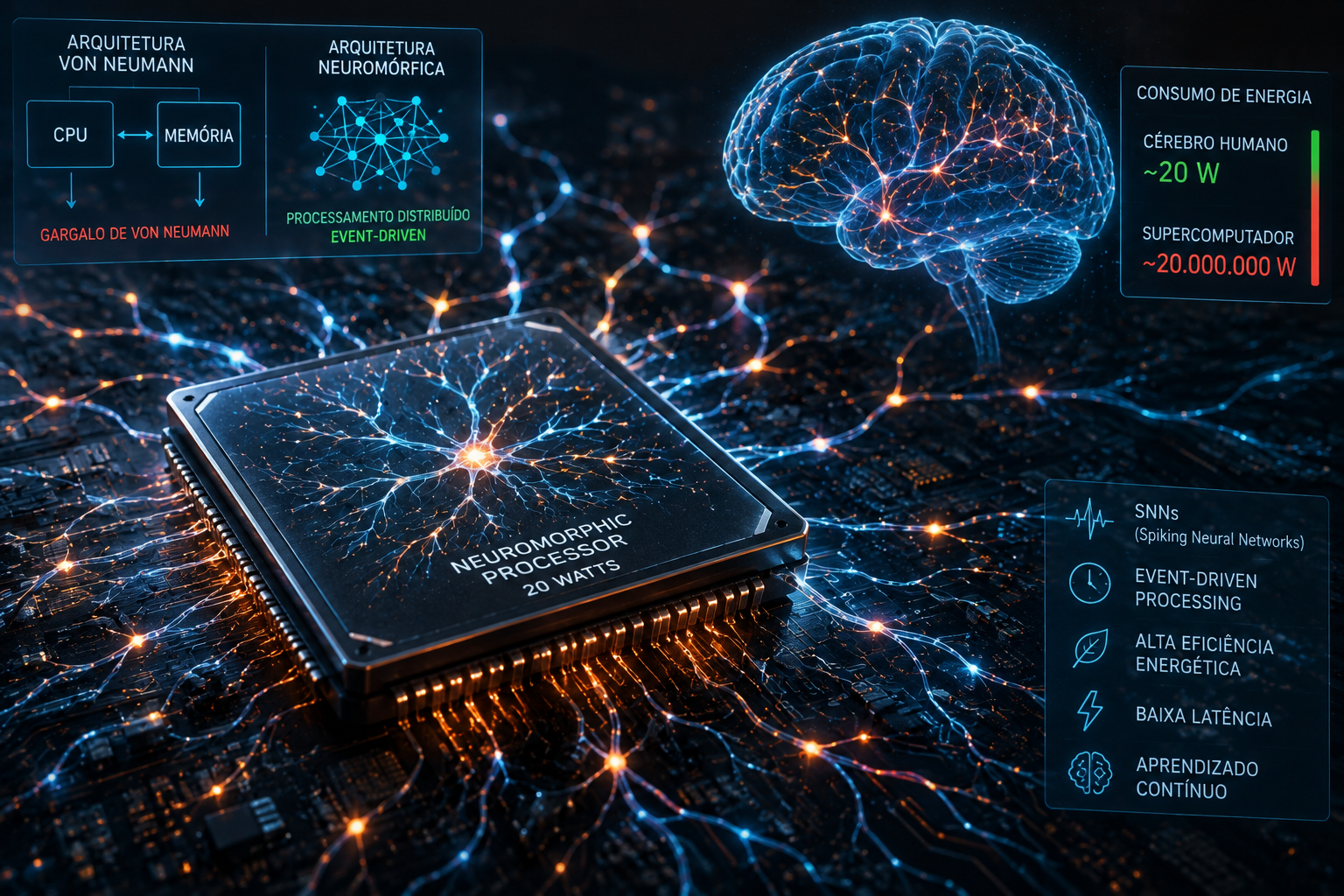
Throughout science fiction, intelligent automata operated with remarkable thermodynamic elegance. Yet behind cinematic fantasy, modern computer science and semiconductor engineering have collided with the most severe physical bottleneck in computing history: while contemporary supercomputers and graphics processing unit (GPU) clusters powering Large Language Models (LLMs) consume tens of megawatts and demand complex liquid cooling infrastructures, the biological human brain performs continuous multi-modal perception, abstract reasoning, and motor coordination drawing a metabolic power budget of a mere 20 Watts — less electricity than a standard bedside incandescent bulb.
This immense gap in energy efficiency does not stem from a shortage of microelectronic transistors, but from a fundamental conceptual constraint within classical computing architecture. In this comprehensive essay, Reach Technocracy dissects the cutting-edge frontier of neuromorphic computing and bio-inspired silicon. We explore the biophysical foundations of Spiking Neural Networks (SNNs), the definitive dismantling of the Von Neumann Bottleneck via memristors and compute-in-memory paradigms, the milestones achieved by Intel Loihi 2, the Hala Point supercomputer, and IBM NorthPole, alongside the mathematical challenges that still separate solid-state silicon from biological reflexes.
1. The Silicon Crisis and Biological Efficiency
The classical architecture formulated by John von Neumann in 1945 established a strict physical dichotomy between the Central Processing Unit (CPU) and working memory (RAM). For nearly eight decades, this structural separation fueled technological growth under Moore’s Law and Dennard scaling. However, in the modern era of deep learning and generative artificial intelligence, this division has solidified into the notorious Von Neumann Bottleneck.
The Von Neumann Bottleneck and the Thermodynamic Cost of LLMs
In conventional computing processors and tensor-optimized GPUs, matrix arithmetic requires billions of synaptic weights and activation parameters to be continuously shuttled back and forth between external memory banks (such as HBM3 or DDR5 modules) and arithmetic logic units across physical copper interconnects. Landmark computer architecture analyses from Stanford University and MIT reveal that moving a single 64-bit data word from off-chip DRAM to an execution register consumes 100 to 1,000 times more energy than performing the actual mathematical multiply-accumulate (MAC) operation itself.
Consequently, in dense deep learning workloads, up to 90% of total electrical energy is squandered exclusively on moving data across silicon traces, producing massive ohmic heat dissipation. This defines the dual constraints known as the Memory Wall and the Power Wall. Conversely, the human brain utilizes an inverted topology: memory and computation are intrinsically co-located. Each of its 86 billion biological neurons and 100 trillion synaptic junctions acts simultaneously as an arithmetic processor and a distributed physical storage node, completely eliminating data transit buses.
The Physics of Spikes: Event-Driven Sparsity vs. Continuous Clocking
This thermodynamic disparity also originates from temporal signal dynamics. Conventional digital processors operate synchronously: their internal logic gates toggle continuously driven by a global clock oscillator beating billions of times per second (GHz). On every single clock cycle, billions of semiconductor transistors switch states and dissipate power, regardless of whether incoming data streams contain novel information. In stark contrast, the biological central nervous system functions under the principle of event-driven computation (Event-Driven Sparsity).
Biological neurons do not stream continuous 32-bit floating-point tensors. Instead, they remain in a quiescent electrochemical resting state, consuming virtually zero power until accumulated input stimuli breach an activation threshold. At that exact moment, the neuron discharges a discrete, millisecond-scale electrical pulse known as an action potential, or spike. If a sensory scene is motionless or input signals remain constant, no spikes are generated and dynamic energy dissipation drops to zero. In the human neocortex, only 1% to 2% of neurons fire concurrently in any given millisecond, endowing biological cognition with extreme temporal and spatial sparsity.
2. The Mechanics of Spiking Neural Networks (SNNs) and Memristors
To transfer biological efficiency into solid-state hardware, computer scientists and physicists developed the third generation of neural models: Spiking Neural Networks (SNNs). Unlike traditional Deep Neural Networks (DNNs) that propagate continuous scalar values across dense tensor layers, SNNs treat time as an intrinsic computational coordinate.
Biophysical Modeling: The Leaky Integrate-and-Fire (LIF) Mechanism
At the structural core of neuromorphic silicon sits the mathematical model of the biological cell membrane. The most widely implemented paradigm is the Leaky Integrate-and-Fire (LIF) circuit model, in which the artificial neuron’s membrane is realized as an electrical capacitor wired in parallel with a leakage resistor:
- Signal Integration: Incoming pre-synaptic spikes inject electrical charge proportional to their assigned synaptic weights, steadily elevating the post-synaptic membrane potential.
- Temporal Leakage: In the absence of incoming spikes, the accumulated membrane voltage decays exponentially toward its baseline resting potential, mirroring biological passive ionic diffusion.
- Threshold Firing and Reset: When accumulated membrane potential crosses a critical threshold voltage (Vth), the artificial neuron emits a binary spike (logical 1) across the network and instantly resets its internal potential to baseline.
This formulation enables information to be encoded not merely in spike frequencies (Rate Coding), but within precise temporal intervals between discrete pulses (Time-to-First-Spike and Phase Coding), enabling complex spatio-temporal recognition with minimal energy expenditure.
Memristors and STDP Synaptic Plasticity: Fusing Memory and Logic
While artificial neuron soma circuits are readily fabricated using standard CMOS transistors, the synapse — the plastic interface linking neuronal nodes — finds its physical realization in the memristor (memory resistor), theoretically formulated by Leon Chua in 1971 and fabricated in 2008. The memristor is a passive two-terminal electronic device whose internal electrical conductance varies dynamically depending on the magnitude, direction, and duration of electrical charge previously passed through it, retaining this state non-volatily.
This physical switching behavior precisely mirrors Spike-Timing-Dependent Plasticity (STDP), the biological foundation of Hebbian learning (“neurons that fire together, wire together”):
- Long-Term Potentiation (LTP): If a pre-synaptic neuron spikes immediately prior to a post-synaptic neuron, the memristor’s conductance increases, strengthening synaptic connectivity.
- Long-Term Depression (LTD): If the pre-synaptic neuron fires after the post-synaptic discharge, the memristor’s conductance decreases, weakening the functional link.
By arranging memristors into dense crossbar arrays fabricated directly above CMOS computing layers, neuromorphic engineers achieve true In-Memory Computing: fundamental laws of physics (Ohm’s Law for vector multiplication and Kirchhoff’s Current Law for matrix summation) execute tensor math passively and instantaneously at near-zero power overhead.
3. The Hardware Titans: From Loihi 2 to IBM NorthPole
The translation of biophysical theory into high-yield commercial semiconductor wafers has produced transformative neuromorphic processing engines developed by industry leaders and national laboratories.
Intel Loihi 2 and the Hala Point Supercomputer
Intel Labs spearheads digital neuromorphic processing with its Loihi 2 processor, fabricated on the Intel 4 process node (6nm class). Each individual Loihi 2 die integrates up to 1 million programmable artificial neurons and approximately 120 million synaptic elements across 128 asynchronous neurocores, operating within a thermal envelope of roughly 1 Watt. Loihi 2 introduced fully programmable neuron microcode models and generalized graded spike communication.
The pinnacle of this architecture is realized in the Hala Point neuromorphic system deployed at Sandia National Laboratories. Hala Point clusters 1,152 Loihi 2 processors within a microwave-sized computing enclosure:
- Neural Capacity: 1.15 billion artificial neurons and up to 128 billion active synapses — matching the neuronal complexity of an owl or small primate brain.
- Synaptic Throughput: Exceeding 380 trillion synaptic operations per second (380 neuromorphic TOPS).
- Thermodynamic Efficiency: The entire supercomputing cluster draws a maximum peak power of only 2.6 kilowatts (kW) — comparable to an electric tea kettle or household space heater, whereas an equivalent GPU cluster would consume hundreds of kilowatts alongside dedicated liquid chillers.
IBM NorthPole: Eliminating the External Bus
Concurrently, IBM Research pioneered a complementary paradigm with the IBM NorthPole chip, featured on the cover of Science under Dharmendra Modha’s leadership. Fabricated on a 12nm node, NorthPole was engineered specifically to eliminate memory buses in AI inference workloads.
NorthPole interweaves compute and storage into a unified two-dimensional mesh containing 224 independent compute cores, each co-located with dedicated high-speed static memory (SRAM), totaling 256 MB of on-chip SRAM. No external DRAM or off-chip memory interfaces exist: the entire neural network weight matrix and active activations reside within the silicon core.
In standard computer vision benchmarks (such as ResNet-50), IBM NorthPole delivers an unprecedented 42,460 frames per joule. This represents an energy efficiency 25 times greater than Nvidia’s V100 GPU and 5 times superior to the Nvidia H100, operating entirely with standard passive air cooling without requiring complex liquid loops.
| Parameter / Metric | Conventional GPU (Nvidia H100) | Intel Loihi 2 / Hala Point | IBM NorthPole |
|---|---|---|---|
| Core Architecture | Classical Von Neumann (Tensor Cores + HBM3) | Bio-inspired asynchronous (Distributed SNNs) | Non-Von Neumann co-located (Compute-in-Memory) |
| Execution Mode | Continuous synchronous (Global clock) | Event-driven (Asynchronous discrete spikes) | Dataflow deterministic execution |
| Power Envelope | 350 W to 700 W per card | ~1 W per chip (2.6 kW for 1.15B neurons) | 74 W to 120 W per processor |
| Learning Mechanism | Global off-chip Backpropagation | On-chip STDP / Local synaptic plasticity | Optimized on-chip inference |
| Primary Advantage | Dense matrix precision (Large LLMs) | Extreme temporal efficiency in robotics | Maximum throughput per Watt in computer vision |
4. Practical Applications: Event Cameras, Robotics, and Edge AI
The convergence of event-driven spiking physics and neuromorphic silicon unlocks unprecedented operational capabilities across autonomous edge computing systems (Edge AI).
Neuromorphic Event Cameras (DVS) and Blur-Free High-Speed Vision
Traditional digital cameras record full visual frames at rigid temporal intervals (e.g., 30 or 60 FPS), causing severe motion blur during high-velocity maneuvers and generating massive redundant data in static environments. Dynamic Vision Sensors (DVS), or neuromorphic cameras, fundamentally emulate the biological retina.
In a DVS sensor, each autonomous pixel independently monitors ambient illumination changes. If light intensity remains constant, the pixel remains silent. When a threshold change occurs, the pixel outputs an asynchronous binary spike with microsecond temporal precision. This yields a dynamic range exceeding 120 decibels (dB) — resolving simultaneous details in dark shadows and direct sunlight — with up to 100 times less data bandwidth and sub-millisecond latency.
Robots with Biological Reflexes and Extended Battery Longevity
In autonomous robotics, neuromorphic processing enables unmanned aerial vehicles (drones) to perform agile aerobatic maneuvers and evade incoming obstacles with minimal battery drain. In flight trials conducted by the University of Zurich, pairing DVS sensors with Loihi processors enabled autonomous drones to dodge thrown projectiles with a reaction latency under 3 milliseconds.
Furthermore, artificial electronic skin arrays integrated with neuromorphic processors allow robotic manipulators and prosthetic limbs to process tactile pressure and surface friction locally, dynamically calibrating grip forces on fragile objects without transmitting data to remote cloud servers, preserving privacy, network independence, and milliwatt efficiency.
5. The Major Bottlenecks: Why SNNs Have Not Replaced GPUs
Despite their thermodynamic superiority, neuromorphic architectures have not yet displaced GPUs as the dominant standard across global artificial intelligence. This delay stems from complex mathematical and software hurdles.
The Mathematical Challenge of Non-Differentiability
The dominance of deep learning and Transformer models relies entirely on the Backpropagation algorithm, which requires continuously differentiable activation functions (such as ReLU, GELU, or Sigmoid) to compute partial derivatives via gradient descent. In Spiking Neural Networks, however, spike generation is governed by a Heaviside step function: the output jumps discontinuously from 0 to 1.
The mathematical derivative of this step function is zero everywhere except at the threshold, where it is undefined (a Dirac delta function). This breaks standard gradient descent. While researchers have engineered workarounds such as Surrogate Gradients and ANN-to-SNN conversion methods, training ultra-large spiking models remains computationally demanding during the optimization phase.
Software Fragmentation and the Absence of Unified Toolchains
The second formidable obstacle is software ecosystem maturity. Nvidia’s market dominance is fortified by CUDA, a unified software stack refined over nearly two decades of engineering and natively integrated with PyTorch, TensorFlow, and JAX.
In the neuromorphic realm, development remains fragmented across proprietary toolkits — such as Intel’s Lava, IBM’s Corelet, and the SpiNNaker framework. The lack of a universal compiler capable of automatically transforming standard deep learning computation graphs into optimized asynchronous spiking machine code without requiring manual microcode programming continues to throttle mainstream enterprise adoption.
6. Conclusion: The Convergence of Biology and Silicon
Neuromorphic computing and bio-inspired processors embody humanity’s most sophisticated quest to replicate evolutionary computing principles: the synaptic architecture of the biological brain. By breaking the eight-decade-old barrier between memory and processing imposed by the Von Neumann model, spiking silicon demonstrates that high-order intelligence can run within energy envelopes measured in single Watts rather than electrical megawatts.
The trajectory of artificial intelligence will not be a mutually exclusive rivalry, but a profound technological synthesis. While traditional GPUs and photonic matrix accelerators will continue to dominate centralized hyperscale cloud facilities for training massive foundation models, neuromorphic processors will govern the edge: embedded within autonomous vehicle vision systems, humanoid robotic limbs, biomedical neural implants, and deep-space probes, granting machines biological reflexes and sustainable autonomy.
Do you believe achieving Artificial General Intelligence (AGI) will require an absolute paradigm shift toward bio-inspired neuromorphic chips, or will brute-force scaling of classical silicon architectures continue to lead the way? Share your perspective in the comments below and forward this essay to colleagues tracking the cutting edge of computing hardware!