
If you have ever read Jules Verne’s visionary science fiction classic Journey to the Center of the Earth (1864), you were undoubtedly captivated by Professor Lidenbrock’s daring descent through the volcanic maw of Snaefellsjökull to discover a vast, incandescent world hidden beneath the Earth’s crust.
If your pop culture memories wander across the cinematic landscapes of Star Wars, the volcanic planet Mustafar — where industrial harvesting complexes extracted unlimited energy directly from rivers of liquid magma — captured humanity’s enduring technological dream of tapping planetary thermal power. Or consider the subterranean sanctuary of Zion in the Matrix trilogy, where the last human survivors maintained life support systems and electrical grids deep beneath the surface by tapping the geothermal heat of the Earth’s core.
For over a century, the global quest for clean, decarbonized electricity looked almost exclusively toward the heavens: we erected towering wind turbines across open plains and covered deserts with vast solar photovoltaic arrays. Yet these renewable resources face an insurmountable physical bottleneck: Intermittency. When the sun sets or atmospheric winds stall, modern power grids must fire up polluting natural gas or coal plants to maintain baseload stability, as chemical battery storage remains prohibitively expensive for multi-day grid resilience.
Meanwhile, the largest, cleanest, and most concentrated energy source on planet Earth has remained completely neglected directly beneath our feet: the primordial and radiogenic heat of the Earth’s interior.
The Earth is fundamentally a Colossal Natural Thermal Nuclear Reactor. More than 99% of the planet’s total volume resides at temperatures exceeding 1,000 degrees Celsius. If humanity could extract just 0.1% of the thermal energy stored within the Earth’s crust, we would secure clean, continuous, zero-carbon electricity sufficient to power human civilization for over 20 million years.
Historically, conventional geothermal energy was restricted to rare, shallow hydrothermal volcanic anomalies (such as Iceland or California), because traditional mechanical oil and gas drill bits soften, wear out, and fail mechanically when subjected to temperatures exceeding 200 °C beyond 4 kilometers depth.
However, in 2026, a monumental revolution in directed-energy physics is changing this reality forever: Superhot Rock Geothermal Systems enabled by Millimeter-Wave Gyrotron Drilling.
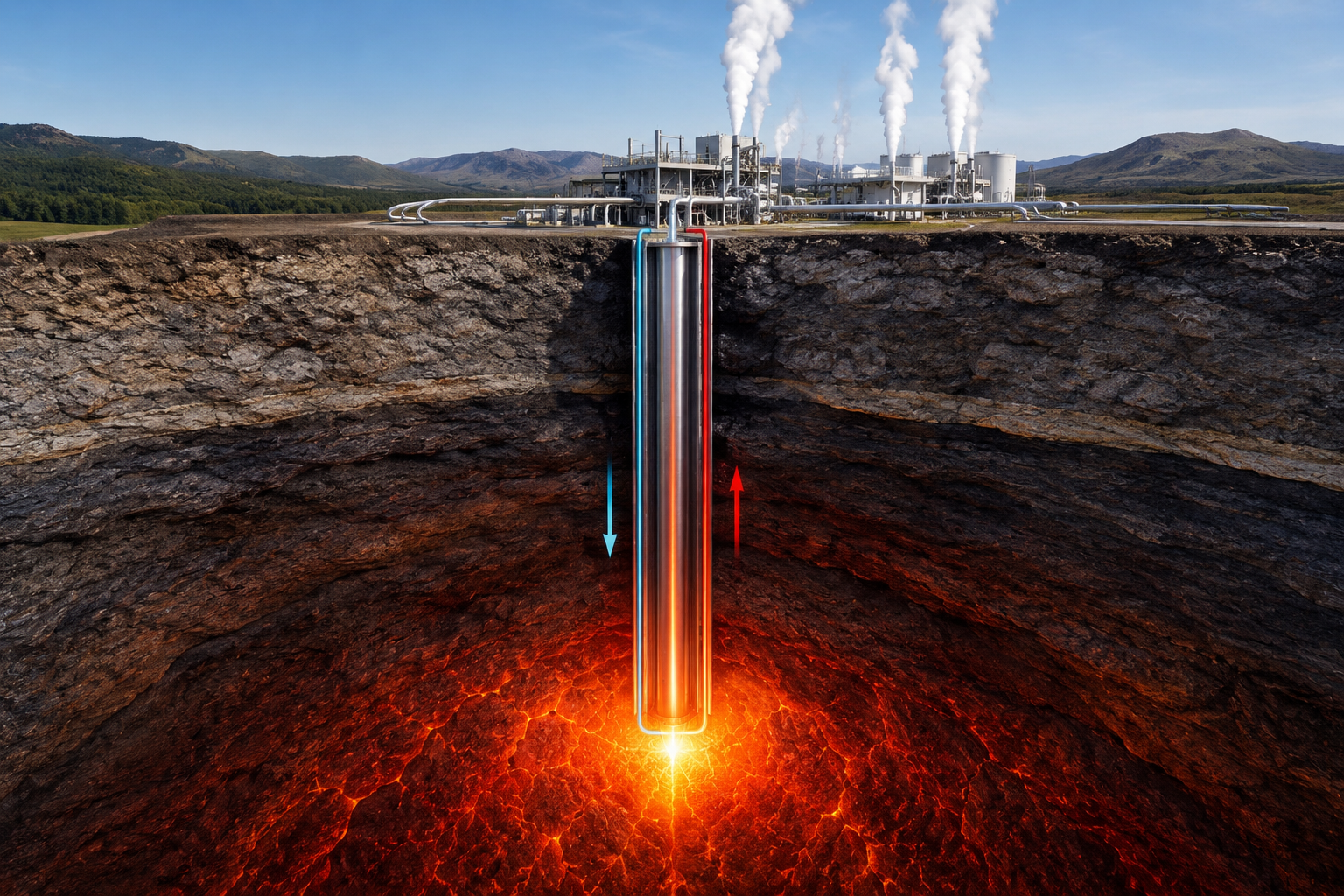
By replacing mechanical drill bits with high-power electromagnetic beams capable of vaporizing hard granite and basalt down to 10 to 20 kilometers depth, science is on the precipice of accessing deep basement rock exceeding 500 °C. At this extreme depth, water enters the Supercritical Fluid State, multiplying electricity output tenfold and unlocking scalable, continuous, compact 24/7 Baseload Geothermal Power virtually anywhere on the planet.
In this deep dive from Reach Technocracy, we explore the physics and deep-earth engineering powering this energy revolution. We will examine the thermodynamics of Earth’s primordial heat, analyze the mechanical limitations of legacy rotary drilling, dissect how megawatt-scale Gyrotrons vaporize solid rock without mechanical contact, discover the power density of supercritical water, and evaluate how deep geothermal systems can repower decommissioned coal plants to transform global energy geopolitics.
1. The Sleeping Giant: The Thermodynamics of Earth’s Primordial Heat
To appreciate the vast potential of deep geothermal energy, we must first examine the thermodynamic engine powering the interior of our planet:
The Two Thermal Engines of Earth
Earth’s interior is heated continuously by two fundamental physical mechanisms:
- Primordial Accretion Energy: Residual thermal energy trapped during the formation of the Solar System 4.5 billion years ago, when violent gravitational compression and asteroid bombardment melted the proto-planet into an incandescent sphere.
- Continuous Radiogenic Decay: Within the mantle and crust, the slow, natural radioactive decay of long-lived unstable isotopes — primarily Uranium-238, Thorium-232, and Potassium-40 — continually radiates hundreds of terawatts of thermal power around the clock.
Earth’s core maintains temperatures exceeding 5,000 degrees Celsius (as hot as the surface of the Sun). This immense heat flux migrates continuously toward the surface through mantle convection and crustal conduction.
Why Conventional Hydrothermal Geothermal Remained Stagnant
Conventional geothermal power accounts for less than 1% of the global electricity supply. This is because traditional hydrothermal plants require an exceptionally rare trifecta of geological conditions:
- High volcanic temperatures at shallow depths (less than 2 to 3 kilometers).
- Naturally permeable, fractured host rock.
- Massive reservoirs of natural circulating groundwater.
Only rare tectonic hotspots — such as Iceland, New Zealand, Italy, and select basins in California — possess these three attributes simultaneously. Across the remaining 98% of the planet’s surface, superhot rock exists, but remains locked deep within impermeable, ultra-dense crystalline basement granite at depths of 5 to 15 kilometers.
2. The Mechanical Drill Ceiling: Why Rotary Bits Fail at Extreme Depths
For over a century, the oil and gas industry advanced rotary drilling using heavy steel drill pipes coupled to drill heads embedded with Polycrystalline Diamond Compact (PDC) cutters.
However, mechanical drilling collides with hard thermodynamic and materials limits when attempting to penetrate deep, hot crystalline granite:
Friction, Thermal Softening, and Tool Wear
As drill strings descend beyond 4 to 5 kilometers:
- Ambient lithostatic rock pressures reach thousands of atmospheres.
- Downhole temperatures exceed 200 °C to 300 °C, softening structural drill steel and accelerating abrasive wear on diamond cutter matrices.
- Mud motors, directional steering electronics, and telemetry sensors suffer thermal dielectric breakdown.
- Drill strings must be fully extracted (tripped) to replace blunted drill bits every few tens of meters — an excruciatingly slow operational process that escalates deep drilling costs to tens of millions of dollars per well.
The historical benchmark for mechanical drilling remains the Soviet Kola Superdeep Borehole on the Kola Peninsula: Soviet engineers required nearly two decades (1970 to 1989) to reach a record depth of 12,262 meters, where 180 °C temperatures and plastic rock deformation permanently halted mechanical progress.
3. The Gyrotron Breakthrough: Vaporizing Granite with Millimeter Waves
To breach the 10-to-20-kilometer depth barrier without physical tool wear, advanced energy engineering adapted a technology originally developed for magnetic confinement nuclear fusion: the High-Power Gyrotron.
Pioneered by vanguard clean-tech enterprises (such as MIT spin-off Quaise Energy), Directed-Energy Thermal Drilling replaces the rotary drill bit with an intense beam of high-frequency electromagnetic radiation:
What Is a Gyrotron?
A Gyrotron is a high-power vacuum tube that utilizes relativistic electron beams gyrating within strong magnetic fields to generate coherent electromagnetic beams in the Millimeter-Wave spectrum (frequencies from 30 GHz to 300 GHz), delivering continuous power outputs in the megawatt range:
- The focused millimeter-wave beam is guided down the borehole through a tubular hollow waveguide.
- At the bottom of the hole, the high-density energy beam strikes the crystalline granite or basalt face.
Thermal Ablation and Instantaneous Vaporization
When the millimeter-wave beam strikes solid rock:
- Surface temperatures instantaneously escalate past 3,000 degrees Celsius.
- The rock is not mechanically fractured; it melts and vaporizes instantaneously via thermal ablation.
- A pressurized coaxial stream of purging gas (such as nitrogen or compressed air) flushes the vaporized rock upward, condensing it into microscopic glassy slag particulate that is continuously evacuated to the surface.
- The extreme radial thermal pulse vitrifies the borehole walls into a seamless, high-strength ceramic glass liner, stabilizing the well against collapse without costly steel casing.
This directed-energy paradigm enables drilling speeds 10 times faster than mechanical rotary bits, penetrating hard basement rock at meters per hour toward deep thermal horizons.
4. Supercritical Fluids: Multiplying Power Extraction Tenfold
The ultimate prize of drilling to depths of 10 to 20 kilometers is tapping the extraordinary thermodynamic properties of Supercritical Water.
In classical thermodynamics:
- Liquid water boils into steam at 100 °C under atmospheric pressure.
- Conventional geothermal reservoirs extract hot water at 150 °C to 200 °C, producing low-enthalpy steam.
However, when water is subjected simultaneously to temperatures exceeding 374 degrees Celsius and pressures exceeding 22.1 Megapascals (roughly 218 times atmospheric pressure), it crosses the Thermodynamic Critical Point:
The Supercritical State of Matter
Under these extreme conditions:
- The phase boundary between liquid and vapor ceases to exist.
- The fluid behaves neither as a simple gas nor a standard liquid; it exhibits the high density of a liquid combined with the ultra-low viscosity and high diffusivity of a gas.
- Supercritical water transports up to 10 times more thermal energy (enthalpy) per kilogram than standard pressurized hot water.
Injecting surface water down closed-loop deep wells into 500 °C rock fractures transforms the fluid into an energetic supercritical stream. When produced to the surface, a single supercritical geothermal well delivers 50 to 100 Megawatts of electric capacity, compared to just 5 to 10 MW for a standard hydrothermal well.
5. Grid Decarbonization: Repowering Fossil Infrastructure
The global deployment of deep superhot rock geothermal systems delivers transformative structural benefits for the clean energy transition:
24/7 Continuous Baseload Power
Unlike solar photovoltaics and wind turbines, Earth’s internal thermal energy is immune to weather patterns, diurnal cycles, and seasonal shifts. Superhot rock geothermal plants operate at capacity factors exceeding 95%, providing unwavering baseload reliability.
Radical Land-Use Efficiency
To generate 1 Gigawatt of electrical power:
- Utility-scale solar requires hundreds of square kilometers of land and extensive transmission buildout.
- Wind farms require vast geographic footprints.
- A superhot rock geothermal facility requires a compact surface footprint of only a few acres for wellheads and turbine halls.
Repowering Decommissioned Coal Power Plants
One of the most compelling economic advantages of deep geothermal is its compatibility with legacy thermal generation:
- The supercritical steam extracted from deep wells matches the exact temperature and pressure parameters required by steam turbines at existing coal-fired and natural gas power plants.
- Utilities can drill deep geothermal wells directly adjacent to retiring coal plants, connecting clean geothermal steam into existing turbines, transformers, and transmission lines, preserving industrial jobs and avoiding billions in grid expansion costs.
6. Conclusion: The Planetary Reactor Beneath Us
For millennia, humanity gazed outward at the stars with awe, rarely contemplating that the ground beneath our feet is a colossal natural nuclear forge containing boundless energy.
The convergence of Gyrotron Beam Physics, Supercritical Fluid Thermodynamics, and Directed-Energy Deep Drilling is unlocking the ultimate planetary energy vault. We do not need to wait decades for commercial fusion or accept the intermittency of weather-dependent renewables to decarbonize the globe; we only need to drill deep enough to tap the inexhaustible heat that forged our world.
At Reach Technocracy, we will remain dedicated to analyzing every directed-energy drilling milestone, deep supercritical well test, and engineering breakthrough transforming Earth’s internal heat into the backbone of global clean energy.
Do you believe superhot rock geothermal power will surpass utility-scale solar and nuclear fission before 2040? What fascinates you most: vaporizing granite with microwave beams or harvesting the raw power of supercritical water? Share this deep dive with your clean energy, engineering, and sustainability network, and leave your thoughts in the comments below!
🔭 Continue Exploring the Frontier of Science and Technology: