
In James Cameron’s iconic blockbuster film Avatar, human corporate forces travel light-years across the cosmos to the distant alien moon of Pandora driven by a single, all-consuming economic obsession: extracting an exorbitantly expensive, room-temperature superconducting mineral ironically dubbed Unobtainium. The entire military conflict and interstellar power struggle of the narrative centers upon controlling this singular, irreplaceable resource.
What many moviegoers do not realize is that in the real world, human technological civilization is already entangled in its very own high-stakes race for Unobtainium.
Only this critical resource is not hidden beneath the bioluminescent canopy of an alien jungle light-years away; it resides right here on planet Earth, buried within the periodic table under the enigmatic label of Rare Earth Elements (REEs).
Without a specialized family of 17 chemical elements bearing exotic names — such as Neodymium, Dysprosium, Lanthanum, Praseodymium, and Terbium —, modern digital society would instantly grind to an absolute halt. There would be no high-torque permanent magnet motors powering electric vehicles, no multi-megawatt offshore wind turbines generating clean electricity, no precision haptic vibration motors in smartphones, no fiber-optic internet amplifiers, and no guidance avionics steering the world’s most sophisticated fifth-generation fighter jets.
In this deep dive from Reach Technocracy, we explore the intersection of atomic physics, materials engineering, and global geopolitics. We will examine what these elements actually are, why their historic name is one of the greatest scientific misnomers, how China forged a near-monopoly over their global supply chains, and the frantic worldwide race to secure the invisible gold of the 21st century.
1. What Are Rare Earth Elements and Why Do They Possess Superpowers?
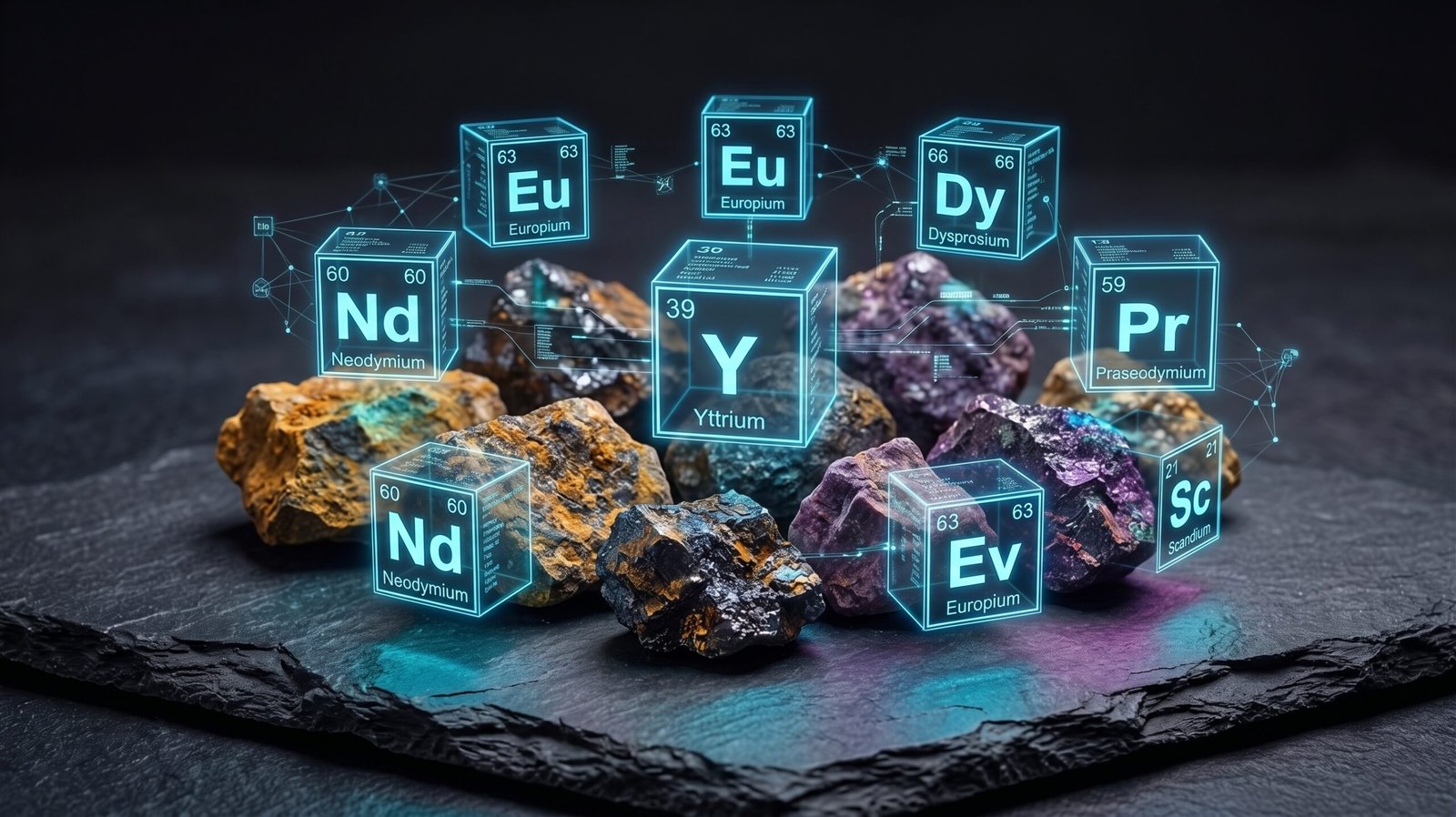
On the standard periodic table, Rare Earth Elements comprise a cohesive family of 17 chemical elements: the 15 metallic elements of the Lanthanide series (ranging from Lanthanum at atomic number 57 to Lutetium at 71), joined by Scandium and Yttrium.
While these elements lack the mainstream cultural fame of gold, silver, iron, or copper, they possess a unique electronic subshell configuration in their atomic architecture (specifically within their shielded, unpaired 4f electron orbitals). This peculiar subatomic physics endows rare earth elements with unmatched properties across permanent magnetism, luminescence, thermal stability, and catalytic efficiency.
Let us examine several of the most critical elements and their transformative applications:
- Neodymium (Nd) and Praseodymium (Pr): The fundamental building blocks for synthesizing Neodymium-Iron-Boron (NdFeB) permanent magnets — the strongest magnetic materials known to science. A compact NdFeB magnet the size of a coin can lift hundreds of times its own weight. They constitute the electromagnetic heart of electric vehicle traction motors, hard disk drive actuators, and industrial wind turbine generators.
- Dysprosium (Dy) and Terbium (Tb): Vital heavy rare earth additives alloyed into neodymium magnets to preserve magnetic coercivity and prevent demagnetization under the extreme thermal environments (exceeding 200 °C) typical of automotive powertrains.
- Europium (Eu) and Erbium (Er): Europium emits a brilliant, pure red phosphor luminescence indispensable for ultra-high-definition displays. Erbium functions as the active dopant inside Erbium-Doped Fiber Amplifiers (EDFAs), boosting optical laser pulses and enabling internet data packets to traverse transoceanic undersea cables for thousands of miles without signal loss.
- Lanthanum (La) and Cerium (Ce): Widely utilized in automotive catalytic converters to scrub toxic emissions, as well as in precision glass polishing for high-grade satellite optics and camera lenses.
Light vs. Heavy Rare Earths: The Asymmetry of Strategic Vulnerability
In metallurgy and mineral economics, the 17 elements are categorized into two critical strategic tiers:
- Light Rare Earth Elements (LREEs): Encompassing Lanthanum, Cerium, Praseodymium, and Neodymium. These elements are geologically more abundant and possess active deposits across North America, Australia, and Brazil.
- Heavy Rare Earth Elements (HREEs): Comprising Dysprosium, Terbium, Erbium, and Yttrium. These elements are exceptionally scarce and overwhelmingly concentrated in ionic adsorption clay deposits in southern China and Myanmar. Because heavy rare earths are the irreplaceable additives ensuring thermal coercivity in military guidance systems, hypersonics, and radar arrays, this specific sub-group represents the absolute chokepoint of global defense supply chains.
2. The Great Misnomer: Why Rare Earths Are Not Actually Rare
The historical term rare earths is a scientific relic dating back to late 18th-century chemistry, when Scandinavian mineralogists isolated these elements from unusual oxide minerals and presumed they existed in vanishingly small concentrations across the crust.
Modern planetary geology has thoroughly shattered this myth: rare earth elements are remarkably abundant throughout the Earth’s continental crust.
For example, Cerium is more abundant in Earth’s crust than Copper or Lead, while Neodymium is vastly more common than Gold, Silver, or Platinum.
The true engineering challenge that transforms rare earths into such a critical geopolitical chokepoint is not geological scarcity, but the immense chemical complexity and environmental toxicity of their extraction and refining:
- Extreme Geological Dispersion: Rare earths rarely concentrate in pure, rich native veins (like gold nuggets). Instead, they are found dispersed in microscopic fractions within common mineral ores, requiring mining operations to blast, crush, and process hundreds of tons of host rock to yield a few kilograms of purified oxide.
- Identical Chemical Twins: Because all lanthanides share nearly identical trivalent ionic radii and oxidation states, separating individual rare earth elements from one another requires complex industrial chemical cascades involving hundreds of sequential liquid-liquid solvent extraction stages using harsh acids.
- Severe Radioactive Environmental Footprints: Primary rare earth ores (such as bastnäsite and monazite) are naturally intergrown with hazardous radioactive elements, particularly Thorium and Uranium. Refining processes historically generated millions of gallons of toxic chemical tailings and radioactive sludge, leading many nations to shutter operations due to environmental devastation.
3. The Chinese Monopoly and the Geopolitical Chessboard
Throughout the mid-20th century, the United States was the world’s leading producer of rare earths, anchored by the legendary Mountain Pass mine in California.
However, during the 1980s and 1990s, as Western mining operations closed due to environmental compliance costs, visionary Chinese leader Deng Xiaoping recognized the strategic leverage of the periodic table, famously remarking: “The Middle East has oil; China has rare earths.”
Backed by comprehensive state industrial planning, dedicated metallurgical research institutes, and low environmental labor thresholds in Baotou (Inner Mongolia), China executed a masterful multi-decade industrial strategy:
- China secured dominance over more than 70% of global rare earth mining extraction.
- Even more critically: China captured an astonishing 90% global monopoly over midstream chemical refining, oxide separation, and NdFeB magnet manufacturing.
This means that even when Western nations (such as the US or Australia) extract raw rare earth ore from their own domestic soil, they have historically been forced to export the semi-processed concentrate directly to China to be chemically refined into usable metallic alloys and magnets.
The 2010 Senkaku Crisis: The Wake-Up Call
In September 2010, following a maritime territorial clash near the contested Senkaku Islands, China enacted an unannounced embargo on rare earth shipments to Japan. Within weeks, Japanese automotive and consumer electronics supply chains faced operational paralysis, and global prices for dysprosium and neodymium surged by more than 500%.
This geopolitical shockwave served as a thunderous alarm for Western defense and economic planners: unfettered reliance on a single geographic supplier for rare earths is the Achilles’ heel of national security and the global clean energy transition.
4. National Defense and Clean Energy: What Hangs in the Balance?
The high-stakes battle over rare earths extends far beyond commercial smartphones; it directly underpins geopolitical defense parity and planetary decarbonization:
- Fifth-Generation Defense Systems: A single F-35 Lightning II stealth fighter requires approximately 417 kilograms of rare earth materials across its Pratt & Whitney turbofan engine, AESA radar array, stealth radar-absorbent coatings, and flight surface actuators. A Virginia-class nuclear submarine incorporates over 4 metric tons of precision magnets and alloys. If rare earth supply lines are severed, the production of precision-guided missiles, radar systems, and military satellites halts.
- The Global Clean Energy Transition: Every modern direct-drive offshore wind turbine incorporates over 1 to 2 metric tons of permanent rare earth magnets, while electric vehicle drivetrains consume between 1 to 2 kg per vehicle. Achieving net-zero carbon goals is physically impossible without uninterrupted access to these 17 elements.
The Strategic Value of Scandium and Yttrium
While the 15 lanthanides dominate industrial magnet discussions, Scandium (Sc) and Yttrium (Y) play pivotal roles in aerospace and clean hydrogen technologies:
- Scandium: When alloyed with aluminum in fractions as low as 0.2%, it creates super-alloys with exceptional weldability, high thermal resistance, and lightweight strength, enabling next-generation airframes for supersonic commercial aviation and space launch vehicles.
- Yttrium: Vital for synthesizing Yttrium Barium Copper Oxide (YBCO) high-temperature superconducting tapes, which form the magnetic containment coils inside next-generation commercial nuclear fusion reactors.
5. Engineering the Alternatives: Diversification, Magnetless Motors, and Urban Mining
Deep-Sea Mining and Abyssal Polymetallic Nodules
Confronting geopolitical bottlenecks on land, international mining consortiums and defense planners are turning toward the ocean abyss. Across the vast Clarion-Clipperton Zone (CCZ) on the Pacific seabed, trillions of polymetallic nodules — potato-sized mineral concretions resting thousands of meters deep — contain vast reserves of nickel, cobalt, copper, and critical heavy rare earths. While deep-seabed harvesting promises to diversify supply outside continental Asia, it has ignited fierce environmental debates regarding the preservation of fragile benthic deep-ocean ecosystems.
To break this geopolitical bottleneck, global research laboratories, automakers, and mining ventures are pioneering aggressive technological counter-measures:
- Onshoring Supply Chains: Western initiatives — including Australia’s Lynas Rare Earths, the revitalized Mountain Pass facility in California, and massive newly discovered deposits in Sweden and Brazil — are building integrated domestic processing and magnet fabrication facilities outside Asia.
- Magnet-Free Electric Motors: Automotive leaders such as BMW, Renault, and Tesla are developing Externally Excited Synchronous Motors (EESM) and synchronous reluctance designs that replace permanent neodymium magnets with traditional copper windings, completely eliminating rare earth dependencies from their electric drivetrains.
- Urban Mining and Bio-Recycling: Discarded consumer electronics, obsolete hard drives, and retired wind turbine generators represent rich urban mines containing higher concentrations of neodymium than natural ores. Next-generation recycling methods and biomining (using engineered bacterial proteins that selectively bind and harvest rare earth ions without toxic acid baths) promise to recover millions of tons of strategic minerals from existing waste streams.
6. Conclusion: The Geopolitics of the Periodic Table
In an era governed by artificial intelligence, quantum computing, and renewable energy, the true measure of planetary geopolitical power is no longer calculated solely in barrels of crude oil, but in grams of purified lanthanide oxides.
Rare earth elements are the invisible physical bridge linking the raw geological crust of the Earth to the most sophisticated technological marvels ever engineered by humanity. Understanding their unique chemistry, environmental footprint, and supply chain dynamics is essential to deciphering the economic alliances and technological conflicts that will shape the 21st century.
At Reach Technocracy, we will continue monitoring the hidden science and materials powering our technological civilization.
Did you realize how deeply your smartphone and the clean energy revolution depend on rare earth elements? Share this article with fellow geopolitics and technology enthusiasts, and join the discussion in the comments below!
🔭 Continue Exploring the Frontier of Science and Technology: