
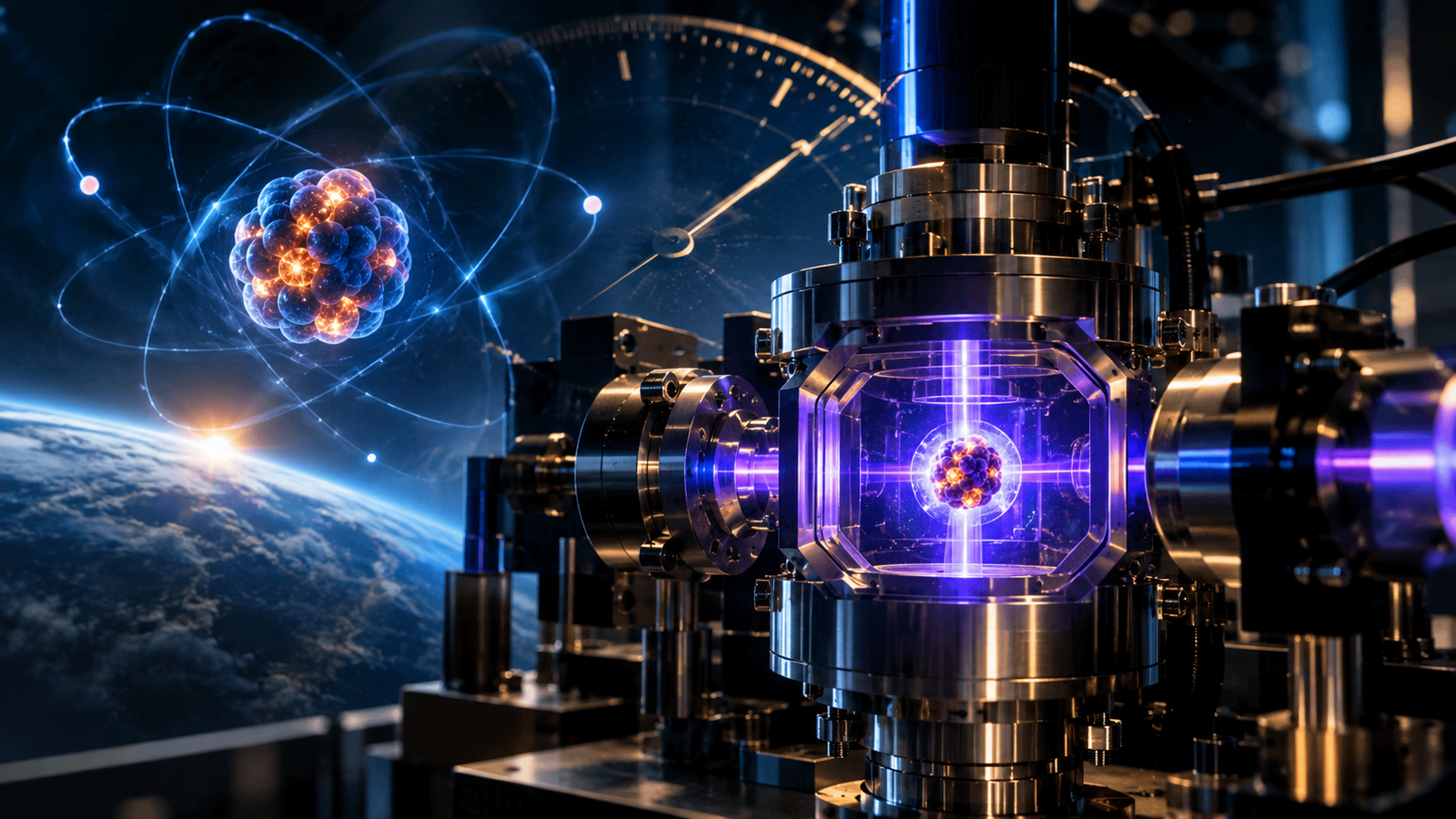
In Christopher Nolan’s acclaimed sci-fi epic Interstellar (2014), the crew of the Endurance descends to the surface of Miller’s Planet, an ocean world orbiting precariously near the event horizon of the supermassive black hole Gargantua. Under the haunting, metronomic score by Hans Zimmer — ticking inexorably every 1.25 seconds —, the astronauts confront one of the harshest realities of modern physics: relativistic time dilation. For every second spent in that extreme gravitational well, entire hours and days vanish on Earth. The lesson is permanent: time is not an abstract, uniform river, but a malleable coordinate woven into the fabric of spacetime.
For nearly six decades, human civilization believed it possessed the definitive ruler to measure this coordinate. Since 1967, the International System of Units (SI) has defined the second by electronic transitions within Caesium-133 atoms and, over the past decade, within ultra-stable optical lattices of Strontium and Ytterbium. Yet, as extraordinary as these quantum timekeepers are, every contemporary atomic clock shares a congenital vulnerability: they all depend on the cloud of electrons orbiting the atomic nucleus. That electronic periphery is diffuse, deformable, and inherently susceptible to thermal noise, stray magnetic fields, and environmental perturbations.
This physical ceiling has now been broken. In two landmark, coordinated papers published in the journal Nature in October 2026, international teams demonstrated the world’s first operating optical nuclear clocks. The European experiment, led by researchers at TU Wien in Austria and Germany’s national metrology institute, the Physikalisch-Technische Bundesanstalt (PTB), detailed in their seminal research on a thorium-229 optical nuclear clock with feedback loop (and first reported on arXiv), locked a continuous-wave ultraviolet laser directly onto the internal oscillations of the Thorium-229 (²²⁹Th) atomic nucleus, operating autonomously and self-stabilized for over 24 consecutive hours. Concurrently, physicists at Tsinghua University reported an independent nuclear clock synchronized to 229Th in a highly compact solid-state architecture.
By moving past the electronic cloud and delving into the atomic nucleus, physics opens the door to fractional instabilities on the scale of 10⁻¹⁹. In this technical essay, you will discover why electrons reached their fundamental limits, the quantum anomaly that makes Thorium-229 unique in the known universe, the laser feedback engineering pioneered in Vienna and Braunschweig, and how this nuclear metronome will track dark matter and measure Earth’s gravitational potential down to the millimeter.
1. The Tyranny of Electrons: Why Atomic Clocks Hit a Quantum Ceiling
Every high-precision timekeeper relies on two core building blocks: a stable oscillator that delivers identical ticks and a counting mechanism that records these periodic cycles.
Caesium’s Second and the Leap of Optical Clocks
In traditional microwave atomic standards, the oscillator is an electromagnetic wave locked to the hyperfine transition between two ground-state levels of the outer valence electron in Caesium-133 (9,192,631,770 cycles per second). At the dawn of the 21st century, the development of optical frequency combs enabled physicists to replace microwave radiation with optical laser frequencies, elevating the oscillation rate into hundreds of terahertz (429 trillion cycles per second in Strontium-87).
Because clock stability scales inversely with resonance linewidth and directly with transition frequency, optical lattice clocks achieved monumental quality factors (Q), reaching fractional frequency instabilities on the order of 10⁻¹⁸ — an uncertainty of less than one second across the entire age of the universe.
The Structural Vulnerability of the Electron Cloud
Despite this technical triumph, electron-shell optical clocks have collided with fundamental barriers dictated by the quantum mechanics of the atomic periphery:
- The Frailty of Electric Polarizability: The electron cloud spans a spatial radius of angstroms (10⁻¹⁰ meters). Being light and negatively charged, its high electric dipole polarizability induces significant phase shifts in response to minute stray electrostatic fields inside the experimental chamber.
- Blackbody Radiation (BBR) Frequency Shifts: The ambient walls of any laboratory emit thermal infrared photons. This blackbody radiation starkly perturbs the outer electronic orbitals of strontium or ytterbium atoms, shifting their clock resonance. Mitigating this effect requires cumbersome cryogenic vacuum vessels cooled near absolute zero (-273 °C).
- Stray Zeeman and Electric Quadrupole Effects: Unshielded magnetic fields break quantum degeneracy, shifting atomic levels and requiring complex, multi-layered mu-metal shields.
These vulnerabilities make state-of-the-art optical lattice clocks massive, fragile laboratory installations that are sensitive to vibrations and virtually impossible to deploy on mobile platforms, submarines, or deep-space probes. Precision metrology urgently required an oscillator sheltered within an inherently noise-immune environment.
Comparative Table: The Evolution Across Three Generations of Metrology
To illustrate this paradigm shift from atomic shells to the atomic nucleus, the matrix below contrasts the three historical milestones of quantum timekeeping:
| Engineering Parameter | 1st Generation: Caesium-133 (Microwave) | 2nd Generation: Strontium-87 (Optical Lattice) | 3rd Generation: Thorium-229 (Solid-State Nuclear) |
|---|---|---|---|
| Interrogated Quantum State | Valence electron hyperfine | Orbital optical electronic | Intranuclear isomeric nucleon |
| Oscillator Frequency (f₀) | 9.192 GHz (Microwave) | 429 THz (Visible red light) | 2,020.4 THz (Vacuum ultraviolet – VUV) |
| Interrogation Wavelength (λ) | 3.26 cm | 698 nm | 148.38 nm |
| Quality Factor (Q = f₀ / Δf) | ~10¹⁰ | ~10¹⁷ | 10¹⁹ to 10²⁰ (Theoretical ceiling) |
| Sensitivity to Thermal Noise (BBR) | Moderate | Extreme (Demands cryogenic cooling) | Virtually zero (Inherent nuclear shielding) |
| Typical Fractional Instability | ~10⁻¹³ to 10⁻¹⁴ | ~10⁻¹⁸ | ~10⁻¹⁴ to 10⁻¹⁵ (Demonstrated) / 10⁻¹⁹ (Target) |
| Architecture and Footprint | Moderate (Commercial rack-mount) | Extreme (Multi-table lab chambers) | Low to Moderate (Solid-state crystal at 21 °C) |
2. The Atomic Nucleus: A Shielded Quantum Fortress
The fundamental solution to electronic fragility resides in the atomic nucleus, the dense core where nearly all atomic mass is concentrated.
While the electron shell extends across 10⁻¹⁰ meters, a heavy nucleus measures merely 10⁻¹⁵ meters (femtometers) in radius. This represents a monumental spatial volume reduction: the nucleus is approximately one quintillion (10¹⁵) times smaller in volume than the surrounding atom.
Nature’s Faraday Cage
This extreme spatial confinement endows the nucleus with unparalleled physical isolation:
- Suppressed Electromagnetic Moments: The nuclear magnetic dipole and electric quadrupole moments are three to four orders of magnitude smaller than those of valence electrons. Ambient thermal photons and stray magnetic fields exert negligible torque or phase perturbation on the packed nucleons.
- Electrostatic Shielding from the Electron Shell: Rather than acting as a source of noise, the surrounding inner electronic core acts as an intrinsic Faraday cage, screening low-frequency electrostatic fluctuations before they can penetrate the central nucleons.
However, the force binding nucleons together is the strong nuclear force, roughly 137 times more powerful than electromagnetism. Transitioning a nucleus between discrete energy states typically demands megaelectron-volt (MeV) or kiloelectron-volt (keV) photons — the realm of destructive gamma rays. Gamma radiation cannot be harnessed in continuous-wave coherent optical cavities and shatters atomic lattices via Compton scattering.
For decades, this seemed an insurmountable barrier: atomic nuclei were too well-shielded to be manipulated by lasers, while electronic shells were easily probed but too fragile to remain undisturbed.
Until physicists uncovered the unique anomaly of Thorium-229.
3. The Thorium-229 Isomer: The 8.34 eV Quantum Anomaly
Among the thousands of known nuclear isotopes, Thorium-229 (containing 90 protons and 139 neutrons) represents a remarkable mathematical accident of quantum many-body physics.
Inside such a heavy nucleus, two colossal physical forces battle for supremacy: the attractive strong nuclear force pulling nucleons together and the repulsive Coulomb electrostatic force pushing 90 positively charged protons apart. Each of these interactions contributes roughly 1,800 MeV of internal binding energy.
The Near-Perfect Cancellation
In the ground state of ²²⁹Th (labeled by the nuclear angular momentum state 5/2+ [633]), this arrangement is stably balanced. However, there exists a low-lying metastable isomeric state, designated ²²⁹ᵐTh (state 3/2+ [631]), associated with a subtle spatial realignment of the unpaired outer neutron.
By an extraordinary physical coincidence, the change in Coulomb repulsive energy and the change in strong nuclear attractive energy between these two configurations cancel each other out almost completely. The residual net difference between the ground state and the excited nuclear isomer is a mere:
E = 8.338 eV (λ ≈ 148.38 nm)
This energy falls squarely in the vacuum ultraviolet (VUV) spectrum. For the first time in scientific history, a quantum transition within an atomic nucleus became addressable by coherent laser sources.
The Historic Hunt for the Exact Energy
Although theoretically predicted in 1976 by L. A. Kroger and C. W. Reich at the Idaho National Engineering Laboratory, pinning down the exact excitation energy remained an elusive quest for half a century, with estimates fluctuating wildly between 100 eV and 3.5 eV — an uncertainty spanning hundreds of gigahertz.
The roadmap accelerated decisively over the last decade:
- Detection of Internal Conversion Decay (2016): Peter Thirolf’s team at LMU Munich observed low-energy electrons ejected during the non-radiative decay of ²²⁹ᵐTh, conclusively confirming the isomer’s existence near 8.28 eV.
- Direct VUV Frequency-Comb Excitation (2024): A milestone collaboration between JILA (led by Jun Ye) and TU Wien (led by Thorsten Schumm) illuminated thorium nuclei with a vacuum ultraviolet frequency comb, directly bridging the nuclear transition frequency to an optical strontium clock.
- Autonomous Feedback-Loop Operation (October 2026): The final engineering breakthrough — creating a self-regulating optical control loop in which the laser interrogates the nucleus and applies continuous feedback to steer its own frequency.
4. Engineering in Vienna and Braunschweig: The Solid-State Clock
The breakthrough unveiled in October 2026 by TU Wien and the PTB accomplished what had long seemed impossible: an optical nuclear clock operating inside a solid-state crystal at room temperature (294.7 K or 21.5 °C), entirely eliminating the need for ultra-cold ion traps or deep cryogenic infrastructure.
The CaF₂ Host Crystal and the Suppression of Internal Conversion
The central innovation was embedding Thorium-229 nuclei into a transparent Calcium Fluoride (CaF₂) host crystal.
CaF₂ possesses an exceptionally wide electronic bandgap of 11.8 eV. Because the isomeric transition requires only 8.34 eV, incoming laser photons cannot promote valence electrons across the bandgap. This quantum confinement completely suppresses the destructive internal conversion decay pathway, forcing embedded thorium nuclei to absorb and re-emit photons strictly through radiative optical channels.
Furthermore, a millimeter-sized CaF₂ sample hosts approximately 10¹⁶ thorium nuclei within the laser path. While trapped single-ion clocks operate with a single emitter (suffering from limited quantum signal-to-noise ratios), the solid-state nuclear approach exploits a massive ensemble of oscillators, delivering high optical absorption signals.
The Challenge of the VUV Laser and Continuous Absorption Spectroscopy
Generating narrow-linewidth continuous-wave radiation at 148 nm is notoriously difficult because atmospheric air absorbs VUV light completely:
- High-Coherence Seed Source: An infrared external-cavity diode laser at 1,187 nm stabilized to an ultra-low-expansion Fabry-Pérot cavity via the Pound-Drever-Hall (PDH) technique.
- Cascaded Harmonic Generation: The infrared beam is frequency-quadrupled to 297 nm in non-linear crystals.
- Second-Harmonic Generation in SBO: The 297 nm radiation traverses a randomly quasi-phase-matched Strontium Tetraborate (SrB₄O₇ or SBO) crystal, doubling the frequency to 148 nm with continuous optical power in the picowatt to nanowatt regime.
Rather than relying on spontaneous fluorescence (which would require waiting tens of minutes for the long-lived isomer to decay), the system monitors continuous optical absorption as the VUV beam passes through the crystal, detecting photons with a solar-blind caesium iodide (CsI) photomultiplier tube. The real-time absorption dip yields an immediate error signal.
Closing the Active Feedback Loop
This error signal is fed back to an electro-optic modulator (EOM) that dynamically adjusts the laser frequency in one-second actuation steps. The feedback loop continuously compensates for cavity drift (~200 mHz per second), locking the laser to the ²²⁹Th nuclear resonance at 2,020,400,000,000,000 Hz.
The system demonstrated shot-noise-limited fractional frequency instability scaling as 3 × 10⁻¹² / √(τ / s), reaching the 10⁻¹⁴ to 10⁻¹⁵ range over 24 hours of unattended, continuous operation.
5. Frontier Physics: The Ultimate Detector of the Hidden Universe
Beyond providing ultra-stable reference signals for navigation and secure communications, the Thorium-229 nuclear clock acts as an unprecedented quantum laboratory for testing fundamental physics. These developments directly converge with the quantum hardware paradigms explored in our cornerstone analysis on The Definitive Guide to Quantum Computing, where light-matter interactions and quantum coherence rewrite the rules of information processing.
A 10,000x Amplification Factor for the Fine-Structure Constant
The Standard Model of particle physics treats physical parameters like the fine-structure constant (α ≈ 1/137) and quark masses as immutable constants. However, grand unification models and string theory suggest these numbers may experience slow cosmological drifts or spatial gradients.
In standard atomic clocks, atomic transitions scale smoothly with α, yielding modest sensitivity factors (K between 0.1 and 1).
In Thorium-229, because the 8.34 eV excitation results from the near-perfect cancellation of two opposing 1,800 MeV nuclear binding energies, any minute fractional drift in α or the strong nuclear interaction coupling produces an amplified shift in the transition frequency:
The sensitivity factor K in Thorium-229 is enhanced by 10,000 to 100,000 times compared to electronic clocks.
Consequently, even in its inaugural demonstration, the solid-state nuclear clock established competitive bounds on the linear temporal drift of α and the quantum chromodynamics (QCD) confinement scale, setting limits on the order of 10⁻¹⁸ per day.
Tracking Ultralight Dark Matter in the Laboratory
Leading cosmological hypotheses suggest that dark matter may consist of ultralight scalar bosons (such as axion-like particles or dilatons) behaving as classical fields that oscillate at their Compton frequency.
As Earth traverses this dark matter halo, feeble couplings to standard model particles induce rhythmic oscillations in fundamental constants, which manifest as periodic frequency wobbles in the Thorium-229 resonance.
By performing Lomb-Scargle periodogram analyses on beat-frequency data between the nuclear clock and an independent Yb⁺ single-ion clock over 23 continuous hours, the European team established stringent exclusion limits. Benefiting from the nuclear transition’s enhanced sensitivity, these measurements placed constraints on scalar dark matter couplings to the strong force and quark masses that are 100 to 1,000 times deeper than any previous atomic clock comparison.
Millimeter-Scale Relativistic Geodesy
According to Albert Einstein’s General Theory of Relativity, clocks in differing gravitational potentials tick at different rates:
Δf / f = (g · Δh) / c² ≈ 1.09 × 10⁻¹⁶ per meter of elevation
When nuclear clocks reach their projected operational limit of 10⁻¹⁹, they will resolve elevation differences (Δh) of merely 1 millimeter.
This precision transforms the solid-state clock into a portable gravimetric sensor:
- Real-Time Volcanology: Detecting the ascent of subterranean magma chambers through local gravitational potential variations days before seismic swarms appear.
- Tectonic Stress Mapping: Measuring subtle, vertical crustal deformations along active fault lines in real time without orbital radar baselines.
- Oceanography and Aquifer Monitoring: Tracking groundwater mass depletion and polar ice sheet thinning with high-resolution field instruments.
6. Critical Analysis, Engineering Bottlenecks, and the Future of Time
Despite the breakthrough of operating a nuclear clock for 24 hours, Thorium-229 systems remain in their foundational stage. Progressing from the current 10⁻¹⁵ demonstration to the theoretical 10⁻¹⁹ threshold requires resolving significant materials science and optical hurdles.
Physical Bottlenecks: From ²²⁹Th Scarcity to the 10⁻¹⁹ Barrier
The technological roadmap faces four critical bottlenecks:
- Severe Global Scarcity of ²²⁹Th: Thorium-229 does not occur naturally. It is a synthetic isotope with a half-life of 7,932 years, produced exclusively as a decay daughter of Uranium-233 (²³³U) bred in Cold War military reactors. Only a few tens of grams exist globally, stored primarily at Oak Ridge National Laboratory (ORNL) and selected European nuclear sites. Expanding international research hinges on continued chemical extraction from these finite stockpiles.
- The VUV Laser Power Deficit: Current experiments operate with VUV laser powers in the picowatt to nanowatt regime. This constraint stems from low nonlinear conversion efficiency in SBO crystals and VUV optical degradation. Reaching instabilities below 10⁻¹⁷ in solid-state platforms will require continuous-wave VUV lasers producing microwatts of power, leveraging resonant enhancement cavities or four-wave mixing in metal vapors like cadmium.
- Crystal Inhomogeneity and Spectral Broadening: Doping thorium into CaF₂ distorts the local lattice symmetry, causing embedded nuclei to experience non-uniform electric field gradients. This inhomogeneous broadening broadens the line to hundreds of kilohertz and limits frequency reproducibility across different crystal positions to ~5 × 10⁻¹³. Additionally, magnetic interactions with surrounding Fluorine-19 (¹⁹F) nuclei induce localized magnetic shifts. Future work is focusing on stoichiometric crystals like Thorium Tetrafluoride (ThF₄) — where thorium is a native structural constituent — and host solids devoid of nuclear spin.
- The Solid-State vs. Trapped-Ion Crossroads: Achieving the ultimate 10⁻¹⁹ performance will likely require single ²²⁹Th³⁺ ions confined in radiofrequency Paul traps in ultra-high vacuum, sympathetically cooled with laser-cooled strontium ions. While relinquishing the high particle density of solid-state crystals, the trapped-ion scheme eliminates all lattice perturbations, unlocking the intrinsic nanohertz natural linewidth of the nuclear isomer.
Civilization’s Next Second
The dual milestones reported in Vienna and Beijing in October 2026 signify the sunset of atomic metrology’s exclusive reliance on orbital electrons. Just as quartz crystals eclipsed mechanical pendulums, and microwave caesium cavities replaced quartz, precision metrology has found an unyielding anchor within the atomic nucleus.
Thorium-229 is far more than an incremental improvement in timekeeping precision. By harmonizing high-energy nuclear physics, precision optical lasers, and room-temperature materials engineering, the nuclear clock transforms the measurement of time into the sharpest cosmological microscope ever engineered by human intellect.
Which frontier do you believe this nuclear precision will unlock first: detecting temporal variations in the fundamental constants of physics, or directly revealing the nature of dark matter in the laboratory? Share your perspective in the comments and join the discussion on the future of fundamental science!
🔭 Continue Exploring the Frontier of Science and Technology: