
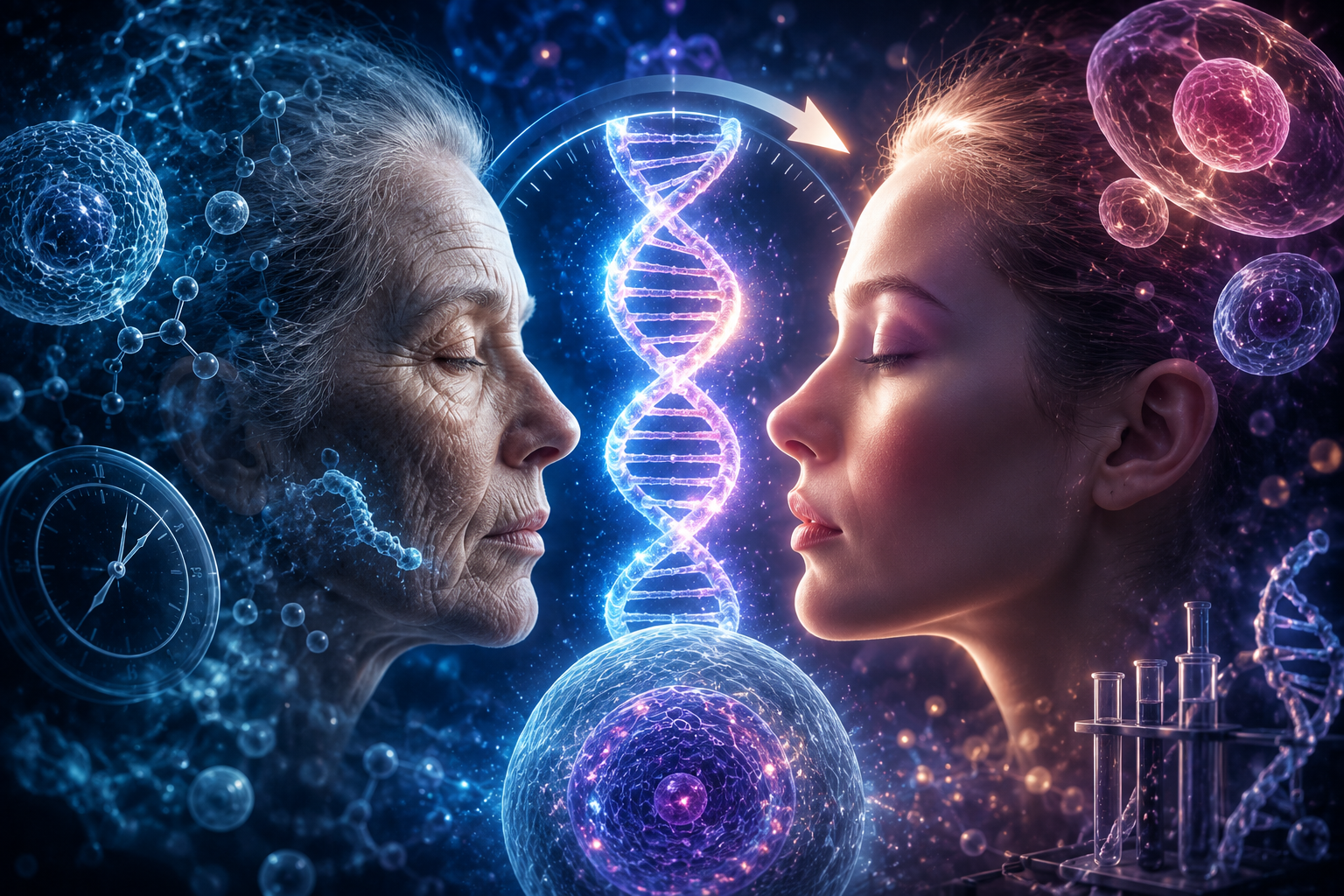
If you watched David Fincher’s acclaimed film The Curious Case of Benjamin Button (2008), starring Brad Pitt and adapted from F. Scott Fitzgerald’s celebrated story, you were undoubtedly mesmerized by the poetic premise of a man born with the physiological frailty of an eighty-year-old who undergoes a continuous biological reversal, growing progressively younger, cellularly resilient, and physically vibrant with every passing decade.
If your pop culture memories wander toward comic lore and DC Comics adaptations, the legendary villain Ra’s al Ghul preserves his immortality across six centuries by bathing periodically in the mythical Lazarus Pits — biochemical pools capable of regenerating necrotic tissue, restoring failing organs, and reversing terminal trauma. Or consider the cyberpunk universe of Altered Carbon (2018), where human consciousness is digitized into cortical stacks and transferred indefinitely across cloned, youthful biological bodies known as “sleeves.”
For millennia, human civilization accepted biological aging as an inescapable, immutable physical law: we are born, mature, accumulate cumulative molecular damage, degenerate, and die. Traditional clinical medicine has always treated aging as an inevitable background reality, attempting to treat individual age-related diseases — such as Alzheimer’s, ischemic heart failure, osteoarthritis, and macular degeneration — as isolated, reactive pathologies.
However, over the past decade, molecular biology and regenerative genetics have catalyzed the most profound paradigm shift in medical history: biological aging is not an irreversible one-way mechanical decay, but rather a corrupted epigenetic software state that can be reprogrammed and rebooted.
The cornerstone of this revolution was the discovery of the Yamanaka Factors by Japanese stem cell pioneer Shinya Yamanaka (which earned the 2012 Nobel Prize in Physiology or Medicine): a cocktail of four transcription factor proteins capable of taking mature, differentiated adult human cells and rewinding their biological clock back to an embryonic-like Induced Pluripotent Stem Cell (iPSC) state.
Today, in 2026, vanguard biotechnology enterprises and premier longevity research centers (including Life Biosciences, Altos Labs, and laboratories at Harvard Medical School) are executing the most daring translational leap in medical science: deploying Partial Epigenetic Reprogramming in vivo to rejuvenate tissues and organs in living mammals — restoring lost vision from glaucoma, reversing neurodegeneration, and rewinding cellular clocks without triggering oncogenic tumors.
In this comprehensive deep dive from Reach Technocracy, we explore the molecular mechanics of cellular rejuvenation. We will examine the distinction between the genome (hardware) and the epigenome (software), explore how Horvath’s DNA methylation clocks quantify biological age, dissect the transcription dynamics of the Yamanaka Factors (Oct4, Sox2, Klf4), discover how cyclic partial reprogramming restores tissue function without teratoma formation, and evaluate human clinical trials set to redefine medicine.
1. Genome vs. Epigenome: The Information Theory of Aging
To understand how cellular age can be reversed, we must first dispel the long-standing dogma that aging is caused primarily by irreversible, permanent DNA mutations.
Enclosed within the nucleus of virtually all 37 trillion cells in the human body resides the exact same genomic sequence: approximately 3.2 billion base pairs of DNA.
If a cortical neuron, an epidermal skin cell, and a cardiac muscle cell possess identical genomic code, what dictates their wildly divergent physiological forms and functions?
The answer is the Epigenome:
The Analogy of the Grand Piano and the Musical Score
- The Genome (Hardware): Represents the physical keyboard of a grand piano. The 88 keys represent the permanent genes inherited from your parents. The keyboard remains static across your entire life.
- The Epigenome (Software): Represents the musical score and the pianist. The epigenome is the complex array of molecular chemical tags instructing which genes to express, when to express them, at what volume, and which genes must remain strictly silenced.
A skin cell functions as skin because its epigenome active expression cascades for keratin and collagen while silencing neuronal neurotransmitter genes.
The Information Loss Paradigm (Epigenetic Noise)
According to the Information Theory of Aging (championed by Harvard geneticist David Sinclair), biological aging represents a loss of epigenetic information over time:
- Over decades of life, ionizing radiation, metabolic reactive oxygen species (ROS), double-strand DNA breaks, and systemic chronic inflammation continually recruit chromatin-modifying enzymes away from their primary regulatory sites to repair cellular damage.
- Over time, these regulatory proteins fail to return to their precise original genomic coordinates.
- Chemical tags (such as methyl groups affixed to cytosine nucleotides) accumulate aberrantly: genes meant to be silenced become noisily activated, and vital cellular maintenance genes are downregulated.
The cell experiences an identity crisis: an aged neuron begins to lose its crisp synaptic function, accumulating metabolic debris and cellular senescence.
Rejuvenation does not require altering the underlying DNA code; it requires scrubbing away the accumulated epigenetic noise to restore the pristine musical score of youth.
2. Horvath’s Epigenetic Clock: Measuring Biological Age via DNA Methylation
Historically, medicine assessed age purely by chronological date of birth. Yet two individuals celebrating their 60th birthdays can possess radically divergent biological vitality: one displaying the cardiovascular biomarkers of a 45-year-old, while the other exhibits the physiological frailty of a 75-year-old.
In 2013, biostatistician and geneticist Steve Horvath at UCLA developed the first high-precision molecular biomarker of human longevity: the Horvath DNA Methylation Clock.
What Is DNA Methylation?
DNA methylation is a fundamental biochemical mechanism wherein small chemical tags composed of one carbon and three hydrogen atoms (methyl groups, -CH3) attach to specific cytosine bases within the genome (CpG islands):
- Across human life, specific CpG sites across the genome gain or shed methyl groups at a statistically predictable, clockwork rate.
- By sequencing and analyzing the methylation landscape across several hundred specific CpG loci from blood or tissue samples, machine learning algorithms calculate an individual’s Biological Age with sub-year accuracy.
The Horvath Clock established an empirical foundation for longevity research: if a molecular therapy strips away age-accumulated aberrant methyl tags and restores youthful methylation geometry, the cell’s biological age is measurably reversed, accompanied by functional biochemical rejuvenation.
3. Shinya Yamanaka’s Breakthrough: The Reprogramming Transcription Factors
The empirical proof that cellular specialization is not a permanent, irreversible dead end occurred in 2006, when Japanese stem cell biologist Shinya Yamanaka published a landmark study in Cell.
Yamanaka identified 24 embryonic genes, methodically narrowing them down to a core cocktail of four master transcription factors — known universally in life sciences as the Yamanaka Factors (OSKM):
- Oct4 (Octamer-binding transcription factor 4)
- Sox2 (Sex determining region Y-box 2)
- Klf4 (Krüppel-like factor 4)
- c-Myc (Proto-oncogene cellular Myc)
How Yamanaka Factors Rewind the Cellular Clock
When these four proteins are introduced into a terminally differentiated adult somatic cell (such as a dermal fibroblast from an elderly patient):
- They bind directly to closed chromatin, unwinding compact DNA heterochromatin structures.
- They comprehensively erase the accumulated somatic epigenetic marks accrued over decades of life.
- The adult skin cell sheds its specialized somatic identity, resetting into an Induced Pluripotent Stem Cell (iPSC) functionally indistinguishable from an early embryonic stem cell.
From that newly created iPSC, biologists can derive fresh, youthful motor neurons, cardiomyocytes, or retinal cells. This proved that aged adult cells retain the pristine genetic operating instructions of youth — they merely require molecular keys to unlock them.
4. Partial In Vivo Reprogramming: Rejuvenation Without Tumorigenesis
Despite its revolutionary promise, Yamanaka’s original full reprogramming paradigm presented a fatal barrier for living therapies:
- Continuously expressing all four OSKM factors inside a living mammal forces somatic cells to fully de-differentiate into generic stem cells (a heart cell forgets how to pump blood and becomes an unspecialized stem cell).
- This uncontrolled de-differentiation triggers the formation of lethal embryonic-like tumors known as Teratomas.
The decisive breakthrough of contemporary longevity science was the development of Partial In Vivo Reprogramming:
The OSK Formula (Eliminando the Oncogenic c-Myc)
Researchers engineered a refined cocktail omitting c-Myc (a potent oncogene), deploying only the protective trio Oct4, Sox2, and Klf4 (the OSK cocktail).
Cyclic, Regulated Gene Expression
Rather than expressing OSK constitutively, scientists engineered inducible genetic switches activated transiently (e.g., pulsing expression for brief intervals in response to an oral small-molecule inducer like doxycycline):
- The OSK pulse is maintained long enough to scrub accumulated epigenetic noise and restore youthful DNA methylation patterns.
- The therapy is switched off before the cell loses its differentiated somatic identity.
- A retinal ganglion cell remains a specialized retinal cell, but its biological clock, mitochondrial energy output, and axonal regeneration capacity revert to a youthful state.
Groundbreaking Experimental Proof
In landmark preclinical studies conducted at Harvard Medical School and published in Nature:
- Aged mice and animals suffering from glaucoma-induced optic nerve crush damage received AAV viral vectors delivering the OSK cocktail directly into the eye.
- The retinal ganglion cells epigenetically rejuvenated, regrew damaged axons, and fully restored visual acuity in adult blind animals — a therapeutic milestone previously thought biologically impossible in adult mammalian neurology.
5. The Clinical Horizon: Human Trials and the Paradigm Shift to Healthspan
In 2026, epigenetic reprogramming is transitioning from preclinical rodent models to Human Clinical Trials:
Phase 1/2 Clinical Trials in Ophthalmology
Biotechnology pioneers including Life Biosciences (holding FDA investigational clearances) and Altos Labs (backed by multi-billion-dollar commitments to cellular rejuvenation) have advanced clinical programs targeting degenerative optic neuropathies (including Non-Arteritic Anterior Ischemic Optic Neuropathy — NAION — and primary open-angle glaucoma).
The human eye serves as the ideal translational proving ground: as an immune-privileged, localized compartment, it allows precise delivery of Adeno-Associated Viral (AAV) gene therapies with minimal risk of systemic off-target biodistribution.
Rejuvenating Hematopoietic Stem Cells and Muscle Tissue
Concurrently, landmark 2026 studies demonstrate that partial epigenetic reprogramming can rejuvenate aged hematopoietic stem cell niches and skeletal muscle satellite cells, restoring youthful immune function and counteracting sarcopenia (age-related muscle wasting).
From Lifespan to Healthspan
The primary objective of epigenetic medicine is not extending biological life into centuries of infirmity, but dramatically maximizing Healthspan (the duration of human life spent in vibrant physical health, cognitive clarity, and functional independence):
- By maintaining cellular epigenomes in a youthful state through targeted periodic therapies, chronic drivers of cardiovascular disease, neurodegeneration, and metabolic decline can be treated at their common biological origin, fundamentally transforming global healthcare economics.
6. Conclusion: Shattering the Tyranny of the Biological Clock
Throughout human history, physical decay and mortality were perceived as immutable cosmic edicts written into the fabric of mortal biology. Poets, philosophers, and physicians shared the unyielding belief that time’s arrow flowed in only one destructive direction for human flesh.
The science of Epigenetic Reprogramming and Yamanaka Factors proves that this biological barrier was never an immutable law of physics, but an informational challenge waiting to be decoded.
Our cells carry within their DNA double helices the pristine, youthful instructions that formed our bodies. We do not need to invent human biology anew; we only need to speak the molecular language that commands our cells to rewind time and reclaim their youthful vitality.
At Reach Technocracy, we will remain dedicated to tracking every clinical trial milestone, gene therapy innovation, and scientific paradigm shift transforming cellular longevity into reality.
Would you undergo an epigenetic reprogramming gene therapy to reverse the biological age of your organs and extend your healthy lifespan? What do you view as the greatest bioethical and societal considerations of this longevity revolution? Share this comprehensive analysis with your network of biotechnology, medicine, and life sciences enthusiasts, and leave your thoughts in the comments below!
🔭 Continue Exploring the Frontier of Science and Technology:
- mRNA Vaccines Against Cancer: Personalized Medicine
- CRISPR-Cas9 and Genome Engineering: Super-Soldiers and Gene Therapy
- Organoid Intelligence (OI) and Living Biocomputers