
If you followed the classic science fiction franchise Star Trek, you undoubtedly remember those iconic moments when Captain Picard or Captain Kirk ordered the bridge crew: “Engage long-range sensors, full scan.” Within seconds, the Enterprise mapped the molecular atmospheres of alien worlds, detected faint thermal emissions light-years away, and pierced through impenetrable interstellar nebulae.
If your pop culture memories wander toward Carl Sagan’s masterpiece Contact (1997), starring Jodie Foster, humanity’s relentless quest to decode electromagnetic signals from the deep cosmos captured our species’ deepest scientific ambition: engineering optical and radio observatories capable of discovering whether we are alone in the universe and unveiling how the very first celestial structures coalesced. Or consider Christopher Nolan’s Interstellar (2014), where searching for habitable worlds orbiting distant stars required understanding radiation and ancient light traversing curved spacetime.
For over three decades, the legendary Hubble Space Telescope, deployed in 1990, served as humanity’s primary window into the cosmos. Hubble gifted humanity with awe-inspiring imagery across visible and ultraviolet wavelengths. However, the primordial universe remained hidden from Hubble’s optical instruments: due to the Metric Expansion of Spacetime, light emitted by the very first stars and protogalaxies over 13.5 billion years ago was stretched across its multi-billion-year journey, shifting entirely out of visible light into the Infrared Spectrum.
To shatter this cosmological barrier and observe the long-sought “Cosmic Dawn,” humanity engineered the most complex, audaciously ambitious space observatory in history: the James Webb Space Telescope (JWST).
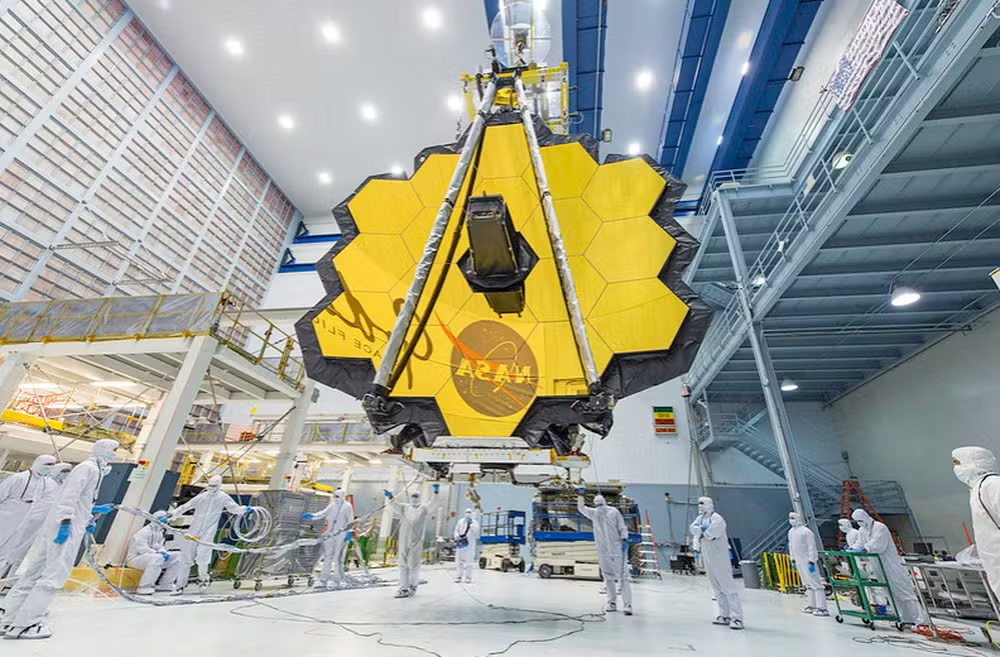
Forged through an international partnership between NASA, the European Space Agency (ESA), and the Canadian Space Agency (CSA), the James Webb is a masterclass in cryogenic mega-engineering and nanometer-scale optics. Operating 1.5 million kilometers from Earth at the Sun-Earth Lagrange Point 2 (L2), Webb deploys a 6.5-meter primary mirror, a tennis-court-sized thermal sunshield maintaining a temperature gradient of nearly 300 degrees Celsius, and sensors chilled to the precipice of Absolute Zero.
In this deep dive from Reach Technocracy, we lift the hood on this mechanical marvel. We will explore the physics of infrared astronomy and cosmological redshift, investigate why its 18 hexagonal mirrors were machined from beryllium and vapor-coated in pure gold, examine the autonomous mechanical origami deployment sequence in deep space, analyze the closed-cycle cryocoolers operating at 7 Kelvin, and explore how this observatory is rewriting astrophysics by capturing primordial galaxies and decoding the atmospheres of habitable exoplanets.
1. Why Infrared? Cosmological Redshift and Interstellar Dust
To understand why Webb required an architecture radically different from Hubble, we must examine two fundamental laws of observational astrophysics:
Cosmological Redshift and the Expanding Universe
When Albert Einstein formulated General Relativity and Edwin Hubble confirmed the expansion of the cosmos, physics recognized that the fabric of space itself stretches continuously over cosmic time.
When a first-generation star (a Population III star) radiated energetic ultraviolet and blue photons 13.6 billion years ago (shortly after the Big Bang):
- That light embarked across the expanding cosmos toward the coordinates of our future solar system.
- As photons traversed expanding space, their wavelengths were stretched proportionally (shifting from blue to green, to optical red, and ultimately deep into the Near- and Mid-Infrared).
To human eyes and Hubble’s optical sensors, these primordial galaxies are invisible. Webb was engineered as a dedicated infrared flagship to capture these ancient, stretched electromagnetic signals.
Penetrating Dense Interstellar Nebulae
Infrared astronomy offers a second decisive advantage: piercing cosmic dust. Stellar nurseries (such as the “Pillars of Creation” in the Eagle Nebula) contain vast molecular clouds of gas and silicates that scatter and absorb short-wavelength visible light.
Infrared photons possess longer wavelengths that pass effortlessly around sub-micron dust grains without scattering. Webb literally sees through interstellar dust clouds, revealing nascent stars, protoplanetary disks, and planetary systems forming within protected stellar cocoons.
2. Golden Optics: Beryllium Substrates, Pure Gold Coating, and Nanometer Actuators
Webb’s most recognizable signature is its colossal 6.5-meter primary mirror, composed of 18 hexagonal segments.
Engineering a segmented mirror array capable of surviving the cryogenic vacuum of deep space required extraordinary breakthroughs in materials science:
Why Beryllium? Cryogenic Structural Rigidity
Standard terrestrial telescope mirrors use thick borosilicate glass. However, glass is heavy and distorts unpredictably under extreme temperature swings.
NASA engineers selected Beryllium (Be):
- Beryllium is lightweight (its density is comparable to industrial plastics, about one-third the weight of aluminum), yet boasts extreme structural stiffness.
- It exhibits an exceptionally low coefficient of thermal expansion at cryogenic temperatures (-233 °C / 40 Kelvin): once cooled in deep space, beryllium retains its polished optical figure with zero structural warping.
Each segment was forged from high-purity beryllium powder through hot isostatic pressing, polished to sub-nanometer tolerances, and cryo-tested in thermal vacuum chambers.
The 100-Nanometer Vapor-Deposited Gold Layer
While the mirror substrate is beryllium, its surface gleams with pure gold. Why gold?
Gold delivers peak reflectivity across the infrared spectrum, reflecting over 98% of light between 0.8 and 28 micrometers (outperforming aluminum and silver).
To coat the 18 segments:
- Engineers utilized Vacuum Vapor Deposition: pure gold is vaporized inside a vacuum chamber, condensing into an ultra-thin film onto the polished beryllium.
- The gold layer measures just 100 nanometers thick (approximately 1,000 times thinner than a single human hair).
- A micro-thin capping layer of amorphous silicon dioxide (synthetic quartz glass) was applied over the gold to shield the soft metal against micrometeoroid impacts.
To coat the entire 25-square-meter primary mirror, engineers used a mere 48 grams of pure gold — roughly the volume of a single golf ball.
Nanometer Alignment via 126 Cryogenic Actuators
In space, the 18 separate hexagonal segments must function as a single monolithic mirror. Mounted behind each segment are 7 cryogenic stepper-motor actuators (6 controlling hexapod spatial orientation and 1 controlling center radius of curvature).
These motors adjust mirror positioning in increments of just 10 nanometers (a fraction of a wavelength of light), aligning the optical wavefront with sub-atomic precision.
3. The 5-Layer Kapton Sunshield: A 300 °C Thermal Chasm
Infrared astronomy operates under a strict physical constraint: heat is infrared light.
Every physical object above Absolute Zero emits thermal infrared photons. If the telescope structure remained at ambient room temperature, its mirrors and framework would radiate a blinding thermal glow, completely overwhelming faint cosmic signals — akin to trying to photograph distant candles while staring into a stadium searchlight.
To maintain optical sensitivity, Webb’s mirrors and instruments must remain chilled below -233 °C (40 Kelvin).
The observatory achieves this via its tennis-court-sized 5-Layer Sunshield:
The Great Thermal Divide
Measuring 21.2 meters long by 14.2 meters wide, the sunshield establishes two radically different thermal environments:
- The Hot Side (Facing Sun, Earth, and Moon): Houses solar arrays, high-gain communication antennas, fuel tanks, and spacecraft avionics, operating at temperatures up to +85 °C.
- The Cold Side (Facing Deep Space): Houses beryllium mirrors and scientific instruments, permanently shadowed in deep cryogenic cold at -233 °C (40 Kelvin).
The sunshield maintains a colossal 300 °C temperature differential across a physical barrier measuring only a few centimeters thick.
The Physics of Kapton and Vacuum Radiative Cooling
The sunshield comprises five ultra-thin membranes of Kapton polyimide film, separated by vacuum gaps:
- Each Kapton sheet is coated with reflective aluminum, with the outer layers doped with silicon to withstand harsh solar ultraviolet radiation.
- The primary layer reflects over 90% of incident solar energy directly into space.
- Heat leaking between sheets is redirected into the vacuum gaps and radiated out the sides.
- Temperatures step down drastically across layers: Layer 1 (+85 °C) -> Layer 2 (+54 °C) -> Layer 3 (-10 °C) -> Layer 4 (-170 °C) -> Layer 5 (-233 °C).
This passive thermal architecture functions with an effective Sun Protection Factor (SPF) exceeding 1,000,000.
4. The Scientific Instrument Suite and the 7-Kelvin Cryocooler
Mounted within the Integrated Science Instrument Module (ISIM) behind the primary mirror are four world-class instruments:
NIRCam (Near-Infrared Camera)
Built by the University of Arizona, NIRCam serves as the observatory’s primary imager (0.6 to 5 micrometers). Equipped with optical coronagraphs, it blocks the blinding glare of host stars to directly image orbiting exoplanets and circumstellar debris disks.
NIRSpec (Near-Infrared Spectrograph)
Developed by ESA, NIRSpec features an array of 250.000 addressable Microshutters. Each microshutter is a microscopic door the width of a human hair that can be opened or closed magnetically, allowing NIRSpec to capture spectra from 100 individual galaxies simultaneously in a single exposure.
NIRISS / FGS (Fine Guidance Sensor and Slitless Spectrograph)
Provided by the Canadian Space Agency, the FGS ensures sub-milliarcsecond pointing stability, while NIRISS performs transit spectroscopy to analyze the chemical fingerprints of exoplanet atmospheres.
MIRI (Mid-Infrared Instrument) and the Closed-Cycle Cryocooler
While NIRCam and NIRSpec operate at 40 Kelvin via passive cooling, the Mid-Infrared Instrument (MIRI) (5 to 28 micrometers) requires an even deeper freeze: it operates at just -266 °C (under 7 Kelvin), mere degrees above Absolute Zero.
To achieve this, engineers developed a Closed-Cycle Helium Cryocooler:
- Rather than relying on finite liquid helium dewars that boil away over time, the cryocooler uses opposed-piston acoustic compressors cycling helium gas through closed loops.
- Expanding gas across a Joule-Thomson valve absorbs heat from MIRI and exhausts it onto hot-side radiators, providing active cooling designed to last for over 20 years of continuous scientific operations.
5. Cosmic Origami: Surviving 344 Single Points of Failure to L2
No launch vehicle on Earth possessed a payload fairing large enough to accommodate an unfurled 6.5-meter mirror and a 21-meter sunshield. The fairing of the European Ariane 5 rocket measured 5 meters in diameter.
The engineering solution was extraordinary: Webb was built as a massive folding robotic origami payload.
Launch and the Voyage to Lagrange Point 2 (L2)
On December 25, 2021, an Ariane 5 lifted off from Kourou, French Guiana, placing Webb on a high-precision trajectory toward Lagrange Point 2 (L2), located 1.5 million kilometers from Earth.
At L2, the combined gravitational pull of the Sun and Earth matches the centrifugal force of the spacecraft’s orbit, allowing Webb to orbit the Sun in lockstep with Earth while keeping the Sun, Earth, and Moon permanently behind its sunshield.
Unfurling in the Void: 344 Single Points of Failure
During its initial deployment voyage to L2, Webb executed the most complex autonomous mechanical choreography in aerospace history:
- The mechanism required 140 release actuators, 70 hinge assemblies, 400 pulleys, and 400 meters of drive cables.
- The deployment sequence contained 344 Single Points of Failure (SPOFs): if a single motor seized or a single cable snapped, the $10-billion observatory would have become dead space debris, since L2 is far beyond the reach of human servicing missions.
Executing flawlessly under the stewardship of the Space Telescope Science Institute (STScI), every mechanism functioned with 100% mission success, tensioning the sunshield and latching the golden mirror wings into deep-space configuration.
6. Conclusion: A Window into the First Dawn of Creation
The James Webb Space Telescope stands as a testament to what international scientific collaboration, mechanical audacity, and engineering precision can achieve when humanity dares to peer into the unknown.
By uniting the atomic properties of beryllium, the sub-micron physics of vapor-deposited gold, the cryogenic thermodynamics of Kapton shields, and closed-cycle helium refrigeration at Lagrange Point 2, Webb has granted humanity the power to look backward across cosmic time — observing the birth of the first galaxies that illuminated the primordial universe and analyzing water vapor, methane, and carbon dioxide in the atmospheres of distant alien worlds.
At Reach Technocracy, we will remain dedicated to tracking every deep-field discovery, molecular spectrum, and cosmological paradigm shift unlocked by the golden eye of the James Webb Space Telescope.
Which engineering feat of the James Webb astonishes you most: the nanometer alignment of its beryllium mirrors or the 300 °C thermal barrier of its sunshield? Do you believe Webb will confirm definitive biosignatures on an exoplanet before 2030? Share this deep dive with your network of astronomy, astrophysics, and engineering enthusiasts, and leave your thoughts in the comments below!
🔭 Continue Exploring the Frontier of Science and Technology: