
If you have watched any recent sci-fi movies — especially Marvel superhero films —, you have almost certainly noticed a classic scriptwriter trick: whenever someone needs to explain an impossible piece of technology or justify time travel, they simply throw the word “quantum” into the dialogue. We have the Quantum Realm, quantum energy, quantum tunnels, and even computers capable of hacking any mainframe in seconds.
In fiction, quantum physics has become a convenient magic wand. But outside movie theaters and superhero suits, quantum computing is a genuine, rapidly advancing field of engineering. And the best part: it has nothing to do with shrinking heroes down to the size of insects.
The global interest surrounding this field is both urgent and practical: classical computers — from the smartphone in your pocket to the largest industrial supercomputers — are rapidly approaching an unavoidable physical wall. To continue making breakthrough discoveries in medicine, sustainable materials, and artificial intelligence, we need a fundamentally new way to process data.
In this article from Reach Technocracy, we are going to open this “black box” and explore in simple, engaging terms what quantum computing actually is, how it works under the hood, why it will not replace your home computer, and how it is building a quiet revolution across science.
1. The Starting Point: How Does Your Current Computer Work?
Before taking a leap into the subatomic world, it is worth revisiting the basic logic of the computers you use every day.
At the most fundamental level, every modern digital device — whether it is a PlayStation 5, a work laptop, or cloud servers — is built from billions of microscopic electrical switches called transistors.
These switches operate on a strictly binary system:
- If the switch is turned off and no electric current passes, it registers the value 0.
- If the switch is turned on and current flows freely, it registers the value 1.
This minimum unit of digital information is what we call a bit (binary digit).
Everything we consume and create in the digital realm — photos, streaming music, spreadsheets, texts, and 3D games — is a monumental sequence of zeros and ones processed in rapid succession.
Classical computing is linear and deterministic: the processor receives instructions, evaluates one state at a time, and delivers an exact, predictable answer. This architecture built modern society, but it is now colliding with an unyielding barrier of physics.
The End of Moore’s Law and the Atomic Limit
For decades, computer hardware followed Moore’s Law, an empirical observation by Intel co-founder Gordon Moore, predicting that the number of transistors on a microchip would double roughly every two years, boosting performance and reducing costs.
To pack billions of transistors onto a small silicon chip, engineers had to make them smaller and smaller. Today, cutting-edge transistors measure just a few nanometers — an atomic scale where the physical walls of the transistor are only a few dozen atoms thick.
And this is where classical physics breaks down. At this microscopic scale, electrons experience quantum tunneling: they simply “teleport” through the physical barrier of the transistor even when switched off, like a ghost walking through a solid wall. The switch loses its ability to reliably alternate between 0 and 1.
Because we cannot build transistors smaller than individual atoms, scientists realized the solution was not to fight quantum effects, but to build computers that use these quantum rules to compute.
2. The Physics Behind the Magic: What Is a Qubit?
In classical computing, the foundational unit is the bit. In quantum computing, the fundamental unit is the qubit (quantum bit).
While a classical bit is an electrical charge along a silicon pathway, a qubit is constructed from real physical subatomic systems — such as the spin of an electron, the energy level of an isolated atom, or photons of light in superconducting circuits.
The qubit possesses remarkable capabilities thanks to two core principles of quantum physics: superposition and entanglement.
| Metric / Concept | Classical Bit | Quantum Bit (Qubit) |
| Fundamental State | Strictly 0 OR 1 | 0, 1, OR a superposition of both |
| Physical Analogy | A coin resting flat on a table | A coin spinning rapidly on the tabletop |
| Search Method | Evaluates paths one by one (sequential) | Explores multiple paths simultaneously |
| Scaling Capacity | Linear growth | Exponential growth via entanglement |
Superposition: The Spinning Coin
The most intuitive analogy for understanding superposition is a spinning coin:
- A classical bit is like a coin lying flat on a table. It can only show one face at a time: either Heads (1) or Tails (0).
- A qubit is like that same coin spinning rapidly on the tabletop. While spinning at high speed, what state is it in? It is not purely heads nor purely tails; it exists in a combination of probabilities of both outcomes simultaneously until someone stops the spin.
While a classical bit can only represent 0 or 1 at any single moment, a qubit exists in a superposition of 0 and 1 at the same time.
Imagine a complex labyrinth:
- A classical computer searches for the exit by testing one path at a time. If it hits a dead end, it backtracks and tries the next branch sequentially.
- A quantum computer uses superposition to explore all branches of the labyrinth simultaneously. Through quantum interference, incorrect routes cancel each other out, while the correct route is reinforced and amplified, delivering the direct solution.
Quantum Entanglement: The “Spooky” Connection
If superposition allows an individual qubit to process multiple states at once, quantum entanglement connects multiple qubits to multiply computational power exponentially.
When two or more qubits become entangled, they become part of an indivisible physical system. What happens to one qubit instantly dictates the state of the other, regardless of the physical distance between them.
Albert Einstein famously referred to this concept as “spooky action at a distance”, doubting that anything could transmit information instantaneously without violating the speed of light. Yet, modern laboratory experiments have repeatedly proven that entanglement is entirely real.
For computing, entanglement unlocks an extraordinary scaling multiplier:
- 2 classical bits represent only 1 value at a time out of 4 possible combinations (00, 01, 10, or 11).
- 2 entangled qubits process all 4 combinations simultaneously.
- 3 qubits hold 8 states at once.
- 10 qubits hold 1,024 states at once.
- 50 qubits entangled together process more than 1 quadrillion numbers in a single computational instant.
- With approximately 300 perfectly entangled qubits, the system would hold more simultaneous numerical states than the total number of atoms in the observable universe.
3. What Does a Real Quantum Computer Look Like?
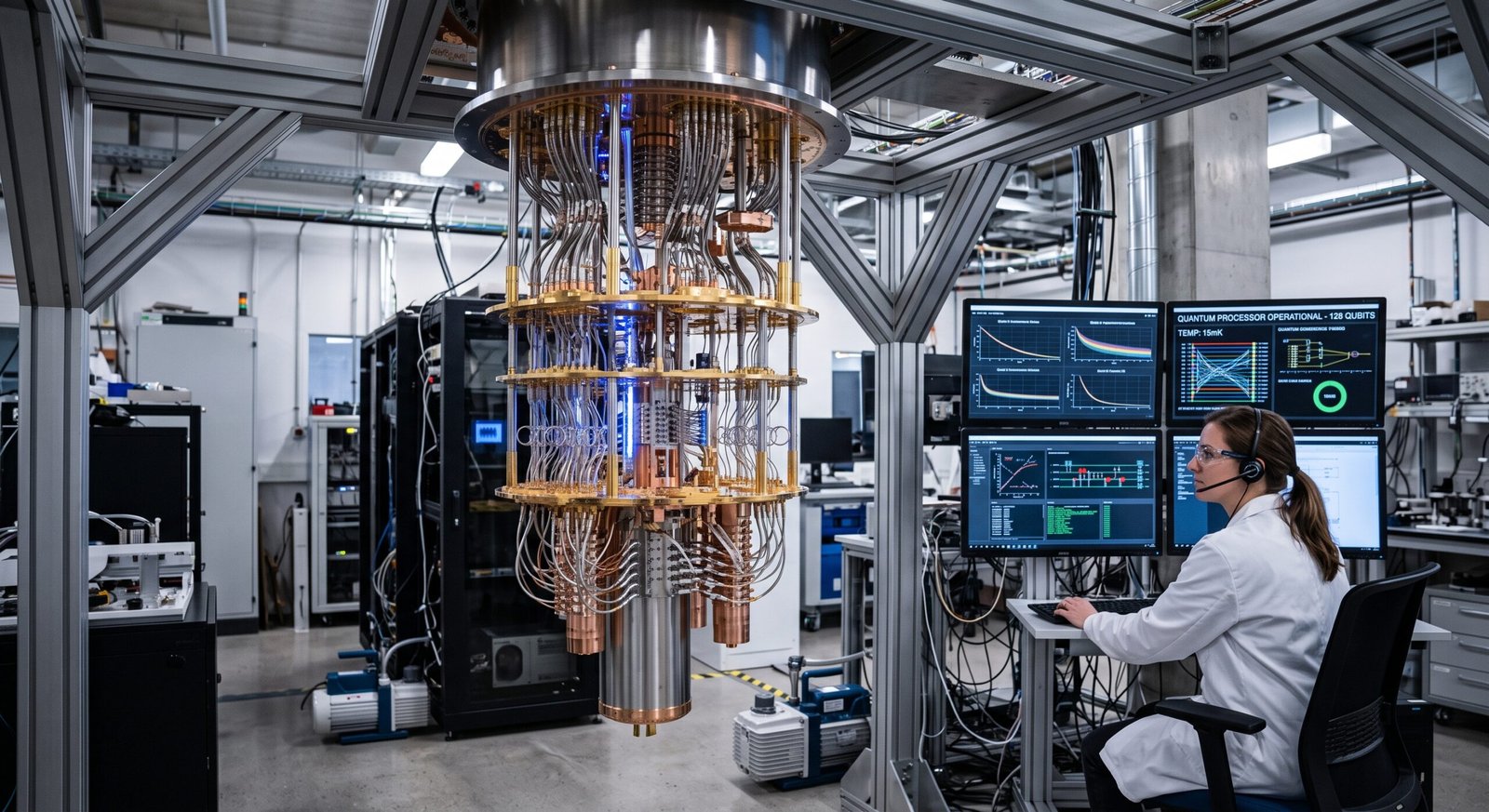
Images of real quantum computers reveal an impressive chandelier-like structure of gold and copper suspended from the ceiling, reminiscent of futuristic machinery from Cyberpunk 2077 or Portal.
That metallic tower is not the processor itself — it is a sophisticated, multi-stage dilution refrigerator. The actual quantum processor chip sits at the very bottom tip and is roughly the size of a small postage stamp. The entire apparatus exists to maintain an environment of absolute isolation.
The Thermal Architecture of a Quantum Refrigerator (From Top to Bottom):
- Stage 1 (Top / Room Temp): Standard laboratory temperature (~20 °C / 293 K).
- Stage 2 (Intermediate): Liquid nitrogen cooling stage (~ -196 °C / 77 K).
- Stage 3 (Pre-cooling): Liquid helium circulation stage (~ -269 °C / 4 K).
- Stage 4 (Deepest Chamber): Helium-3 and Helium-4 dilution mixture at -273.135 °C (0.015 Kelvin), where the quantum chip is mounted.
Extreme Cold and Decoherence
To function without losing their quantum properties, superconducting qubits must be cooled to roughly 0.015 Kelvin (-273.135 °C), colder than the vacuum of deep space.
This extreme temperature is required because qubits are hyper-sensitive. Any stray heat, Wi-Fi radiation, or mechanical vibrations cause qubits to lose superposition and make calculation errors.
This collapse of the quantum state is called decoherence.
Decoherence is the primary engineering bottleneck in quantum computing today. Currently, scientists can keep qubits stable for only fractions of a second. This is why the major scientific race is developing fault-tolerant logical qubits with quantum error correction (QEC), where multiple physical qubits protect a single clean logical qubit of usable data.
4. Myth vs. Reality: Why You Won’t Have a Quantum PC at Home
A recurring question is: “When will we have quantum processors to run games at incredible frame rates or make our home computers instantaneous?”
The realistic answer is: never — and you don’t need one.
Classical and quantum computers are not direct competitors; they are fundamentally different tools designed for distinct purposes.
Consider the comparison between an everyday passenger car and an orbital rocket:
- A car is ideal for commuting to work, running errands, and road trips with comfort and fuel efficiency.
- A rocket in your driveway to go to the grocery store would be hazardous, astronomically expensive, and destroy the neighborhood on launch. But to travel to the Moon, the car is useless and the rocket is the only viable option.
For daily tasks — browsing the web, streaming 4K video, editing documents, and running games —, classical computers will always be cheaper, faster, and more practical.
Practical access to quantum computing happens today through the cloud in a model known as QaaS (Quantum as a Service). Cloud platforms such as IBM Quantum, Google Quantum AI, Microsoft Azure Quantum, and Amazon Braket provide remote access so researchers can submit code to cryogenic machines in secure laboratory environments.
5. Where the Revolution Happens: Practical Applications
If quantum computers are not suited for consumer tasks, why are tech giants investing billions into this field?
The answer lies in combinatorial complexity problems, where the number of variables grows so rapidly that classical supercomputers would take thousands of years to evaluate every hypothesis. This is where quantum computing excels.
Here are four major industries set to be transformed:
1. Medicine and Drug Discovery
Nature, at its atomic foundation, is governed by quantum mechanics.
When pharmaceutical companies develop a drug, they must model how a synthetic molecule interacts with human proteins. Simulating complex molecular interactions on classical computers requires rough approximations and immense computational power.
Because qubits follow the rules of atomic physics, they act as ideal chemical simulators. This will allow researchers to:
- Shorten pharmaceutical development timelines from decades to months.
- Develop hyper-personalized treatments for rare cancers and genetic diseases.
- Map complex protein folding mechanisms, shedding light on neurodegenerative disorders like Alzheimer’s and Parkinson’s.
2. Materials Science and Sustainability
One of the world’s most vital industrial chemical reactions is the Haber-Bosch Process, used to synthesize ammonia from atmospheric nitrogen to produce agricultural fertilizers. This method sustains food production for nearly half of humanity, but consumes up to 2% of global energy and produces heavy carbon emissions.
Soil bacteria perform this exact reaction at room temperature using an enzyme called nitrogenase. Science has not yet replicated this clean reaction industrially because we cannot model the exact quantum mechanics of the enzyme. A quantum computer could unlock this puzzle, enabling clean, inexpensive fertilizers.
Additionally, quantum simulation promises:
- Solid-state batteries for electric vehicles with high energy density and charging times of mere minutes.
- Room-temperature superconductors, eliminating electrical losses in power grids and advancing magnetic levitation (Maglev) transit.
3. Cybersecurity and the “Q-Day” Threat
Modern digital security — online banking, encrypted messages, and crypto wallets — relies on public-key encryption, such as the RSA algorithm.
RSA works because it is easy for a computer to multiply two massive prime numbers, but nearly impossible to reverse the calculation (prime factorization). A classical supercomputer would take millennia to crack a 2048-bit RSA key by brute force.
However, in 1994, mathematician Peter Shor published Shor’s Algorithm, proving that a sufficiently powerful quantum computer can solve prime factorization in minutes.
This future threshold is known in the industry as “Q-Day” (Quantum Day).
To prevent global vulnerabilities, specialists are already implementing Post-Quantum Cryptography (PQC) — new mathematical algorithms designed to resist both classical and quantum attacks —, alongside Quantum Key Distribution (QKD), where any eavesdropping physically alters the light signal and reveals the intrusion instantly.
4. Logistics, Supply Chains, and Complex Networks
In the classic Traveling Salesperson Problem, finding the shortest route visiting dozens of cities causes an explosion of permutations: with just 50 locations, there are more possible routes than atoms on Earth.
Classical computers rely on rough approximations. Quantum computers analyze all routes simultaneously to identify the optimal path. This capability transforms:
- Route optimization for cargo shipping fleets and airlines, saving billions in fuel and lowering emissions.
- Dynamic load management on electrical grids to prevent overloads and blackouts.
- Real-time risk management and portfolio rebalancing across millions of financial market variables.
6. The Current State: The NISQ Era and the Global Race
Despite the immense promise, it is essential to keep our feet on the ground: we are still in the early chapters of this journey.
Historians compare today’s quantum computers to classical computing in the 1950s, when machines like the ENIAC filled entire rooms, drew massive power, and used vacuum tubes that burned out every few hours.
Today, we live in the NISQ era (Noisy Intermediate-Scale Quantum):
- Modern quantum processors feature between dozens and a few thousand physical qubits.
- Error rates and noise remain significant, limiting complex algorithms.
- Milestones of Quantum Advantage have been demonstrated, though primarily on abstract mathematical benchmark problems.
The transition from NISQ systems to commercially viable, fault-tolerant quantum computers is expected to solidify over the coming decade.
7. Conclusion: Stepping Into the Era of Hybrid Computing
Quantum computing is not here to cancel or replace the computers we already use. Its true destination is to inaugurate an era of hybrid computing.
In this ecosystem:
- The classical computer will remain the irreplaceable interface for user interaction, media processing, web browsing, and everyday software.
- The quantum computer will operate in the cloud as a specialized accelerator, called upon when humanity needs to solve molecular and mathematical challenges once deemed impossible.
To summarize the core takeaways:
- The classical bit is binary and static: always 0 or 1.
- The qubit leverages superposition (multiple possibilities at once) and entanglement (connections multiplying computing power).
- The real goal is not to replace your phone, but to discover life-saving drugs, develop green materials, optimize global infrastructure, and reinvent digital security.
Quantum physics has stepped out of abstract theory and into the frontier of information engineering. At Reach Technocracy, we will continue monitoring every leap forward in this revolution.
Did you enjoy this article? Share it with fellow technology enthusiasts and leave your thoughts in the comments: which quantum computing breakthrough do you think will impact society the most?
🔭 Continue Exploring the Frontier of Science and Technology:
- The Grand Challenges of Quantum Computing
- Lattice-Based Cryptography
- Optical Chips and Computing with Light