
If you watched the acclaimed technological thriller series Mr. Robot (2015), starring Rami Malek, you undoubtedly remember the electrifying tension surrounding the power of cryptographic keys: with the right mathematical algorithms, a cybersecurity architect can shield financial empires or dismantle trillion-dollar corporations with a single command.
If your cinematic memory turns toward history, the gripping film The Imitation Game (2014) dramatized Alan Turing’s race at Bletchley Park to break the Nazi Enigma cipher, proving that the survival of global civilizations has always hinged upon the silent battle between code-makers and code-breakers. Or consider the cyber realms of Tron and The Matrix, where the sudden compromise of master cryptographic keys signifies the instantaneous collapse of digital civilization.
For nearly fifty years, global society has operated with absolute trust in the mathematical armor of digital encryption. Every time you open your mobile banking app, complete an e-commerce credit card transaction, send an end-to-end encrypted message on WhatsApp, or connect to a secure cloud server, your data is shielded by asymmetric public-key algorithms such as RSA and Elliptic Curve Cryptography (ECC).
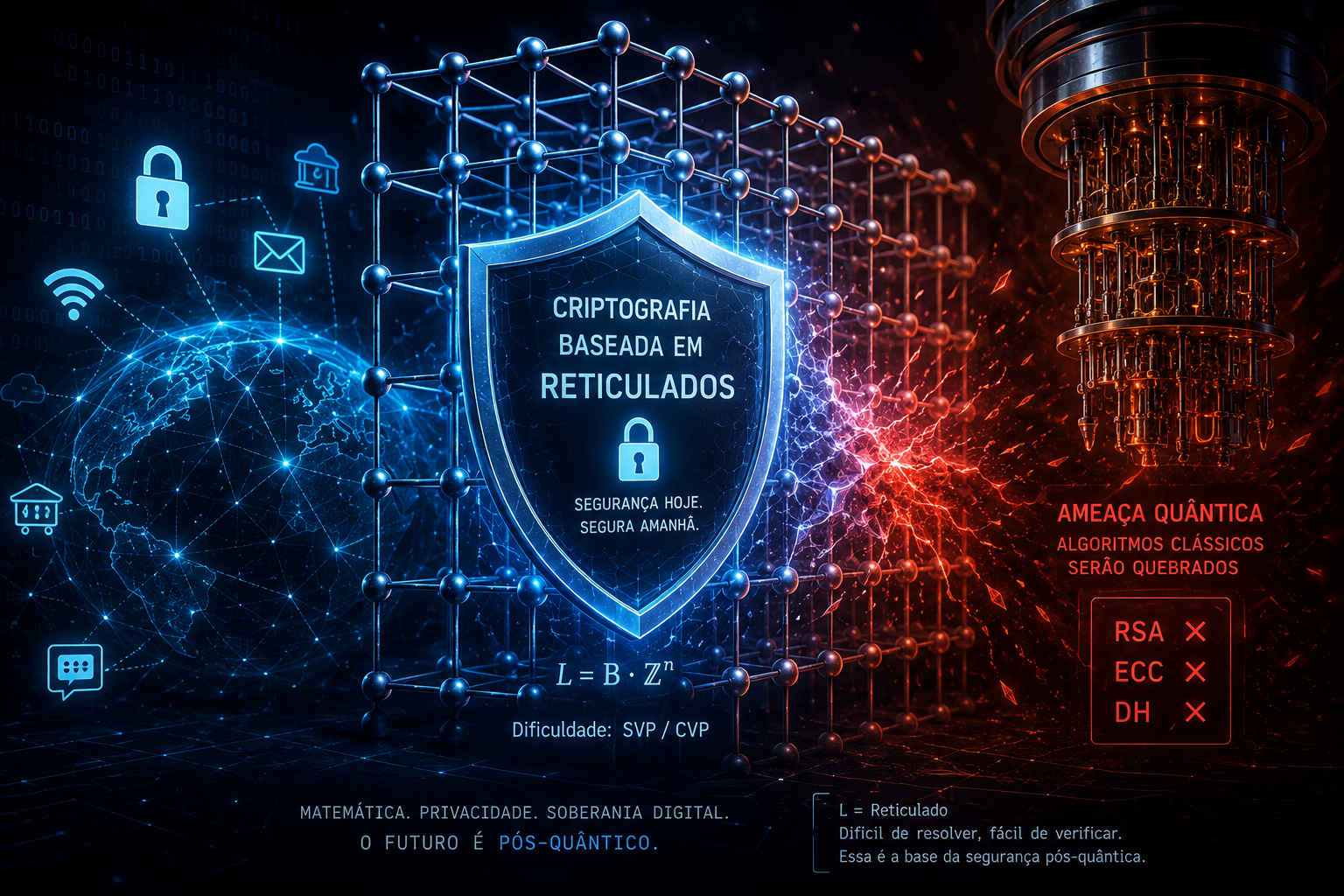
Yet this foundational pillar of modern civilization is approaching an existential cliff. The imminent emergence of fault-tolerant quantum computers armed with the legendary Shor’s Algorithm will render RSA and ECC instantaneously obsolete. This anticipated event is known across global cybersecurity as “Q-Day” — the moment when the world’s digital locks can be compromised in minutes.
Even more urgent is the silent reality of Harvest Now, Decrypt Later (HNDL): adversarial state actors and cyber syndicates are already intercepting and archiving petabytes of encrypted global traffic today, storing it to decrypt the moment scalable quantum processors become operational.
To neutralize this threat, modern mathematics has engineered the ultimate defense: Post-Quantum Cryptography (PQC), anchored by the unyielding geometry of Lattice-Based Cryptography.
In this deep dive from Reach Technocracy, we explore the mathematics and systems engineering safeguarding the digital future. We will examine how classical cryptography operates and why quantum mechanics breaks it, unravel the multidimensional geometry of mathematical lattices, evaluate the new global standards ratified by NIST (including ML-KEM / Kyber and ML-DSA / Dilithium), and analyze the urgent global migration required to upgrade the world’s servers before time runs out.
1. The Modern Internet’s Digital Locks: How RSA and Elliptic Curves Shield the World
To appreciate the severity of the quantum threat, we must first understand how public-key cryptography protects modern communications.
Asymmetric cryptography relies upon an elegant mathematical structure known as a Trapdoor Function: a mathematical operation that is trivial to compute in the forward direction, but computationally intractable to reverse unless one possesses a specific piece of secret auxiliary data (the private key).
The two foundational pillars of digital security are:
The RSA Algorithm and Prime Factorization
Formulated in 1977 by Ron Rivest, Adi Shamir, and Leonard Adleman, RSA relies upon the asymmetry of prime multiplication:
- If you take two massive multi-hundred-digit prime numbers (p and q) and multiply them, any standard smartphone computes the composite product (N = p × q) in microseconds.
- However, if you provide only the product N to the world’s most powerful classical supercomputers and ask them to determine the original prime factors p and q (Integer Factorization), it would take billions of core-hours of trial computation.
Elliptic Curve Cryptography (ECC)
Powering modern HTTPS/TLS web handshakes, SSH protocols, and cryptocurrency signatures, ECC relies upon the Discrete Logarithm Problem over algebraic curves. It achieves equivalent mathematical security to RSA with drastically smaller key sizes (256 bits versus 2048 bits for RSA), enabling low-latency mobile security.
For decades, global enterprise infrastructure operated on the theoretical certainty that no computing architecture could solve these mathematical problems within a human lifespan.
2. Shor’s Algorithm and “Q-Day”: The Structural Death of Classical Cryptography
That mathematical certainty was permanently upended in 1994 when American mathematician Peter Shor published a landmark theoretical paper introducing Shor’s Algorithm.
Shor demonstrated that a quantum computer does not need to brute-force prime factors sequentially like a classical Turing machine. By leveraging quantum mechanical properties — specifically Quantum Superposition (evaluating multi-state vectors simultaneously) and Quantum Interference —, a quantum computer transforms integer factorization and discrete logarithms into the problem of finding the period of a modular mathematical function.
The implications are catastrophic for classical security:
- A classical supercomputer requires billions of years to factor a 2048-bit RSA key.
- A fault-tolerant quantum computer running Shor’s Algorithm will solve that exact same key in mere minutes to hours.
The Urgent Threat: “Harvest Now, Decrypt Later” (HNDL)
A common misconception is that post-quantum security is an issue reserved for the distant future.
In reality, cybersecurity intelligence agencies have identified Harvest Now, Decrypt Later (HNDL) as an active, immediate vulnerability:
- Adversarial nation-states are intercepting and silently stockpiling petabytes of encrypted diplomatic cables, military command communications, healthcare records, and intellectual property traversing the public internet today.
- While adversaries cannot decrypt this traffic currently, they are storing the raw encrypted payloads in hyper-scale data banks.
- The instant a sufficiently capable quantum computer becomes operational (Q-Day), this archived data will be decrypted retroactively. Information requiring long-term confidentiality (such as state secrets or classified patents) is already compromised in transit today.
3. The Geometry of Lattices: The Quantum-Resistant Mathematical Shield
To replace RSA and ECC, the global cryptographic community required new mathematical problems that remain fundamentally intractable for both classical supercomputers and quantum processors executing Shor’s Algorithm.
The most mathematically robust answer was discovered in Lattice-Based Cryptography.
What is a Mathematical Lattice?
In formal mathematics, a lattice is an infinite, discrete geometric grid of points generated by the linear integer combination of a set of linearly independent basis vectors in n-dimensional Euclidean space. In two or three dimensions, calculating the closest lattice point or finding the shortest vector between points is computationally trivial and can be visualized effortlessly on coordinate graph paper.
However, consider that exact same geometric structure expanded into an abstract multidimensional vector space spanning 500 to 1,000 dimensions.
In high-dimensional space, human visual intuition completely breaks down. A thousand-dimensional lattice contains an astronomical number of possible vector combinations, directions, and hyper-planes. While a mathematically ‘good’ basis (consisting of nearly orthogonal vectors of minimal length) makes navigation straightforward, generating a public key using an obfuscated ‘bad’ basis (consisting of extremely long, skewed, and non-orthogonal vectors) transforms the lattice into an impenetrable geometric maze.
Lattice-based cryptography relies upon two primary NP-hard geometric problems:
- Shortest Vector Problem (SVP): Given an arbitrary, mathematically obfuscated (“bad”) basis of a multi-hundred-dimensional lattice, determine the non-zero lattice vector with the shortest Euclidean length to the origin. In hundreds of dimensions, the combinatorial explosion of potential geometric directions creates an impenetrable mathematical labyrinth.
- Learning With Errors (LWE): Recover a secret vector from a system of linear equations where a small, randomized Gaussian “noise” vector is introduced to each equation. Without noise, Gaussian elimination solves the system in milliseconds; with noise added, the problem becomes mathematically intractable even for the superposition states of a quantum processor.
Because Shor’s Algorithm relies strictly on exploiting the periodic algebraic symmetry of abelian groups — which high-dimensional geometric lattices inherently lack —, quantum computers enjoy zero algorithmic speedup when attempting to break lattice-based ciphers.
4. The Global NIST Standards: ML-KEM, ML-DSA, and the Post-Quantum Era
Following an exhaustive eight-year global scientific competition evaluating hundreds of candidate algorithms from world-leading cryptographers, the U.S. National Institute of Standards and Technology (NIST) officially finalized the primary global Post-Quantum Cryptography standards in 2024:
ML-KEM (Formerly CRYSTALS-Kyber): Key Encapsulation
ML-KEM (Module-Lattice-Based Key-Encapsulation Mechanism) has been established as the primary international standard for general public-key encryption and secure session handshakes. Derived from the hardness of the Module Learning With Errors (M-LWE) problem over polynomial rings, ML-KEM enables two communicating web entities to establish a shared symmetric secret key across an unencrypted public channel. It executes with sub-millisecond computational latency, minimal memory footprint, and provides ironclad security parameters corresponding to AES-128, AES-192, and AES-256 equivalent security levels.
ML-DSA (Formerly CRYSTALS-Dilithium): Digital Signatures
ML-DSA (Module-Lattice-Based Digital Signature Algorithm) serves as the primary global standard for identity authentication and digital signature generation. Based on the Fiat-Shamir with Aborts framework over module lattices, ML-DSA guarantees that digital documents, financial transactions, smart contracts, and operating system firmware updates cannot be forged, manipulated, or repudiated. Any attempt by a quantum adversary executing Shor’s Algorithm to forge an ML-DSA digital signature would require solving the intractable Shortest Vector Problem across hundreds of lattice dimensions.
SLH-DSA (SPHINCS+) and FN-DSA (FALCON): Secondary Defense Lines
Recognizing that global cybersecurity demands cryptographic defense-in-depth, NIST standardized secondary cryptographic suites based on alternate mathematical foundations:
- SLH-DSA (Stateless Hash-Based Digital Signature Algorithm / SPHINCS+): Relies solely on the security properties of standard cryptographic hash functions (such as SHA-256 and SHAKE-256). Because it does not rely on algebraic or geometric lattices, SLH-DSA provides an essential mathematical safety net in the unlikely event that unforeseen algorithmic shortcuts are ever discovered against lattice-based math.
- FN-DSA (Fast-Fourier Lattice-Based Digital Signature Algorithm / FALCON): Utilizes Gentry-Peikert-Vaikuntanathan (GPV) hash-and-sign frameworks over NTRU lattices, leveraging Fast Fourier Transforms to produce the smallest digital signatures and public keys among all lattice schemes, making it ideal for bandwidth-constrained IoT hardware and embedded smartcards.
5. The Great Migration: Upgrading the World’s Digital Infrastructure
Standardizing the algorithms was merely the theoretical milestone; the monumental engineering task now underway is the largest software and network infrastructure migration in human history.
Deploying post-quantum cryptography at planet-scale involves overcoming three major technical constraints:
Cryptographic Key and Signature Expansion
Classical ECC public keys were exceptionally compact, measuring just 32 bytes (256 bits). In contrast, lattice-based ML-KEM public keys span 800 to 1,500 bytes, while ML-DSA digital signatures require 2.4 to 4.5 kilobytes. This data overhead requires network protocol re-engineering across TLS, SSH, and VPN tunnels to prevent packet fragmentation and latency spikes across mobile networks.
Hybrid Cryptographic Deployments
To ensure seamless backwards compatibility and eliminate implementation vulnerabilities, global technology leaders (including Google, Cloudflare, Apple, and Microsoft) are actively deploying Hybrid Key Exchange across Google Chrome, Apple iMessage, and global Content Delivery Networks (CDNs). The hybrid protocol pairs classical algorithms alongside post-quantum lattice algorithms (e.g., X25519 + Kyber): an adversary would need to simultaneously break both the classical and post-quantum mechanisms to compromise the connection.
Enterprise Cryptographic Bill of Materials (CBOM)
Billions of embedded IoT microcontrollers, banking mainframe architectures, and enterprise databases have legacy cryptographic algorithms hardcoded directly into immutable hardware and firmware. Cataloging and migrating this digital debt before Q-Day represents a multi-hundred-billion-dollar global cybersecurity effort.
6. Conclusion: The New Frontier of Digital Sovereignty
The history of cybersecurity is an unending evolutionary race between the lock and the pick. When quantum mechanics threatened to dismantle the mathematical foundations that safeguarded human civilization for fifty years, mathematicians and computer scientists responded by elevating cryptographic defenses into the multidimensional geometry of lattices.
Post-Quantum Cryptography is not a speculative academic exercise for future decades; it is the indispensable architectural foundation preserving human privacy, financial integrity, and national sovereignty today.
At Reach Technocracy, we will remain dedicated to analyzing every protocol migration, browser deployment, and quantum hardware breakthrough defining the future of global digital trust.
Has your organization begun its post-quantum readiness assessment? Are your personal browsers and communications channels utilizing hybrid post-quantum encryption? Share this deep dive with your cybersecurity and technology network, and let us know your thoughts in the comments below!
🔭 Continue Exploring the Frontier of Science and Technology: