
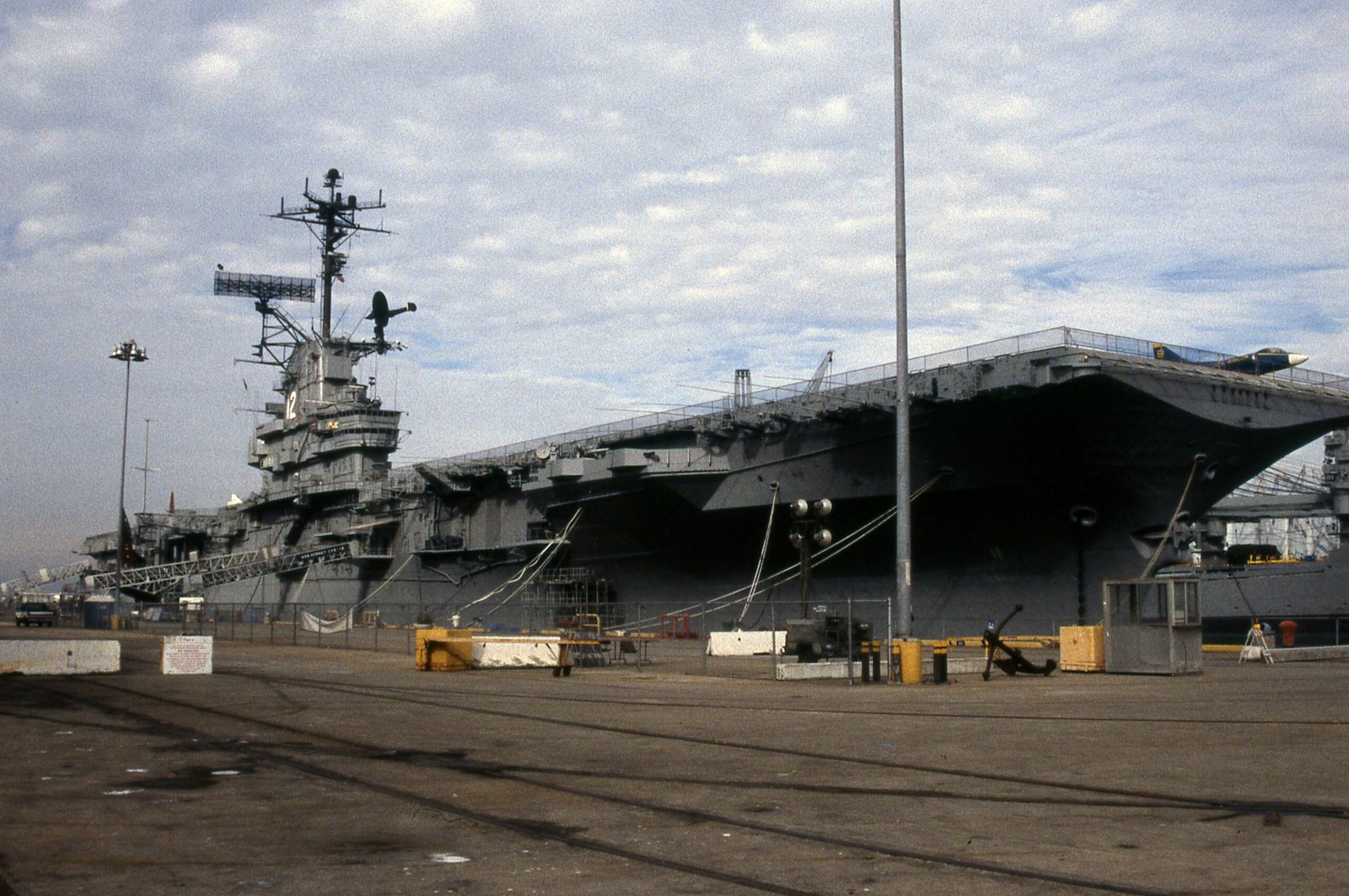
If you have watched the classic aviation film Top Gun or its acclaimed sequel Top Gun: Maverick, you were almost certainly captivated by the electrifying scenes of F/A-18 supersonic fighter jets launching from and recovering onto the flight deck of an aircraft carrier in the open ocean. The deafening roar of afterburning turbofan engines, steam venting from the catapult tracks, and the choreographed ballet of flight deck crews working inches away from spinning jet intakes look like a scene orchestrated in a futuristic military sci-fi universe.
Yet beneath all of that cinematic adrenaline lies the absolute zenith of naval, nuclear, and mechanical engineering ever conceived by humanity.
A modern nuclear-powered aircraft carrier — such as the United States Navy’s flagship Gerald R. Ford-class supercarrier — is a colossal leviathan of steel. Displacing over 100,000 metric tons, stretching over 330 meters in length, and standing 25 stories tall from keel to mast, this vessel is not merely a warship; it is a fully sovereign mobile airbase and a self-contained nuclear city capable of operating for 25 consecutive years without refueling a single drop of fuel.
In this deep dive from Reach Technocracy, we explore the hidden mega-engineering behind these floating fortresses of the high seas. We will dissect the naval nuclear reactors that propel them, the extreme electromagnetic physics of modern aircraft catapults, the mechanical miracle of arresting gear wires, and the invisible electronic warfare shield safeguarding these crown jewels of global naval defense.
1. The Atomic Heart: Nuclear Propulsion and Boundless Endurance
The single most astounding engineering feature of a modern supercarrier is that it never needs to dock at a port to take on propulsion fuel.
While massive commercial container vessels burn thousands of tons of heavy, polluting bunker fuel, a Ford-class aircraft carrier is propelled by two Bechtel A1B pressurized water nuclear reactors.
These ultra-shielded naval reactors operate on highly enriched nuclear fuel. Controlled nuclear fission superheats pressurized water, which transfers thermal energy through steam generators to spin four massive steam turbines connected to four 30-ton bronze propulsion shafts.
The operational capability unlocked by this atomic engineering is unprecedented:
- Unlimited Global Cruising Range: The carrier can maintain continuous transit speeds exceeding 30 knots (over 56 km/h) non-stop for 25 consecutive years on its initial nuclear core loading. The ship’s sole operational constraint at sea is the volume of food provisions and aviation fuel stored for its human crew and air wing.
- Massive Electrical Generation Capacity: The Ford-class A1B reactors generate nearly 300% more electrical power than previous-generation Nimitz-class ships, producing enough electricity to power a medium-sized terrestrial city. This immense electrical margin is designed specifically to power high-energy laser defense weapons, advanced radar arrays, and next-generation electromagnetic launch systems.
2. The Floating Metropolis: Life for 5,000 Sailors at Sea
Operating a sovereign combat airbase in the middle of international waters requires complete urban municipal infrastructure. A deployed supercarrier supports between 4,500 and 5,000 service members (encompassing the ship’s company and the specialized tactical air wing).
This self-sustaining oceanic metropolis features:
- Industrial Desalination Plants: Processing over 1.5 million liters of seawater into ultra-pure potable fresh water every single day for cooking, hygiene, and industrial cooling.
- Full-Scale Surgical Hospital: Equipped with multi-bay trauma operating suites, intensive care beds, digital radiography laboratories, dental clinics, and a complete pharmaceutical dispensary.
- Monumental Culinary Logistics: The ship’s galleys prepare and serve over 18,000 hot meals every 24 hours. Over a standard six-month overseas deployment, the crew consumes hundreds of tons of meat, thousands of gallons of milk, and tens of thousands of dozens of eggs.
- Specialized Flight Deck Operations: The flight deck is universally recognized as one of the most hazardous working environments on Earth. Flight deck personnel wear color-coded tactical jerseys (the famous Rainbow Side: green for catapult and arresting gear crews, yellow for aircraft directors, red for ordnance and explosive disposal, and purple for Jet-A fuel handlers) to execute error-free flight operations amidst deafening acoustic noise and jet blast hazards.
3. The Physics of Launch: From Steam Pistons to EMALS
The active runway on an aircraft carrier’s flight deck measures only about 90 to 100 meters long. On a standard land-based civilian airfield, a heavy military jet requires at least 1,500 to 2,000 meters of concrete tarmac to achieve aerodynamic takeoff velocity.
How do you launch a 30-ton tactical strike fighter — heavily laden with live precision-guided missiles and full internal fuel tanks — in under 100 meters? The answer is the aircraft launch catapult.
The Steam Era vs. The Electromagnetic Leap (EMALS)
For more than six decades, aircraft carriers relied on hydraulic steam catapults. Massive pistons fed by high-pressure steam tapped directly from the nuclear reactors pulled the fighter’s nose gear launch bar along a deck track, violently hurling the aircraft into the air.
However, steam catapults imposed harsh mechanical stress on airframes, required intensive maintenance, and could not fine-tune launch acceleration for lightweight tactical drones.
The modern Ford-class supercarrier pioneered the Electromagnetic Aircraft Launch System (EMALS):
- EMALS utilizes a linear induction motor, the same physics powering maglev bullet trains and world-class electromagnetic launch roller coasters.
- Massive electrical energy stored in high-speed kinetic disk alternators releases a traveling magnetic wave down the deck stator rails.
- This magnetic field accelerates the 30-ton aircraft from 0 to 255 km/h in just 2.5 seconds across a 90-meter track, delivering perfectly smooth, digitally metered acceleration. The naval aviator experiences forces up to 4 Gs, pinned firmly against their ejection seat as the jet is launched cleanly into the sky.
During early World War II carrier operations, flight decks were configured in a straight longitudinal line. If an arriving aircraft missed the arresting wires during landing, it violently crashed into the parked aircraft and deck crew stationed on the bow.
The defining breakthrough in naval aviation architecture was the invention of the Angled Flight Deck: the landing strip is canted at an offset angle of roughly 9 degrees relative to the ship’s longitudinal axis. This elegant geometric innovation enables simultaneous launch and recovery operations while ensuring that an aircraft experiencing a bolter (missed arresting wire) can apply full afterburner and climb safely back over the open ocean without endangering aircraft parked on the forward deck.
4. The Miracle of Arrested Landing: Advanced Arresting Gear (AAG)
While launching a jet in 90 meters is an extraordinary feat, recovering a supersonic jet onto a pitching flight deck in rough seas is considered the most demanding piloting task in military aviation.
The aircraft approaches the carrier’s stern at 240 km/h. The pilot lowers an engineered high-strength steel hook beneath the tail (the Tailhook).
Stretched across the flight deck are three heavy braided steel arresting wires, held suspended inches above the steel non-skid surface.
The physics of an arrested trap is counter-intuitive:
- At the exact millisecond the jet’s wheels make contact with the deck, the pilot does not apply brakes; they slam the throttles forward to full military afterburner power!
- This protocol is vital for survival: if the tailhook fails to engage an arresting wire (known as a Bolter), the fighter must possess instant aerodynamic thrust to accelerate off the angled deck and climb back into the sky rather than tumbling into the ocean.
- When the tailhook successfully snags an arresting wire, the ship’s Advanced Arresting Gear (AAG) electric motor absorbers engage, dissipating millions of Joules of kinetic energy and decelerating the 30-ton jet from 240 km/h to a dead stop in less than two seconds over a distance of just 90 meters.
Advanced Weapons Elevators (AWE): Electromagnetic Combat Logistics
Transporting 2,000-pound precision-guided JDAM bombs from deep armored magazines in the ship’s hold to the flight deck is a vital combat bottleneck. Older carriers relied on mechanical cable-and-pulley elevators that were slow and maintenance-intensive.
The modern Ford-class supercarrier engineered Advanced Weapons Elevators (AWE) powered by cableless linear electromagnetic induction motors. These high-speed armored elevators transit vertically through automated blast-tight watertight hatches, allowing flight deck crews to re-arm tactical strike squadrons 33% faster, dramatically elevating the carrier’s Sortie Generation Rate (SGR) in high-intensity combat.
5. The Layered Fortress: AESA Radar, Electronic Warfare, and Point Defense
A supercarrier never deploys in isolation. It anchors a Carrier Strike Group (CSG), escorted by Aegis guided-missile cruisers, Arleigh Burke-class destroyers, anti-submarine frigates, and nuclear attack submarines prowling the ocean depths.
The carrier itself possesses formidable multi-tier defensive systems:
- Dual-Band AESA Radar Arrays: Advanced active electronically scanned arrays providing 360-degree three-dimensional tracking of hundreds of high-speed air and surface tracks simultaneously across hundreds of miles.
- Point-Defense Weapon Systems (CIWS Phalanx and Sea Sparrow): If an incoming anti-ship cruise missile bypasses the outer escort destroyer screen, the carrier’s autonomous Phalanx 20mm radar-guided Gatling gun fires 4,500 tungsten rounds per minute, creating a dense wall of lead to destroy the incoming threat at close range.
- Damage Control, Redundancy, and Armor Metallurgy: A modern nuclear supercarrier is engineered to survive direct combat torpedo strikes and anti-ship missile detonations. The vessel’s internal hull is subdivided into thousands of blast-resistant watertight compartments constructed from HY-100 and HSLA-115 high-strength structural steel alloys, capable of absorbing immense explosive shockwaves. Furthermore, all vital command, power distribution, and combat data systems feature full triple-redundancy.
- Electronic Countermeasures: High-power active jamming pods blind hostile tracking radars, while secure satellite datalinks coordinate strike group defensive grids in real time.
The Strategic Dimension of Carrier Air Wings
A deployed carrier air wing typically embarks between 65 and 75 advanced aircraft, functioning as a multi-role tactical air force:
- Strike Fighters (F/A-18E/F Super Hornet and F-35C Lightning II): Delivering precision long-range strike and air-superiority capabilities.
- Airborne Early Warning (E-2D Advanced Hawkeye): Acting as the airborne digital nerve center, scanning hundreds of miles of airspace with high-power UHF radar.
- Electronic Attack (EA-18G Growler): Suppressing enemy air defense radars with high-power electromagnetic tactical jamming.
- Rotary Wing Assets (MH-60R/S Seahawk): Executing anti-submarine warfare, combat search and rescue (CSAR), and vertical replenishment logistics.
A modern nuclear aircraft carrier is far more than an instrument of geopolitical deterrence; it is the ultimate testament to what human engineering and applied physics can construct when atomic power, electromagnetism, and advanced aerodynamics unite.
In the decades ahead, these oceanic fortresses will continue to evolve: integrating autonomous unmanned combat air vehicles (UCAVs), high-energy laser point-defense weapons, and next-generation nuclear reactor designs.
At Reach Technocracy, we celebrate the frontiers where extreme science transforms into the mega-engineering of the real world.
Would you have the nerve to experience an electromagnetic catapult launch to 250 km/h or land an aircraft on a pitching flight deck in a nighttime storm? Share this article with your fellow military engineering and aviation enthusiasts, and join the conversation in the comments below!
🔭 Continue Exploring the Frontier of Science and Technology: