
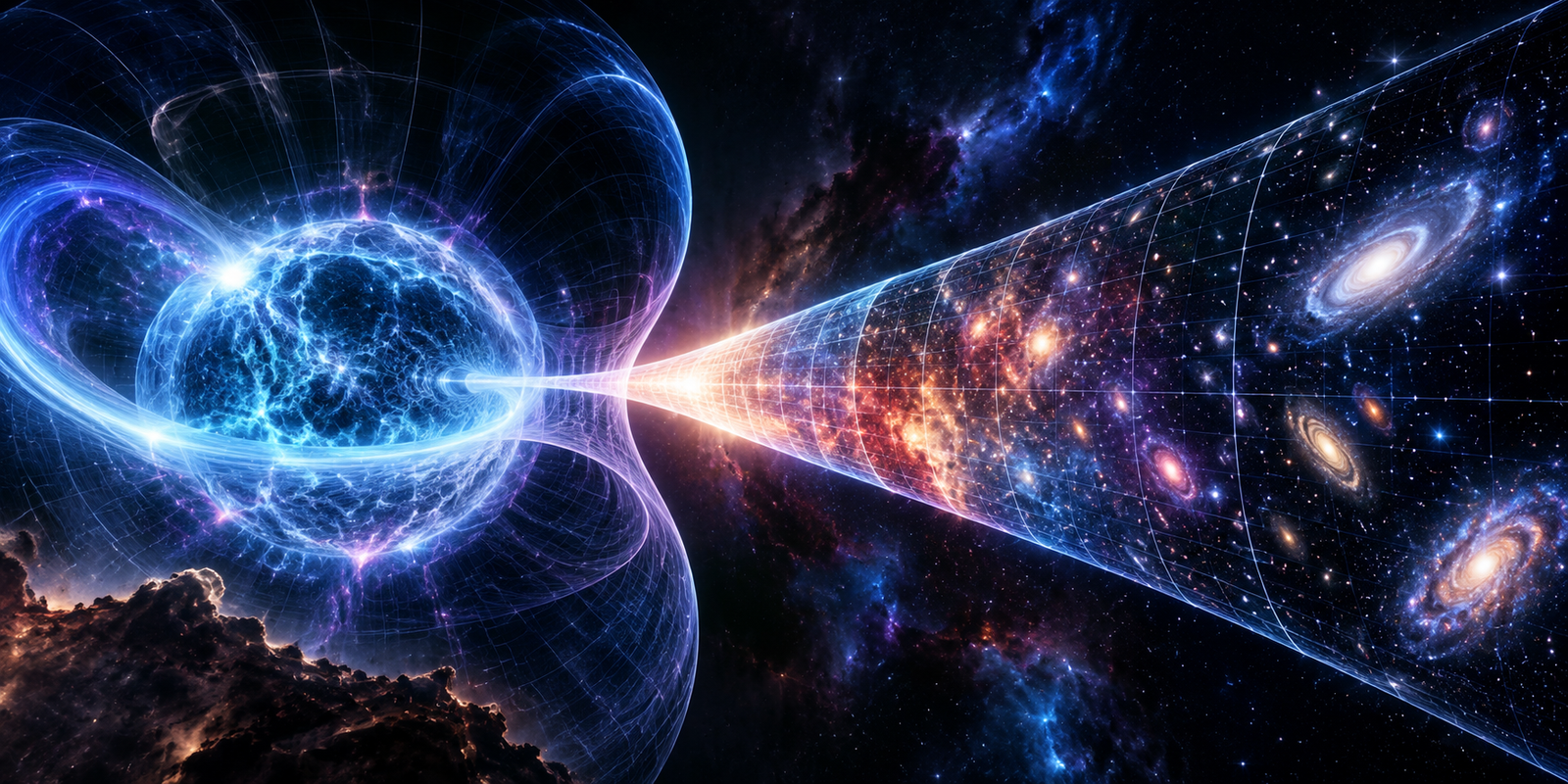
Ever since humanity first gazed up at the night sky, a fundamental question has echoed across philosophy and astrophysics: what existed before the beginning of everything? The standard cosmological model, which posits the birth of the cosmos roughly 13.8 billion years ago from a colossal cosmic expansion, stands as one of the triumphant achievements of modern science. Yet behind its elegant equations and widely accepted graphs lies an uncomfortable paradox: Albert Einstein’s general relativity breaks down completely at time zero.
In Edwin A. Abbott’s 1884 literary classic Flatland, a two-dimensional civilization is fundamentally incapable of conceiving the concept of height. When a three-dimensional sphere passes through their planar world, the inhabitants perceive only mysterious circles that materialize out of nowhere, expand rapidly, and vanish into the void—attributing the event to a miraculous anomaly. Decades later, modern cinema explored similar geometric paradoxes in Christopher Nolan’s Interstellar (2014), where human perceptions of time and space prove hopelessly narrow when confronted with higher spatial dimensions.
What if the birth of our own universe is reality’s equivalent of the 3D sphere visiting Flatland? This is the groundbreaking hypothesis formulated by theoretical astrophysicists at the Perimeter Institute for Theoretical Physics and the University of Waterloo. According to the seminal study on the four-dimensional mirage for the Big Bang origin by researchers Razieh Pourhasan, Niayesh Afshordi, and Robert B. Mann, our three-dimensional universe never originated from an infinite singularity. Instead, our cosmos may be an expanding 3D membrane generated by debris ejected when a massive four-dimensional star collapsed into a black hole within a higher-dimensional bulk.
In this technical essay, you will explore the mathematics underpinning braneworld cosmology, understand why the classical singularity shatters theoretical physics, discover how a 4D star naturally resolves cosmic enigmas without arbitrary patches, and examine why our very existence might be the holographic shadow of a stellar collapse in hyperspace.
1. The Tyranny of the Initial Singularity: Standard Cosmology’s Blind Spot
To grasp the significance of the 4D star theory, one must first confront the unresolved ghost of theoretical physics: the initial gravitational singularity. When early twentieth-century astronomers observed distant galaxies receding in all directions, the mathematical implication derived from general relativity appeared inescapable: if space-time is expanding, running cosmic history in reverse demands that all matter, energy, and space itself were once compressed into a single infinitesimal point.
The Penrose-Hawking Singularity Theorems
During the 1960s, Roger Penrose and Stephen Hawking formalized this deduction in their landmark space-time singularity theorems, proving that classical general relativity leads inevitably to a state of zero volume, infinite mathematical density, and infinite curvature. Epistemologically, when a physical equation yields infinity, nature is not signaling magic; it is warning us that the mathematical model has breached its domain of validity and lost predictive capability.
In practice, the classical Big Bang singularity requires the universe to have emerged from an uncaused state where the laws of physics cease to operate. Einstein’s field equations cannot explain the provenance of primordial matter or the initial boundary conditions. It represents an uncaused beginning—a conceptual wall that modern science seeks to overcome through higher-dimensional geometry and quantum gravity.
The Two Conundrums Demanding Cosmic Fixes
Beyond the singularity itself, the standard Big Bang model harbors two glaring observational paradoxes that compelled cosmologists to engineer the theory of cosmic inflation during the 1980s:
- The Horizon Problem: When space telescopes analyze the cosmic microwave background (CMB) radiation mapped by the European Space Agency’s Planck satellite, they discover that opposite sectors of the sky, separated by tens of billions of light-years, exhibit an identical baseline temperature of 2.725 Kelvin to an accuracy of one part in 100,000. In classical Big Bang physics, there was insufficient time for thermal energy to travel across the cosmos to equilibrate before spatial expansion pulled them apart. How could causally disconnected regions be thermally uniform?
- The Flatness and Isotropy Problem: Why is our observable universe geometrically flat on large scales, and why did primordial matter distribute itself with near-perfect uniformity rather than chaotic clumping?
To rescue the model, Alan Guth and Andrei Linde proposed cosmic inflation: a hypothetical scalar field (the inflaton) that drove exponential superluminal expansion between 10⁻³⁶ and 10⁻³² seconds after the beginning. While mathematically convenient, physicists still do not know what fundamental particle constituted the inflaton, what triggered it, or why it abruptly decayed.
2. The Mechanics of a 4D Star and Braneworld Cosmology
Faced with this theoretical deadlock, astrophysicists Niayesh Afshordi, Razieh Pourhasan, and Robert B. Mann inverted the problem. Rather than inventing ad hoc quantum fields to justify 3D inflation, they grounded their framework in the geometric foundations of string theory and braneworld cosmology.
The Concepts of Bulk and Brane
In high-energy physics, our conventional universe of three spatial dimensions and one time dimension (3+1D) may not encompass total reality. Dimensional unification theories suggest that we inhabit a sub-structure known as a 3-Brane (a three-dimensional spatial membrane), suspended within a higher-dimensional universe termed the Bulk (a hyperspace containing four or more spatial dimensions).
Standard Model particles—photons, electrons, quarks, and gauge bosons forming tangible matter and radiation—are open strings anchored to the surface of our 3-brane. Conversely, gravity consists of closed vibrating loops with no open endpoints. As demonstrated in groundbreaking research on extra-dimensional gravity in the DGP model by Gia Dvali, Gregory Gabadadze, and Massimo Porrati, gravitons can propagate freely across the higher-dimensional bulk, mediating gravitational interactions between adjacent dimensions.
The Geometry of a Four-Dimensional Black Hole
To visualize the dimensional transition formulated by the Perimeter Institute researchers, examine how event horizons behave as spatial dimensions are added to the gravitational metric:
| Spatial Dimensions | Collapsing Object | Event Horizon Geometry | Physical Analogue |
|---|---|---|---|
| 2 Spatial Dimensions (Flatland) | 2D planar stellar disk | One-dimensional (1D) closed line (a circle on a plane) | Planar gravitational boundary |
| 3 Spatial Dimensions (Our Space) | 3D spherical star | Two-dimensional (2D) spherical surface (Schwarzschild area) | Astrophysical black hole (e.g., Sagittarius A*) |
| 4 Spatial Dimensions (The Bulk) | 4D hyperspherical star | Three-dimensional (3D) spherical membrane | Our Observable Universe (The 3-Brane) |
In a standard 3D black hole, the event horizon—the boundary where escape velocity equals the speed of light—is a 2D spherical surface possessing area but zero geometric thickness. When Einstein’s field equations are solved in four spatial dimensions, the mathematical collapse of a massive 4D star in the bulk yields an event horizon with three full spatial dimensions.
Core Conceptual Takeaway
Our universe of galaxies, stars, and planets is neither the interior singularity of the black hole nor the open void of the bulk. Our cosmos is the three-dimensional membrane acting as the event horizon left behind by the collapsing 4D star. When we peer into deep space, we are observing the geometric boundary of a stellar cataclysm that occurred in a higher dimension.
3. How the 4D Star Hypothesis Resolves the Big Bang Paradoxes
The 4D star theory is not merely an exercise in abstract geometry; its explanatory power lies in how naturally it resolves foundational cosmological conundrums without fine-tuned parameters.
Farewell to the Initial Singularity
In standard cosmology, the universe materializes from an unexplained singularity at time zero. In the Afshordi-Pourhasan-Mann model, cosmic expansion was not creation ex nihilo. The matter composing the 4D star already existed within the bulk. Upon gravitational collapse, ejected stellar debris formed a 3D boundary layer that expanded continuously as it absorbed falling mass.
What we observe as the Big Bang was the geometric phase transition of a four-dimensional stellar collapse. The true mathematical singularity remains safely hidden at the center of the 4D black hole in the bulk, while our 3D event horizon emerges smooth, continuous, and free of pathological infinities.
Natural Resolution of the Horizon Problem Without Inflatons
The mystery of why the cosmic microwave background maintains uniform temperature across the sky no longer requires superluminal inflation. Because the progenitor 4D star existed for epochs within the bulk prior to collapse, its internal thermal structure had already achieved complete thermodynamic equilibrium.
When the star succumbed to gravity and spawned the 3D horizon membrane, this homogeneous thermal signature was imprinted directly into our universe. Antipodal regions of our sky share an identical temperature of 2.725 K because they originated from a single progenitor star that had already equilibrated long before our observable universe expanded.
The Illusion of Cosmic Expansion
Within braneworld geometry, observed cosmic expansion represents the physical growth of the 3D event horizon as it stabilizes dynamically and interacts with residual bulk matter. What we perceive as space being generated out of nothingness is the continuous outward propagation of a membrane through hyperspace.
4. Observational Evidence and Empirical Testing
For any theoretical hypothesis to earn scientific legitimacy, it must generate quantitative predictions capable of empirical refutation. The Perimeter Institute team tested their model by contrasting its mathematical predictions against high-precision astrophysical measurements.
Primordial Perturbations in the Cosmic Microwave Background
During the formation of the 3D membrane horizon, quantum fluctuations within the 4D bulk should imprint minute density variations that subsequently seeded galactic clusters. Standard inflation predicts a cosmological parameter known as the scalar spectral index (denoted nₛ) near 0.968.
Calculating the spectral index directly from the first-principles physics of 4D stellar collapse, the Perimeter Institute team derived nₛ ≈ 0.967. This close concordance with empirical data collected by ESA’s Planck satellite demonstrates that the 4D star model reproduces the observed power spectrum without adjusting arbitrary parameters, positioning it as a compelling contender to inflation.
The Challenge of Primordial Non-Gaussianity and Gravitational Waves
Cutting-edge science demands rigorous differentiation. The 4D star model yields distinct signatures regarding primordial non-Gaussianities and tensor perturbations (primordial gravitational waves). While standard single-field slow-roll inflation predicts virtually undetectable non-Gaussianities, braneworld collapse can introduce subtle anisotropic signatures in CMB polarization (B-mode polarization).
Next-generation observatories, including the Simons Observatory in the Atacama Desert and JAXA’s upcoming LiteBIRD space telescope, are engineered to measure these polarization patterns with unprecedented sensitivity. If observational data reveal deviations irreconcilable with standard inflation, the 4D stellar horizon model could shift from an alternative hypothesis to the forefront of modern cosmology.
5. Comparative Matrix: Standard Big Bang vs. 4D Star Model
To synthesize the distinctions between the conventional cosmological framework and four-dimensional braneworld collapse, we present the following epistemological matrix:
| Analytical Dimension | Standard Big Bang Model | 4D Star Collapse (Perimeter Institute) |
|---|---|---|
| State at Time Zero | Singularity of infinite density and temperature where physics fails. | Stable 4D star in the bulk undergoing gravitational collapse. |
| Nature of Our 3D Universe | Space-time manifold expanding from an initial point. | 3D spherical event horizon membrane around a 4D black hole. |
| Origin of Matter and Energy | Unexplained emergence from quantum vacuum fluctuations at Planck time. | Outer envelope debris shed during the 4D stellar implosion in the bulk. |
| Resolution of Horizon Problem | Requires cosmic inflation driven by an unidentified scalar field. | Natural: Progenitor 4D star was already in thermal equilibrium. |
| Location of Singularity | In our temporal past, forming an unavoidable cosmic boundary. | Isolated at the spatial core of the 4D black hole in the bulk. |
| Empirical Observational Fit | Matches Planck satellite data (nₛ ≈ 0.968 through parameter tuning). | Matches Planck satellite data (nₛ ≈ 0.967 from geometric principles). |
6. Philosophical Implications: Are We Inhabitants of a Holographic Shadow?
The 4D star hypothesis intersects with one of theoretical physics’ profound concepts: the Holographic Principle, pioneered by Gerard ‘t Hooft and Leonard Susskind, and formalized by Juan Maldacena via the AdS/CFT correspondence. This principle states that the complete physical description of a bulk volume can be encoded on its lower-dimensional boundary, much like a 2D hologram projects a complete 3D image.
If the Perimeter Institute model holds true, our three-dimensional reality is a geometric projection. We are physical structures composed of atoms confined to the outer event horizon of a defunct star in a wider hyperspace. Every galaxy, mountain, and civilization exists within the debris of a stellar cataclysm that burned in a spatial dimension beyond biological perception.
This perspective mirrors Plato’s classical Allegory of the Cave: prisoners chained inside a cave observe shadows cast on a stone wall by objects moving before a fire, mistaking the 2D silhouettes for ultimate reality. In an analogous manner, our observable cosmos may be the three-dimensional shadow of a four-dimensional thermonuclear furnace that went dark nearly 14 billion years ago in hyperspace.
Conclusion: The Next Frontier in Cosmic Understanding
The proposition that the Big Bang represents the death of a four-dimensional star is not speculative fiction; it is a mathematically grounded formulation developed by leading theoretical physicists to address the most conspicuous vulnerability of modern cosmology. It restores causal determinism, eliminates unphysical infinities, and provides a thermal explanation for cosmic structure.
As gravitational wave detectors and space-based CMB polarimeters refine our view of the early universe, astrophysics may definitively determine whether our cosmos arose from an inexplicable singularity or if we are the descendants of a four-dimensional stellar collapse. Until then, the theory stands as a testament to humanity’s capacity to transcend sensory boundaries and decipher the hidden dimensions of reality through mathematics.
Continue Exploring the Frontiers of the Cosmos
If you are captivated by relativistic astrophysics, black hole mechanics, and the deep architecture of the universe, explore these essential analyses from our library:
- Hub 5: The Definitive Guide to Space Exploration & Mega-Engineering — Discover the comprehensive roadmap linking advanced propulsion, black holes, and humanity’s expansion into the cosmos.
- The Fastest Star in the Galaxy: The Discovery of S301 at 25,000 km/s Around Sagittarius A* — Examine how Einstein’s general relativity is tested near the event horizon of our galactic core.
- Beyond Chemical Rockets: Ion Thrusters, Solar Sails, and Fusion Propulsion — Explore how frontier propulsion physics will enable humanity to cross interstellar distances.
Do you believe our universe is a three-dimensional membrane suspended in higher-dimensional hyperspace, or does standard three-dimensional inflation remain a more compelling model? Share your perspective in the comments below to join the debate on cosmic origins!