
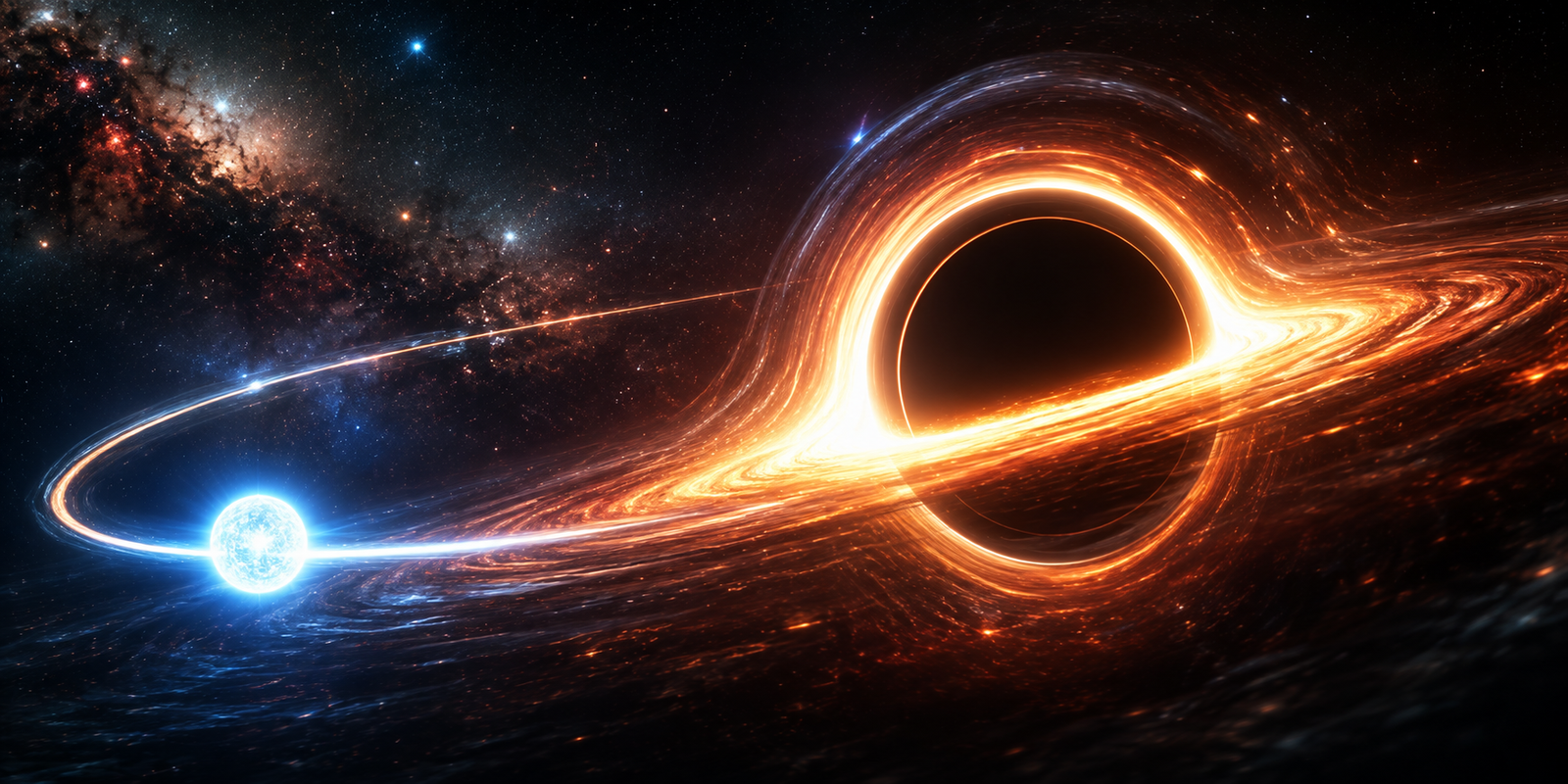
If you watched the acclaimed science fiction masterpiece Interstellar (2014), directed by Christopher Nolan with scientific consultation from Nobel laureate physicist Kip Thorne, you undoubtedly remember the harrowing sequence on Miller’s ocean planet: orbiting perilously close to the event horizon of the supermassive black hole Gargantua, the extreme gravitational field curves spacetime so intensely that every single hour spent on the planet’s surface equals seven full years on Earth.
If your pop culture memories wander across the legendary star routes of Star Wars, Han Solo’s iconic boast of piloting the Millennium Falcon through the hazardous Kessel Run in less than 12 parsecs was fundamentally based on skimming the gravitational event horizons of monstrous black holes in the Maw Cluster. Or consider the realistic astronautics of The Expanse, where gravitational slingshot maneuvers demonstrate how acceleration around massive celestial bodies can propel spacecraft to astronomical velocities.
For over a century, Albert Einstein’s Theory of General Relativity, formulated in 1915, has served as the foundational pillar of modern physics and cosmology. It taught humanity that gravity is not an invisible mechanical force pulling objects across space, but rather the geometric curvature of spacetime itself induced by the presence of concentrated mass and energy.
Yet testing Einstein’s most radical predictions at the extreme boundaries of physics — where gravitational wells are so profound that light cannot escape and time nearly halts — has always required observing natural astrophysical bodies subjected to conditions impossible to engineer in any terrestrial laboratory.
In August 2026, observational astrophysics achieved a historic milestone. Utilizing the European Southern Observatory’s (ESO) Very Large Telescope Interferometer (VLTI) in the Atacama Desert equipped with the upgraded GRAVITY+ instrument, an international consortium of astrophysicists announced the discovery of S301: the fastest and closest star ever detected orbiting the supermassive black hole at the center of the Milky Way (Sagittarius A*).
The orbital metrics of S301 challenge human comprehension: the star completes a full elliptical orbit around the black hole in just 8.7 years and accelerates to an astonishing velocity of 25,000 kilometers per second (approximately 8.5% of the speed of light or 0.085c) at pericenter, passing within just 12 Astronomical Units (12 AU) of the central gravitational singularity (a distance comparable to the separation between Saturn and the Sun).
In this deep dive from Reach Technocracy, we explore the physics of this cosmic laboratory. We will examine the dense S-star cluster at the Galactic Center, dissect S301’s extreme orbital mechanics, analyze relativistic tests of Gravitational Redshift and Schwarzschild Precession, discover how S301 will allow physicists to measure the spin and frame-dragging (Lense-Thirring Effect) of Sagittarius A*, and preview the future of observational cosmology with the upcoming 39-meter Extremely Large Telescope (ELT).
1. The Heart of Darkness: The Gravitational Monolith Sagittarius A* and the S-Star Cluster
Located at the geometric nucleus of the Milky Way, approximately 26,000 light-years from Earth in the direction of the Sagittarius constellation, lies the dynamical engine of our galaxy: Sagittarius A* (Sgr A*).
Sagittarius A* is a Supermassive Black Hole harboring a colossal mass of approximately 4.15 million solar masses, packed into a spatial region smaller than the orbital radius of Mercury.
The extreme gravitational potential of this singularity governs the motion of a unique and tightly packed stellar population known as the S-Star Cluster (S-stars).
What Are the S-Stars?
Unlike the vast majority of stars in the Milky Way — which orbit the galactic center in gentle circular paths requiring more than 200 million years per revolution —, the S-stars are young, massive B-type main-sequence stars trapped in highly eccentric, high-velocity elliptical orbits merely light-days from the event horizon.
For over two decades, the flagship benchmark of this cluster was the famous star S2:
- Monitored by astrophysicists Reinhard Genzel and Andrea Ghez (who received the 2020 Nobel Prize in Physics for proving the existence of the supermassive black hole), S2 completes an orbit every 16 years, reaching pericenter velocities of 7,700 km/s (roughly 2.6% the speed of light).
- In 2018, S2’s close passage confirmed gravitational redshift in complete agreement with General Relativity.
However, astrophysicists recognized that discovering stars orbiting even deeper within the gravitational well would provide the ultimate empirical laboratory for relativistic physics.
That search has now culminated in the discovery of S301.
2. The Extreme Orbital Dynamics of S301: 25,000 km/s and 8.5% of Light Speed
The discovery of S301 shatters all previous velocity records for stars in the Milky Way galaxy.
To put S301’s velocity into perspective:
- A commercial airliner cruises at roughly 900 km/h (0.25 km/s).
- The International Space Station orbits Earth at 7.7 km/s (roughly 27,600 km/h).
- NASA’s Parker Solar Probe, the fastest human-made object in history, achieves top velocities of roughly 190 km/s skimming the solar corona.
- The Earth orbits the Sun at 30 km/s.
The star S301 travels at 25,000 km/s at closest approach to the black hole. This represents 830 times Earth’s orbital velocity and over 100,000 times the speed of a jet airliner. At this rate, S301 could travel from the Earth to the Moon in just 15 seconds and traverse the entire diameter of Earth in half a second.
Key Orbital Parameters of S301
High-precision astrometric measurements collected by the GRAVITY+ consortium reveal an extreme gravitational trajectory:
- Orbital Period: Just 8.7 Earth years to complete a full revolution around Sagittarius A* (nearly half the period of S2).
- Pericenter Distance: Approximately 12 Astronomical Units (12 AU), or roughly 1.8 billion kilometers from the black hole’s center. In our solar system, this is equivalent to the distance between Saturn and the Sun.
- Orbital Eccentricity: Highly eccentric (e > 0.9), meaning the star spends most of its orbital period at distant apocenter before plunging into a steep gravitational free-fall that accelerates it to 8.5% of light speed.
3. Observational Microengineering: The Power of ESO’s GRAVITY+ on the VLTI
Detecting a single faint star 26,000 light-years away through the dense obscuring veil of interstellar dust in the galactic plane is equivalent to distinguishing a one-euro coin on the surface of the Moon from Earth.
This observational feat was made possible by the advanced optical engineering of the European Southern Observatory (ESO) and the GRAVITY+ instrument:
The Very Large Telescope Interferometer (VLTI)
Situated atop Cerro Paranal in Chile, the VLTI combines the coherent infrared light of four 8.2-meter Unit Telescopes. Utilizing subterranean optical delay lines, the system synthesizes a virtual aperture with a baseline resolution equivalent to a 130-meter giant telescope.
Adaptive Optics with Laser Guide Stars
Atmospheric turbulence continuously distorts incoming starlight. GRAVITY+ projects multiple sodium laser beams into the mesosphere, creating artificial “laser guide stars” that allow deformable mirrors to counteract atmospheric blurring over 1,000 times per second.
Near-Infrared K-Band Spectroscopy
Because visible light is completely scattered by dust along the Galactic Center’s line of sight, GRAVITY+ observes in the near-infrared K-band (2.2 micrometers), where interstellar dust becomes transparent, resolving atomic hydrogen and helium absorption lines with micro-arcsecond astrometric precision.
4. The Ultimate Test of Relativity: Gravitational Redshift and Schwarzschild Precession
The close passage of S301 is not merely an astronomical curiosity; it represents the most stringent empirical stress test of Einstein’s General Relativity ever conducted in nature.
Newtonian mechanics predicted that bound two-body orbital systems must trace closed, static ellipses. General Relativity predicts three distinct relativistic departures:
Gravitational Redshift and Relativistic Time Dilation
As S301 plunges deep into Sagittarius A*’s gravitational well, photons emitted from its photosphere must expend energy to climb out of the spacetime curvature toward Earth.
As photons lose energy, their observed wavelengths are stretched toward the red end of the spectrum. Simultaneously, Special Relativistic Time Dilation causes atomic processes on the star to run slower relative to terrestrial clocks. S301’s spectral data provides unambiguous verification of this combined relativistic redshift ($z$) at 0.085c.
Relativistic Pericenter Precession (The Rosette Orbit)
Under General Relativity, the point of closest approach (the pericenter) does not remain stationary in space; rather, the orbital ellipse rotates continuously, tracing a rosette pattern over successive orbits.
While in Mercury’s orbit this Schwarzschild precession amounts to a subtle 43 arcseconds per century around the Sun, S301’s extreme proximity induces a massive precession of several degrees per 8.7-year orbit, confirming the non-Newtonian geometry of the Schwarzschild metric.
5. The Grand Prize: Measuring Black Hole Spin and the Lense-Thirring Frame-Dragging Effect
The holy grail of black hole astrophysics for the coming decade — brought within reach by S301’s discovery — is the direct measurement of Sagittarius A*’s Spin (Angular Momentum).
In theoretical physics, a rotating black hole is governed by the Kerr Metric (derived by mathematician Roy Kerr in 1963).
A rotating black hole does not merely curve space; it drags the very fabric of spacetime around with its rotation, creating a gravitational whirlpool. This relativistic phenomenon is known as Frame-Dragging or the Lense-Thirring Effect.
Why S301 Unlocks the Lense-Thirring Effect
The magnitude of frame-dragging diminishes rapidly with distance (proportional to 1/r^3). Distant stars like S2 were too far out to register this frame-dragging perturbation.
By passing within just 12 AU of Sagittarius A*, S301’s orbital plane experiences a measurable relativistic nodal precession and orbital tilt directly caused by the black hole’s Kerr spin.
Tracking S301 across its orbital trajectory will allow physicists to:
- Constrain the Dimensionless Spin Parameter (a*): Determine the exact rotational velocity of Sagittarius A*’s event horizon (ranging from 0 for a static Schwarzschild black hole to 1 for a maximally rotating Kerr black hole).
- Test the No-Hair Theorem: Verify the foundational cosmological principle that astrophysical black holes are fully characterized by only two observable properties: mass and angular momentum.
6. Conclusion: A Cosmic Waltz at the Edge of Infinity
For millennia, human civilization looked toward the Galactic Center as a faint glowing band of cosmic dust across the night sky. Today, through the convergence of optical interferometry and relativistic mathematics, we can peer into the heart of the galaxy with breathtaking clarity.
The star S301 is more than a record-breaking celestial object; it is an intrepid natural probe navigating the precipice of the event horizon, transmitting empirical proof of how space, time, and gravity intertwine at the outer limits of existence.
With the upcoming commissioning of the Extremely Large Telescope (ELT) — featuring a colossal 39-meter primary mirror —, observational astrophysics will track S301 with unprecedented spatial resolution, unlocking the final gravitational secrets of the black hole that anchors our galactic home.
At Reach Technocracy, we will remain dedicated to analyzing every interferometric image, spectral dataset, and cosmological discovery that expands the boundaries of human knowledge.
Are you astonished by S301’s 25,000 km/s orbital speed around the central black hole? What do you think we will learn once scientists confirm the exact spin of Sagittarius A*? Share this article with your network of astronomy and space science enthusiasts, and leave your thoughts in the comments below!
🔭 Continue Exploring the Frontier of Science and Technology: