
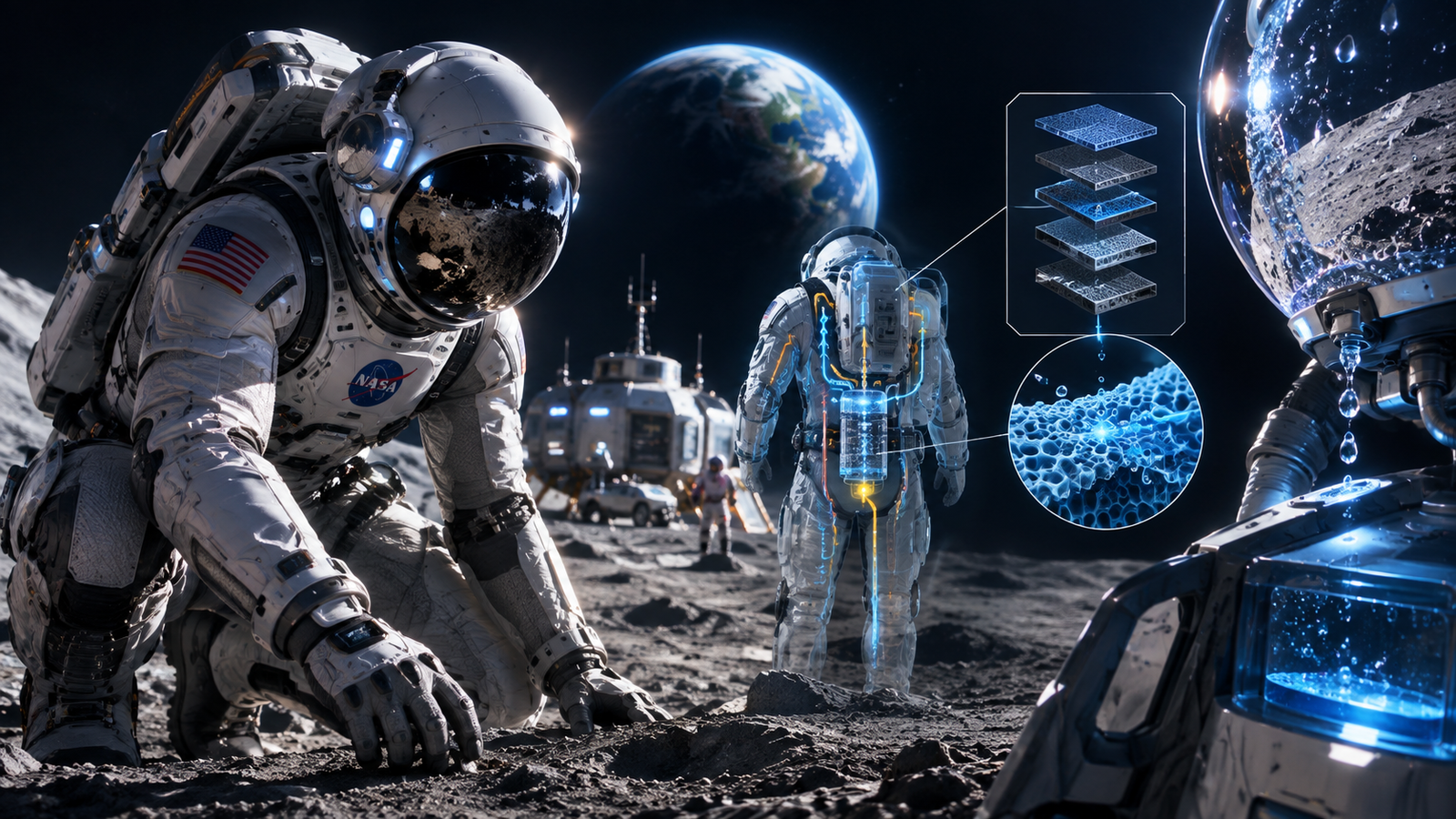
Across the scorched deserts of Arrakis, where humidity hovers near absolute zero and a single drop of water is prized above human life, the Fremen engineered the ultimate technology of biological survival: the Stillsuit. Conceived by author Frank Herbert in his 1965 masterpiece Dune and brought to visceral cinematic life by director Denis Villeneuve, the suit wraps the human body in an intricate micro-sandwich of high-efficiency filtration layers. Powered by the wearer’s natural walking motion through heel-driven pumps, the stillsuit captures every breath, perspiration, and urine, purifying these wastes into potable water. As the Fremen leader Liet-Kynes famously observed: with a suit in good working order, its wearer loses no more than a thimbleful of moisture a day.
For nearly six decades, this engineering marvel seemed confined to science fiction lore. Yet beyond fiction, humanity faces a wasteland far more unforgiving than the dunes of Arrakis: the vacuum of deep space. During extravehicular activities (EVAs) spanning 8 to 12 continuous hours, astronauts confront an uncomfortable and technically hazardous reality that space agencies rarely publicize: to manage biological waste, they still rely on disposable adult diapers lined with sodium polyacrylate—an archaic method introduced in the late 1970s that squanders vital water and poses severe clinical risks.
That primitive dependency may soon end. In a scientific breakthrough reminiscent of the laboratories of Arrakis, a team of researchers from Cornell University and Weill Cornell Medicine has engineered the first functional, real-life stillsuit for space exploration. Detailed in seminal research on advanced in-suit waste management and water recovery published in the journal Frontiers in Space Technologies by researcher Sofia Etlin and colleagues, the system collects, desalinates, and purifies 500 milliliters of urine in just five minutes, delivering clean, electrolyte-enriched drinking water directly to the astronaut’s helmet.
In this technical essay, you will discover the membrane osmosis engineering powering this breakthrough, examine the physiological constraints that rendered space diapers a critical bottleneck for lunar and Martian exploration, contrast Frank Herbert’s literary vision with modern bioengineering, and understand why closing the biological water loop is fundamental to sustaining human life on alien worlds.
1. The Hidden Reality of Spacesuits: The Historical Failure of the Space Diaper
When observing iconic photographs of Apollo astronauts traversing the lunar regolith or live footage of crew members floating outside the International Space Station (ISS), one might assume modern spacesuits are completely autonomous life-support sanctuaries. NASA’s Extravehicular Mobility Unit (EMU) is indeed a personal spacecraft: it provides pressurized oxygen, multi-layer thermal insulation against temperature swings from -150 °C to +120 °C, and micrometeoroid shielding.
The Archaic Legacy of the MAG (Maximum Absorbency Garment)
Yet in the domain of biological waste management, spacesuit technology has remained virtually unchanged for nearly fifty years. Since the inception of the Space Shuttle program in 1978, astronauts undertaking EVAs have worn the MAG (*Maximum Absorbency Garment*). The MAG is essentially an oversized adult diaper packed with sodium polyacrylate, a superabsorbent polymer capable of absorbing hundreds of times its weight in liquid.
While long tolerated as a necessary evil, the operational and clinical drawbacks of the MAG have grown untenable as mission horizons expand:
- Dermatitis and Recurrent Infections: Remaining tightly sealed within a pressurized suit for 8 to 12 hours while working vigorously in direct contact with a damp diaper causes severe skin maceration, contact dermatitis, and recurrent urinary tract infections (UTIs)—a complication that disproportionately affects female astronauts.
- Degradation of Cognitive Focus and Comfort: Physical discomfort, persistent chafing, and odor undermine an astronaut’s psychological composure during high-stakes maneuvers where handling tools in microgravity requires flawless precision.
- Critical Water Waste: A human body excretes between 400 and 800 milliliters of urine during an 8-hour work shift, alongside substantial perspiration. During current spacewalks, 100% of this water is discarded, while the astronaut relies on a static In-suit Drink Bag holding merely 0.9 liters—a volume frequently insufficient to prevent physical dehydration during strenuous tasks.
The Astronomical Cost of Water on Artemis Missions
While the ISS orbits just 400 kilometers above Earth and utilizes the centralized ECLSS (*Environmental Control and Life Support System*) to reclaim 98% of onboard moisture via vapor compression distillation, future lunar missions cannot rely on rapid orbital resupply. Landing payload mass on the lunar South Pole carries an estimated cost of 50,000 to 100,000 dollars per kilogram. Discarding biological water during extended expeditions across shadowed polar craters represents an unacceptable logistical inefficiency.
2. The Engineering of Cornell’s Stillsuit: Osmosis and Nanotechnology
Confronting this logistical barrier, Cornell researchers abandoned passive absorption garments and adopted Frank Herbert’s core principle: the human body must function as a closed-loop biological engine. The prototype engineered by Sofia Etlin’s team combines microfluidics, high-sensitivity sensors, and dual-stage membrane filtration into a module weighing only 8 kilograms.
The Automated Anatomical Collection Interface
To understand the system’s operation and prevent a common biological misconception, one must distinguish how sweat is handled compared to urine. During an EVA, bodily perspiration from an astronaut’s torso and limbs does not pass through the silicone collection cup. Instead, sweat evaporates into the suit’s pure oxygen atmosphere and is circulated through the Liquid Cooling and Ventilation Garment (LCVG). This continuous gas flow routes water vapor to condensation plates within the Portable Life Support System (PLSS) backpack, where it is dehumidified. Cornell’s 2024 prototype focuses its active filtration on the most challenging, concentrated fluid fraction: the immediate capture, drainage, and desalination of liquid urine.
The primary hurdle was capturing urine at the moment of excretion without allowing prolonged contact with the skin. The team designed an external collection cup made from flexible medical-grade silicone, engineered in distinct geometric forms to fit male and female anatomies securely.
The inner face of the cup features an antimicrobial absorbent liner integrated with a radio-frequency identification (RFID) moisture sensor. Within milliseconds of liquid detection, the sensor transmits a signal that triggers an external micro-vacuum pump. The pump rapidly draws urine away from the body through sealed polyurethane tubing before moisture can cause epidermal irritation.
The Physics of Separation: Forward Osmosis (FO) and Reverse Osmosis (RO)
Once captured, the fluid enters the core of the stillsuit: a sequential semipermeable membrane assembly that mimics renal function at the nanoscale, building upon research on NASA advanced water filtration membranes:
How Two-Stage Osmotic Purification Works
Stage 1 — Forward Osmosis (FO): Raw urine flows across one side of a polyamide membrane with sub-nanometer pores. On the opposite side, a concentrated draw solution containing biocompatible electrolytes circulates. The natural osmotic pressure gradient draws pure water molecules across the membrane, completely rejecting proteins, urea, creatinine, microorganisms, and heavy salts without demanding energy-intensive high-pressure pumping.
Stage 2 — Reverse Osmosis (RO): The diluted draw solution is subsequently driven by a compact mechanical pump exerting pressure higher than the osmotic threshold, forcing water through a second ultrafiltration membrane. This final barrier strips residual draw solutes, producing demineralized water matching NASA’s rigorous potable purity standards.
Remineralização and Electrolyte Fortification
Drinking demineralized water during intense physical exertion can cause dilutional hyponatremia, dangerously depleting an astronaut’s serum electrolytes. To counteract this, the recovered water passes through a post-treatment cartridge that reintroduces calibrated ratios of sodium, potassium, and magnesium. The resulting electrolyte beverage is pumped directly into the helmet’s hydration straw for on-demand consumption.
3. Performance Metrics and Energy Efficiency: The Stillsuit in Numbers
To validate the system beyond computational simulations, the Cornell team subjected the prototype to rigorous bench testing replicating spacesuit operating conditions. The empirical findings demonstrated remarkable operational efficiency:
| Performance Parameter | Current Suit (NASA EMU / MAG) | Stillsuit Prototype (Cornell 2024) | Operational Leap |
|---|---|---|---|
| Processing Speed | Not applicable (waste discarded) | 500 ml purified in 5 minutes | Real-time fluid recycling |
| Water Recovery Efficiency | 0% (trapped inside diaper polymer) | 87% purified water yield | Net fluid resource generation |
| Effluent Water Purity | None | Conductivity < 100 μS/cm (NASA Potable Grade) | 99.99% urea and pathogen elimination |
| Module Mass | ~0.5 kg (dry to saturated diaper) | 8.0 kg (complete integrated system) | Mounts onto PLSS backpack |
| Form Factor | Standard absorbent undergarment | 38 cm x 23 cm x 23 cm | Fits Artemis AxEMU backpack envelope |
| Hydration Autonomy | Static 0.9 L in-suit bag | Continuous sustainable 24-hour cycle | Drastic mitigation of dehydration risks |
Consuming only tens of watts supplied by spacesuit avionics batteries, the unit offsets its 8-kilogram launch penalty by eliminating the need to transport heavy redundant water reserves during multi-day planetary surface missions.
4. The Technological Showdown: Frank Herbert vs. Modern Bioengineering
Contrasting Frank Herbert’s 1965 fictional masterpiece with Cornell’s 2024 functional prototype reveals how visionary science fiction often foreshadows genuine technological breakthroughs. Herbert accurately recognized that surviving in extreme environments demands fusing human metabolic regulation with active thermodynamic filtration.
Where Frank Herbert Proved Prescient
- Closed-Loop Metabolism: The realization that the most dependable water source in an arid void is that which the human body naturally expels hour by hour.
- Selective Membrane Filtration: Herbert envisioned the stillsuit as a tiered micro-sandwich of porous fabrics separating salts and waste through micro-gradients—the very principle governing modern forward osmosis membranes.
- Direct In-Helmet Delivery: Channeling recycled moisture straight to a drinking straw mounted near the mouth for immediate rehydration.
Where Reality Diverges from Fiction
While Herbert’s imagination was profound, certain mechanisms conceived for Arrakis clash with physical realities that Cornell engineers had to solve differently:
In Dune, the stillsuit relies entirely on kinetic power: pumps embedded in the boots are driven by the heel-strike of walking. In reality, the mechanical force exerted by footsteps under fractional lunar gravity (one-sixth of Earth) or Martian gravity (one-third) is irregular and insufficient to sustain the constant pressures required for reverse osmosis. Modern engineering relies on compact electric actuators powered by high-density lithium-ion cells.
Furthermore, Herbert’s Fremen suits claimed to process solid fecal matter within in-suit reclamation pads. In current aerospace biotechnology, extracting moisture from human feces within a wearable 8-kilogram garment presents biohazard contamination and membrane fouling obstacles that remain unsolved. Consequently, NASA and Cornell focused on urine and perspiration, which together account for over 90% of bodily water loss.
5. The Stillsuit’s Role in the Artemis Program and the Journey to Mars
The real-world deployment of Cornell’s stillsuit prototype is an active engineering milestone. Under NASA’s Artemis campaign, astronauts will establish a permanent presence near the lunar South Pole, beginning with the crewed Artemis III landing.
Next-Gen Spacesuits: Axiom Space’s AxEMU
Axiom Space, contracted by NASA to deliver the next-generation AxEMU (*Axiom Extravehicular Mobility Unit*), has prioritized active waste management. The external envelope of Cornell’s prototype was deliberately built to match the equipment volume of the Portable Life Support System (PLSS) on Artemis suits.
On the lunar surface, astronauts will conduct arduous geological surveys within permanently shadowed craters where temperatures drop to -240 °C, requiring up to 10-hour EVAs far from pressurized habitats. Real-time water reclamation and rapid waste extraction ensure astronauts maintain peak physiological performance, preventing mission-aborting medical complications where immediate evacuation is impossible.
The Proving Ground for the Red Planet
The true proving ground for closed-loop spacesuit technology will be the first human expedition to Mars in the 2030s. On a three-year round-trip mission hundreds of millions of kilometers from Earth, survival logistics are unforgiving: every gram of payload spared and every liter of water recovered widens the margin of survival. Cornell’s stillsuit marks the initial step toward transforming human explorers into true cosmic nomads, capable of navigating Martian dust plains with the self-sufficiency of Fremen across the deep desert.
6. Comparative Matrix: Proven Lab Science vs. Open Engineering Challenges
To establish a clear epistemological boundary between what has been proven in the laboratory and the technical hurdles remaining before lunar flight certification, consider the following matrix:
| Technological Domain | Empirical Laboratory Fact (2024) | Open Operational Challenge |
|---|---|---|
| Osmotic Filtration | 87% potable water recovery from real urine in 5 minutes. | Membrane biofouling and durability under cosmic ionizing radiation. |
| Collection Interface | Silicone cups with millisecond RFID moisture-triggered vacuum drainage. | Ensuring dynamic hermetic seal during extreme torso flexion and slope climbing. |
| Thermal Management | Efficient fluid heat exchange at ambient test temperatures. | Preventing fluid freezing within exterior lines under the -150 °C lunar shadow. |
| Power Consumption | Operates on micro-pumps driven by commercial battery packs. | Optimizing energy draw during long walks without draining primary suit life support. |
| Fecal Waste Management | Feces excluded to preserve compact 8-kilogram form factor. | Future development of miniature bioreactors for full solid biological recycling. |
Conclusion: The Triumph of Sci-Fi Inspired Bioengineering
The creation of the first functional stillsuit by Cornell University stands as a striking testament to science fiction’s role as a catalyst for technological progress. When Frank Herbert conceived the Fremen survival suit in 1965, he was doing more than crafting a narrative device; he was articulating a fundamental biophysical truth: human survival in resource-starved frontiers demands the absolute recirculation of matter.
Today, as the Artemis program prepares to return astronauts to the lunar surface and chart the path to Mars, aerospace medicine and engineering have caught up with Herbert’s imagination. By retiring archaic space diapers and transforming human metabolic waste into refreshing drinking water within minutes, these advanced spacesuits prove that our future among the stars depends on mastering the closed-loop cycles of life. When astronauts take their first steps across the red sands of Mars, they will be shielded by biological armor that carries the conceptual lineage of Arrakis.
🔭 Continue Exploring the Frontier of Science and Technology
If you are fascinated by life support bioengineering, frontier propulsion, and the long-term conquest of space, explore these core analyses from our library:
- Hub 5: The Definitive Guide to Space Exploration & Mega-Engineering — Discover the comprehensive roadmap linking interstellar propulsion, cryogenic optics, and solar system settlement.
- Beyond Chemical Rockets: Ion Thrusters, Solar Sails, and Fusion Propulsion — Explore how advanced thrust technologies will shorten the voyage to Mars from months to weeks.
- Hub 4: The Definitive Guide to Frontier Energy — Learn about high-density solid-state batteries and compact fusion reactors designed to power future habitats.
Would you drink water recycled from your own urine during an expedition across the Moon or Mars, or does the psychological barrier remain too daunting? Share your thoughts and join the debate in the comments below!