
In Robert Zemeckis’ immortal cinematic masterpiece Back to the Future (1985–1989), Doc Brown’s iconic DeLorean time machine initially relies on weapons-grade refined plutonium to generate its temporal displacement. In the second film, set in the futuristic landscape of 2015, Doc Brown upgrades the vehicle with the legendary home reactor Mr. Fusion—a compact converter capable of fusing banana peels and stale beer to instantaneously generate a colossal 1.21 Gigawatts of clean power without toxic radioactive residue.
Across the Marvel Cinematic Universe, in Iron Man (2008), the young industrialist Tony Stark survives captivity in an Afghan cave by forging the first miniaturized Arc Reactor—a self-contained fusion powerplant pumping infinite clean energy into his chest electromagnet and powering supersonic combat armor. In Christopher Nolan’s Interstellar (2014), the survival of the human species following catastrophic agricultural blight hinges upon gravitational manipulation and tapping cosmic energy around spinning supermassive black holes. In The Matrix (1999), the existential war between humanity and synthetic intelligence culminates when humans “scorch the sky” to sever the machines’ solar power, forcing the AI to convert billions of human bodies into bioelectric and thermal batteries. And in James Cameron’s Avatar (2009), humanity’s interstellar military-industrial complex voyages light-years to the alien moon Pandora driven by the economic desperation of mining Unobtainium—a room-temperature superconductor vital to sustaining the crumbling energy infrastructure of a depleted Earth.
Beneath these enduring pop-culture allegories lies the most fundamental law of physical reality: energy is the universal currency of the cosmos and the absolute prerequisite for every stage of civilizational development. As formulated by astrophysicist Nikolai Kardashev in the celebrated Kardashev Scale, the evolutionary milestone of any technological civilization is measured exclusively by its capacity to capture, convert, and deploy raw power.
For the past two centuries, human civilization has operated in a precarious transitional infancy (Kardashev Type 0.7), depending almost entirely on combustion of finite fossil hydrocarbons—coal, petroleum, and natural gas. This paradigm has released gigatons of greenhouse gases into the atmosphere, strained planetary ecological stability, and sparked geopolitical conflicts over regional reserves. While modern weather-dependent renewables (terrestrial solar PV and wind) have expanded, they face the insurmountable thermodynamic barriers of intermittent generation and low spatial power density, rendering them incapable of single-handedly providing the uninterrupted, dispatchable baseload power (24/7/365) demanded by artificial intelligence supercomputing clusters, heavy metallurgy, chemical synthesis, and electrified megacities.
However, in 2026, humanity stands at the dawn of the Age of Thermodynamic Abundance.
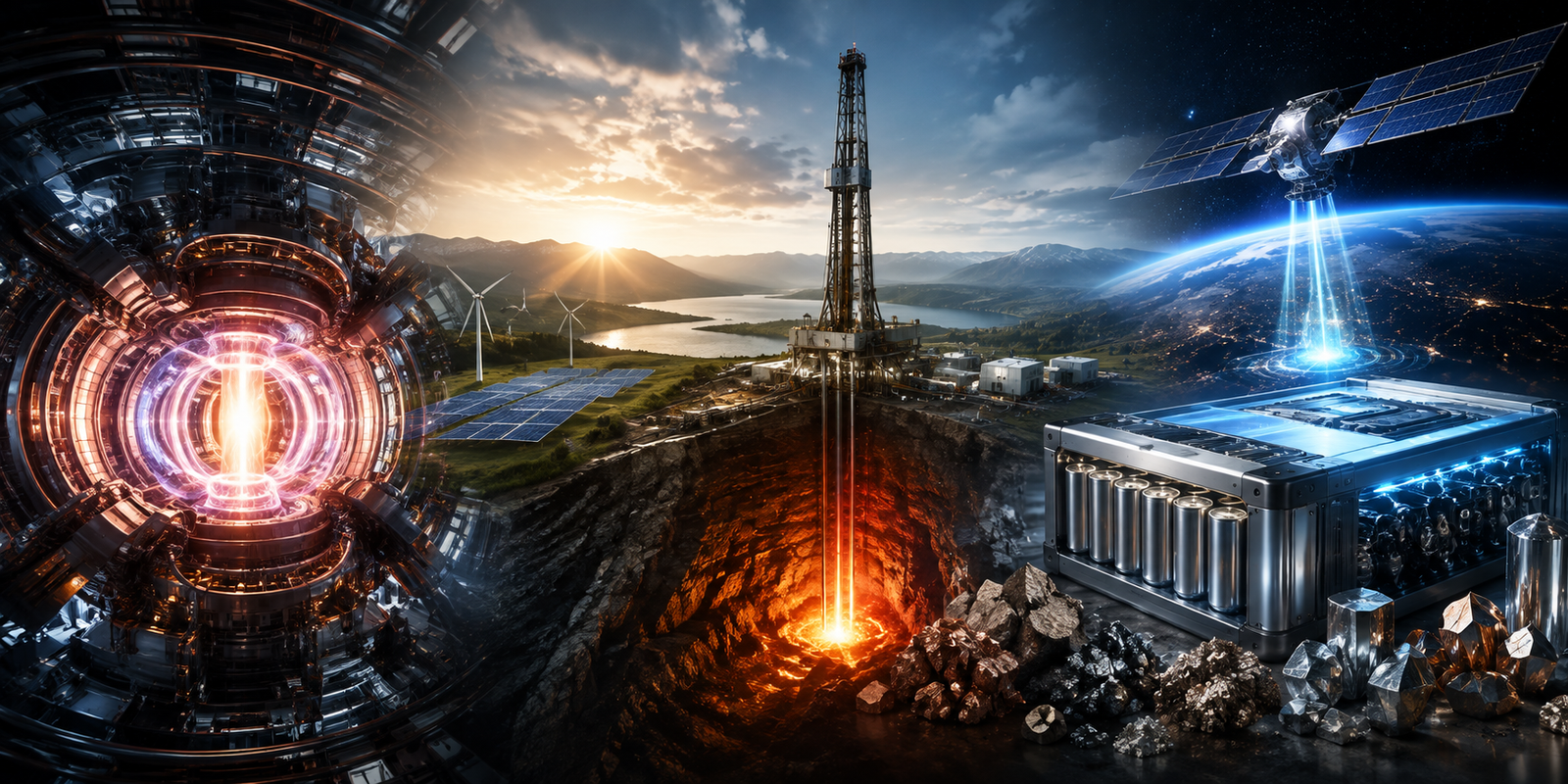
Frontier physics, solid-state electrochemistry, and advanced materials engineering have dismantled historic technological bottlenecks. Nuclear Fusion reactors operating via magnetic and inertial confinement have surpassed the net energy gain threshold (Q > 1), domesticating the power of the stars on Earth; deep-drilling technologies powered by Millimeter-Wave Gyrotrons vaporize crystalline basalt and granite at depths of 10 to 20 kilometers to access inexhaustible Superhot Rock Geothermal Energy anywhere on the globe; Solid-State and Sodium-Ion Batteries shatter the geopolitical stranglehold of the lithium supply chain; the 17 Rare Earth Elements (REEs) are being repurposed through AI-guided metallurgy and circular closed-loop recycling; and orbital Space-Based Solar Power (SBSP) satellites in geostationary orbit prepare to beam continuous microwave electricity down to terrestrial grids 24 hours a day, 365 days a year.
This master document serves as the Official Topic Hub (Hub 4) of Reach Technocracy for the Frontier Energy, Deep Geothermal, Advanced Storage, and Strategic Materials ecosystem. Here you will find the definitive roadmap uniting all our advanced investigations: from the first stable deuterium-tritium burning plasmas to post-lithium electrochemistry, deep-crust drilling physics, and the geopolitics of critical minerals.
Curated Reading Paths (Choose Your Track)
To maximize the strategic value of this master guide according to your technical background, investment focus, and operational goals, select your recommended reading path:
- 🟢 Track 1: The Clean Energy Enthusiast
Focus: Foundational physics principles, pop-culture conceptual models (Mr. Fusion, Iron Man, Avatar), demystification of nuclear myths, and the humanitarian vision of global energy abundance.
Suggested Route: Introduction ➜ Prerequisites Glossary ➜ Chapters 1, 2, and 3 ➜ Fact vs. Sci-Fi Matrix ➜ Conclusion. - 🔵 Track 2: The Energy Engineer, Physicist & System Architect
Focus: Plasma physics, Lawson criterion equations, supercritical thermodynamics, electrochemical impedance spectroscopy in solid-state cells, X-ray diffraction, and lanthanide magnetic anisotropy.
Suggested Route: Executive Key Takeaways across all chapters ➜ Chapters 1 through 5 in full ➜ Access all connected In-Depth Spoke Essays ➜ Epistemological Matrix. - 🟣 Track 3: The Deep-Tech Executive, Policy Maker & Investor
Focus: Levelized Cost of Electricity (LCOE), industrial scalability, CAPEX/OPEX for SMRs and superhot geothermal repowering, rare earth supply chain geopolitics, and the 2026–2035 Strategic Technology Roadmap.
Suggested Route: Executive Key Takeaways ➜ Chapters 2, 3, and 4 ➜ Chapter 7 (Roadmap) ➜ Download the Full Executive Dossier (PDF).
Fundamental Prerequisites & Key Concepts
Frontier energy physics operates upon rigorous thermodynamic, nuclear, and electrodynamic foundations. Below are the six essential conceptual pillars:
- Energy Density & Einstein’s Equation (E = mc²): The measure of usable energy released per unit mass of fuel. While the chemical combustion of 1 kg of bituminous coal yields approximately 24 Megajoules (MJ) of energy, the nuclear fission of 1 kg of Uranium-235 yields 80 million MJ, and the nuclear fusion of 1 kg of Deuterium-Tritium releases an astounding 340 million MJ—representing an energy density 14 million times greater than any fossil fuel.
- Magnetic Confinement (Tokamaks & Stellarators) vs. Inertial Confinement (Lasers/NIF): The two dominant pathways to fuse light atomic nuclei. Magnetic Confinement employs toroidal helical magnetic fields generated by High-Temperature Superconducting (HTS) magnets to suspend a burning plasma at over 100–150 million degrees Celsius away from vessel walls. Inertial Confinement utilizes high-energy ultraviolet laser pulses to spherically compress and implode a millimetric fuel capsule in billionths of a second, recreating stellar interior pressures and densities.
- Baseload Power (24/7/365) vs. Renewable Intermittency: Baseload refers to continuous, dispatchable, and highly reliable electricity generation that stabilizes the grid regardless of weather conditions, cloud cover, seasonal wind calms, or droughts. Advanced nuclear fission, fusion, and deep superhot rock geothermal are the only zero-carbon energy sources capable of delivering high-density baseload power with an ultra-compact land footprint.
- Supercritical Water & Millimeter-Wave Gyrotron Drilling: Water transitions into a thermodynamic supercritical state when subjected to temperatures exceeding 374 °C and pressures above 22.1 Megapascals (MPa). In this hybrid state between liquid and gas, supercritical water transports up to 10 times more thermal enthalpy per cubic meter than conventional hydrothermal steam. Gyrotrons generate directed high-frequency millimeter-wave electromagnetic beams (30 to 300 GHz) that vaporize hard crystalline rock without mechanical contact, unlocking depths of 10 to 20 km where deep earth heat is universally accessible.
- Solid-State Electrolytes vs. Sodium-Ion Electrochemistry: Conventional lithium-ion batteries rely on flammable liquid organic solvent electrolytes prone to dendrite short-circuits and thermal runaway. Solid-State Batteries (ASSB) replace liquid electrolytes with solid inorganic ceramics or sulfides, enabling pure lithium-metal anodes exceeding 500 Wh/kg. Sodium-Ion Batteries substitute expensive lithium, cobalt, and nickel with abundant, low-cost sodium salts, serving as the ideal chemistry for massive stationary grid storage.
- Lanthanide Contraction & The 17 Rare Earth Elements (REEs): The suite of 17 metals in the periodic table (scandium, yttrium, and the 15 lanthanides including neodymium, dysprosium, praseodymium, and terbium). Due to the poor electrostatic shielding of the inner 4f subshell, these elements exhibit an anomalous contraction of ionic radii across the series, bestowing exceptional magnetic dipole strength, luminescence, and catalytic stability indispensable for high-performance NdFeB permanent magnets in wind turbines, EV motors, and humanoid robotics.
Dynamic Timeline of the Energy Revolution
- Phase 1 (1942–1973: From First Artificial Fission to the Global Oil Shock):
– 1942: Enrico Fermi and his team build Chicago Pile-1, achieving the world’s first controlled artificial nuclear fission chain reaction.
– 1951: The EBR-I reactor in Idaho generates the world’s first usable nuclear electricity.
– 1958: Soviet physicists Igor Tamm and Andrei Sakharov formulate the Tokamak magnetic confinement concept.
– 1973: The Global Oil Embargo exposes the fragility of industrial economies dependent upon fossil fuels. - Phase 2 (1974–2020: The Lithium-Ion Boom and Megascale Fusion Facilities):
– 1980–1991: John Goodenough, Stanley Whittingham, and Akira Yoshino develop and commercialize the first rechargeable lithium-ion battery.
– 1997: The JET tokamak in the UK sets a historic fusion record of 16 MW thermal power (Q ≈ 0.67).
– 2006: International ratification and construction launch of the ITER (International Thermonuclear Experimental Reactor) in Cadarache, France.
– 2018: Quaise Energy spins out of the MIT Plasma Science and Fusion Center to commercialize deep gyrotron drilling. - Phase 3 (2021–2026: The Critical Inflection Point — Fusion Ignition, HTS Magnets, and Commercial Sodium-Ion):
– December 2022: The National Ignition Facility (NIF) at Lawrence Livermore National Laboratory achieves historic Fusion Ignition (Q > 1), producing 3.15 MJ from 2.05 MJ of laser energy.
– 2024: Commonwealth Fusion Systems (CFS/MIT) validates 20-Tesla High-Temperature Superconducting (HTS) magnets, enabling fusion reactors 40 times smaller in volume.
– 2025: Global battery manufacturers (CATL, BYD) scale multi-gigawatt factory lines for sodium-ion batteries in passenger EVs and grid storage.
– 2026: Quaise Energy commences field pilot tests of millimeter-wave rock vaporization; Microsoft Quantum and PNNL operate the AI-discovered N2116 solid-state battery. - Phase 4 (2027–2035: The Frontier of Global Thermodynamic Abundance):
– 2027–2029: First commercial repowering of retired coal-fired power plants with superhot rock geothermal steam wells, preserving transmission and turbine assets.
– 2030–2032: First commercial modular fusion pilot reactors (CFS SPARC, Helion, Tokamak Energy) feeding clean baseload power into national grids.
– 2033–2035: Terrestrial rectenna arrays receiving continuous gigawatt-scale orbital power from Space-Based Solar Power (SBSP) satellites; complete decarbonization of global baseload power.
1. The Quest for the Energy of the Stars: Nuclear Fusion vs. Advanced Fission
📌 Chapter Key Takeaways:
1. Nuclear fusion unites light hydrogen isotopes (Deuterium and Tritium) at over 100 million °C, producing harmless helium, zero carbon emissions, and zero meltdown risk.
2. Surpassing the scientific ignition threshold (Q > 1) at NIF and the commercial maturation of 20-Tesla HTS magnets accelerated modular fusion timelines by over a decade.
3. Advanced 4th-generation Small Modular Reactors (SMRs) complement the clean energy transition through passive safety and recycling existing nuclear waste inventories.
For nearly a century, nuclear energy was bifurcated in the public imagination between cold-war weaponization and catastrophic reactor failures like Chernobyl and Fukushima. However, nuclear physics encompasses two fundamentally antithetical processes:
- Classical Nuclear Fission: The splitting of heavy, unstable actinide nuclei (such as Uranium-235 or Plutonium-239) via thermal neutron capture. While exceptionally energy-dense and free of greenhouse gas emissions, traditional 2nd and 3rd generation fission reactors require continuous active cooling against decay heat and produce long-lived minor actinides requiring deep geological repositories.
- Nuclear Fusion (The Mechanism of the Stars): The forced coalescence of ultralight atomic nuclei—primarily the hydrogen isotopes Deuterium (²H) and Tritium (³H)—under temperatures exceeding 150 million degrees Celsius (ten times hotter than the core of the Sun). Upon overcoming Coulomb electrostatic repulsion, they fuse to yield a Helium-4 (⁴He) nucleus, a high-energy neutron (14.1 MeV), and massive thermal energy:
D + T → ⁴He (3,5 MeV) + n (14,1 MeV)
The Insuperable Thermodynamic Advantages of Fusion
Nuclear fusion represents the ultimate energetic frontier of physical science for three decisive reasons:
- Inexhaustible and Geopolitically Ubiquitous Fuel: Deuterium is distilled directly from ordinary seawater (where 33 grams exist per cubic meter—sufficient to power human civilization for billions of years). Tritium is bred directly within the reactor blanket through neutron capture reactions with natural lithium (⁶Li + n → ⁴He + T).
- Inherent Passive Safety (Zero Meltdown Risk): Unlike a fission core containing tons of enriched radioactive fuel in a supercritical chain reaction, a fusion tokamak chamber contains less than five grams of active plasma fuel at any given second. Any operational anomaly, vacuum breach, or magnetic fluctuation immediately quenches the plasma in microseconds, terminating the reaction passively.
- Zero Long-Lived Radioactive Waste: The direct reaction byproduct is non-toxic, non-radioactive inert helium gas. While structural plasma-facing materials undergo neutron activation, advanced low-activation ferritic alloys decay to safe background recycling levels in less than 50 to 100 years.
The Lawson Triple Product and the 20-Tesla HTS Breakthrough
To sustain thermonuclear fusion, the burning plasma must satisfy the Lawson Criterion—the triple product of ion density (n), plasma temperature (T), and energy confinement time (τE):
n · T · τE ≥ 3 × 10²¹ keV·s/m³
Historically, achieving this product required gigantic toroidal vacuum vessels, exemplified by the 23,000-ton ITER facility. The decisive technological leap of the 2020s was the industrialization of Rare-Earth Barium Copper Oxide (REBCO) High-Temperature Superconducting (HTS) tapes operating at 20 Kelvin to generate steady magnetic fields exceeding 20 Tesla.
Because the volumetric power density of a fusion plasma scales with the fourth power of the magnetic field (P ∝ B⁴), doubling magnetic field strength allows a reactor to achieve identical fusion power output in a vessel 40 times smaller in volume. This breakthrough has enabled commercial ventures like Commonwealth Fusion Systems’ SPARC reactor to target net electricity delivery to the grid before 2030 at a fraction of historical capital expenditures.
🔬 IN-DEPTH TECHNICAL ESSAY:
To explore the physics of inertial laser compression at NIF, spherical tokamaks, and comparative Levelized Cost of Electricity (LCOE), read our complete analysis:
👉 Nuclear Fusion vs. Nuclear Fission: The Quest for the Energy of the Stars
2. Superhot Rock Geothermal: Drilling the Earth with Gyrotrons for 24/7 Energy
📌 Chapter Key Takeaways:
1. Superhot Rock Geothermal (SHR) extracts inexhaustible deep crustal heat at over 400 °C, producing supercritical water with 10 times the energy density of conventional geothermal steam.
2. Millimeter-wave Gyrotron drilling replaces wearable mechanical drill bits with directed electromagnetic energy that vaporizes hard crystalline basement rock down to 20 km.
3. The technology enables the direct repowering of existing coal-fired power plants, utilizing existing steam turbines, generators, and transmission grids without new surface infrastructure.
While astrophysicists gaze at the stars for fusion, beneath our feet lies one of the largest thermodynamic engines in the solar system: the core and mantle of the Earth. The planet’s interior holds a thermal reservoir equivalent to billions of years of global civilizational power demand, fueled by primordial gravitational accretion heat and continuous radioactive decay of uranium, thorium, and potassium isotopes in the crust.
Yet for over a century, conventional hydrothermal geothermal energy remained confined to rare, volcanically active tectonic boundaries (such as Iceland, California, and New Zealand) where shallow permeable aquifers (< 3 km) produce warm steam (150 °C to 200 °C). Across 95% of the Earth’s continental landmass, vast thermal energy is locked beneath impenetrable layers of ultra-hard crystalline granite and basalt basement rock.
The Mechanical Limit and the Kola Superdeep Borehole Barrier
For decades, deep drilling engineering stalled against the Mechanical Limit of Polycrystalline Diamond Compact (PDC) Drill Bits. As mechanical bits drill past 5 to 7 km, ambient temperatures exceed 250 °C to 300 °C and lithostatic confining pressures exceed hundreds of megapascals. Mechanical steels soften, synthetic diamond cutters shear, drilling muds boil, and penetration rates plummet to mere inches per hour.
The ultimate demonstration of this barrier was the Soviet Union’s Kola Superdeep Borehole in the Arctic: after more than two decades of grueling mechanical drilling, the project halted at a record depth of 12,262 meters, where extreme plastic rock deformation and 180 °C heat rendered further mechanical progress physically impossible.
The Gyrotron Revolution: Contactless Directed-Energy Rock Vaporization
The engineering solution to penetrate the deep crust without mechanical tool wear originated at the MIT Plasma Science and Fusion Center and is led commercially by Quaise Energy:
- The Gyrotron Beam Principle: The system employs megawatt-class high-power vacuum electron tubes (Gyrotrons) that convert electricity into continuous directed beams of Millimeter-Wave Electromagnetic Energy (30 GHz to 300 GHz)—the identical high-frequency physics developed to heat plasma in fusion tokamaks.
- In-Situ Vaporization and Vitrification: The millimeter-wave beam is guided down a hollow waveguide into the borehole. Upon striking crystalline basalt or granite at depth, the extreme electromagnetic power density heats the rock past its melting point to over 2,000 °C to 3,000 °C, vaporizing the mineral matrix instantly. The surrounding rock vitrifies into a smooth, self-sealing glass liner that prevents borehole collapse without expensive steel casing. A continuous purge of compressed inert nitrogen gas evacuates vaporized ash to the surface in seconds.
- Penetration Rates 10 to 50 Times Faster: With zero physical contact, zero friction, and no drill bits to pull out for replacement, millimeter-wave drilling maintains steady penetration rates of tens of meters per hour, making it possible to reach depths of 10 to 20 kilometers within weeks anywhere on Earth.
The Holy Grail of Supercritical Water and Coal Plant Repowering
At depths of 10 to 20 km, crustal rock temperatures reach between 400 °C and 500 °C. Circulating water through these engineered fractures produces Supercritical Water:
- Supercritical water neither boils nor condenses; it exists in a single dense phase combining the solvent properties of a liquid with the expansion velocity of a gas, carrying up to 10 times more enthalpy per unit volume than conventional geothermal steam.
- A single pair of superhot geothermal wells can power an electric turbine generating 50 to 100 MW of continuous baseload electricity with a surface footprint smaller than a city block.
- The Ultimate Decarbonization Shortcut (*Coal Repowering*): Quaise Energy’s business model involves drilling superhot wells directly adjacent to Existing Coal-Fired Power Stations. The polluting coal boilers are permanently retired, while clean supercritical geothermal steam is piped directly into the existing steam turbines, cooling towers, electrical transformers, and high-voltage transmission lines. This repurposes trillions of dollars in existing utility assets while eliminating 100% of emissions.
🔬 IN-DEPTH TECHNICAL ESSAY:
To explore the thermodynamics of supercritical fluid enthalpy, gyrotron waveguide physics, and deep-drilling pilot benchmarks, read our complete analysis:
👉 Superhot Rock Geothermal: Millimeter-Wave Drilling That Will Unlock Limitless 24/7 Energy
3. The Electrochemical Revolution: Solid-State Batteries, Sodium-Ion, and the End of the Lithium Bottleneck
📌 Chapter Key Takeaways:
1. Solid-state batteries replace volatile liquid electrolytes with inorganic solid conductors, enabling pure lithium-metal anodes with energy densities exceeding 500 Wh/kg and 10-minute fast-charging.
2. Sodium-ion (Na-Ion) chemistry leverages earth-abundant materials, eliminating cobalt and nickel bottlenecks to democratize utility-scale stationary grid storage.
3. AI-driven materials discovery models (such as Microsoft/PNNL’s N2116 solid electrolyte) have compressed the discovery cycle of new solid ionic conductors from decades to months.
For over thirty years, since Sony commercialized the first rechargeable lithium-ion cell in 1991, consumer electronics and modern electric vehicles relied on the same fundamental chemistry: transition metal oxide cathodes (NMC/LFP), intercalated graphite anodes, and a liquid electrolyte composed of lithium salts dissolved in flammable organic carbonates.
While this architecture catalyzed the digital age and early EV adoption, it has converged on hard physical and safety limits:
- Volumetric and Gravimetric Ceilings: Commercial liquid lithium-ion cells have plateaued near 250 to 300 Wh/kg, restricting EV driving range and proving insufficient for heavy trucking, maritime transport, and regional aviation.
- Catastrophic Thermal Runaway: Under mechanical puncture, high overpotential charging, or lithium dendrite short-circuits, liquid electrolytes undergo violent, self-sustaining exothermic combustion that is notoriously difficult to extinguish.
- Geopolitical Supply Chain Vulnerabilities: Critical cathode metals like lithium, cobalt, and nickel suffer from extreme geographic concentration, volatile spot pricing, and severe environmental footprints during refining.
All-Solid-State Battery (ASSB) Architectures
The definitive paradigm shift in electrochemical storage replaces liquid solvents with a Solid Inorganic Electrolyte (utilizing ceramic oxides, crystalline sulfides, or advanced solid polymers):
- Pure Lithium-Metal Anodes: Because dense solid electrolytes mechanically suppress dendrite penetration, the bulky graphite host matrix can be eliminated in favor of an ultra-thin sheet of Pure Lithium Metal. This slashes anode volume by over 50%, elevating cell-level gravimetric energy density to 450–600 Wh/kg (exceeding 1,000 Wh/L).
- 10-Minute Extreme Fast Charging (XFC): The high thermal stability of solid sulfide electrolytes allows operation under elevated current densities without gas generation or boiling risks, enabling 10% to 80% charge cycles in under 10 to 15 minutes at high-power DC chargers.
- Multi-Thousand Cycle Lifespans: Solid-state cells withstand over 3,000 to 5,000 deep discharge cycles while retaining over 80% capacity, ensuring that EV battery packs comfortably outlast vehicle chassis lifespans beyond one million miles.
Sodium-Ion (Na-Ion) Electrochemistry: Democratizing Grid Storage
While solid-state lithium-metal batteries dominate high-performance automotive and aerospace applications, Sodium-Ion (Na-Ion) Batteries have emerged as the definitive solution for Utility-Scale Stationary Energy Storage Systems (BESS):
- Geological Abundance & Low Cost: Sodium is the sixth most abundant element in the Earth’s crust (distilled endlessly from sea salt, NaCl), costing less than 1% to 2% of the price of refined battery-grade lithium carbonate.
- Noble-Metal-Free Cathodes: Na-ion batteries utilize Prussian Blue analogs or layered transition metal oxides paired with hard carbon anodes and inexpensive aluminum current collectors on both cathode and anode (eliminating expensive copper foil).
- Extreme Low-Temperature Resilience: Sodium-ion cells retain over 90% of their discharge capacity at frigid temperatures down to -20 °C to -30 °C, solving the winter range collapse that plagues conventional lithium chemistries.
- Zero-Volt Transport Safety: Unlike lithium batteries that must be shipped with hazardous residual charge, sodium-ion cells can be fully discharged to 0.0 Volts for completely safe global transport and storage with zero ignition risk.
🔬 IN-DEPTH TECHNICAL ESSAY:
To explore sulfide electrolyte synthesis, lithium dendrite electrodeposition physics, and utility-scale sodium-ion cycle test benchmarks, read our complete analysis:
👉 The Solid-State and Sodium-Ion Battery Revolution: The End of Lithium Dependency?
4. The Invisible Gold of the Digital Age: The Critical Geopolitics of the 17 Rare Earth Elements
📌 Chapter Key Takeaways:
1. The 17 Rare Earth Elements (REEs) are the indispensable invisible backbone of electric drivetrains, offshore wind turbine generators, defense avionics, and optical telecommunications.
2. Lanthanide contraction gives 4f-subshell elements unmatched magnetic coercivity and optical luminescence that cannot be replicated by common metals.
3. The geographic concentration of chemical separation and refining represents the supreme geopolitical chokepoint of the global clean energy transition.
In James Cameron’s Avatar, humanity journeys light-years to Pandora seeking the fictional mineral Unobtainium. In the real 21st century, the transition to clean energy, high-performance robotics, and advanced defense systems does not depend on alien minerals, but on a unique group of 17 metals in the periodic table: the Rare Earth Elements (REEs).
Contrary to their historical name, rare earths are not geologically scarce in the Earth’s crust; elements like Cerium and Neodymium are more abundant than lead and silver. Their “rarity” stems from their extreme geochemical dispersion: they rarely concentrate in pure mineral veins, instead existing as minute fractions locked inside complex ores (such as bastnäsite and monazite), making their chemical extraction and separation one of the most complex hydrometallurgical challenges in modern engineering.
The Quantum Mechanics of the Lanthanide Contraction
The extraordinary physical properties of rare earth elements originate in their quantum electronic configurations. Across the 15 lanthanides (from Lanthanum, atomic number 57, to Lutetium, 71), successive electrons enter the inner 4f subshell, while the outermost valence electrons (6s) remain constant.
Because diffuse f-orbitals provide imperfect electrostatic shielding of the increasing positive nuclear charge, the outer valence shell experiences an escalating effective nuclear attraction, pulling the electron clouds inward and systematically decreasing atomic and ionic radii across the series—a quantum phenomenon known as the Lanthanide Contraction:
- Super-Strength Permanent Magnets (NdFeB): Sintered alloys combining Neodymium (Nd), Iron (Fe), and Boron (B), dopadas com Disprosio (Dy) e Terbio (Tb), exhibit a Maximum Energy Product (BHmax) exceeding 50 MGOe—over ten times stronger than traditional ferrite magnets. These magnets are indispensable for direct-drive offshore wind generators, EV traction motors, and humanoid robot actuators.
- Photonic Lasers and Global Telecommunications: Erbium (Er) emite luz en la longitud de onda de 1.550 nanómetros (la ventana de mínima atenuación de la fibra óptica), siendo el núcleo de los amplificadores ópticos (EDFA) que impulsan el tráfico global de internet a través de cables submarinos. Yttrium (Y) e Europium (Eu) alimentan pantallas cuánticas y fósforos de alta resolución.
The Geopolitical Bottleneck of Chemical Separation
The critical vulnerability of the rare earth supply chain lies not in raw mining, but in Multi-Stage Liquid-Liquid Solvent Extraction. Because neighboring lanthanide ions possess nearly identical chemical ionic radii and identical +3 oxidation states, separating neodymium from praseodymium or dysprosium from terbium requires hundreds of sequential mixer-settler tanks utilizing aggressive organic extractants and concentrated acids.
Currently, the People’s Republic of China controls over 60% of global rare earth mining and over 90% of chemical refining and sintered NdFeB magnet manufacturing. This strategic asymmetry has prompted Western nations to enact critical mineral mandates (such as the US Defense Production Act and the European Critical Raw Materials Act) to finance domestic solvent-extraction facilities, pioneer bacterial bio-leaching, and establish Closed-Loop Circular Magnet Recycling from end-of-life wind turbines and electric drivetrains.
🔬 IN-DEPTH TECHNICAL ESSAY:
To explore the quantum mechanics of 4f orbital shielding, industrial solvent extraction flowsheets, and the geopolitical economics of critical minerals, read our complete analysis:
5. Space-Based Solar Power (SBSP) and Orbital Harvesting Mega-Structures
📌 Chapter Key Takeaways:
1. Space-Based Solar Power (SBSP) captures unfiltered solar irradiance in the vacuum of space, operating with solar flux up to 8 times greater than on Earth’s surface.
2. Wireless power transmission beams clean electricity continuously through terrestrial clouds and rain via 2.45 GHz or 5.8 GHz microwave frequencies.
3. The exponential collapse of space launch costs via fully reusable heavy-lift launch vehicles makes megawatt- and gigawatt-scale orbital solar arrays economically viable.
In Isaac Asimov’s seminal 1941 short story Reason, astronauts Powell and Donovan manage an orbital solar station whose sole mission is to harvest intense extraterrestrial sunlight and beam it flawlessly down to Earth’s energy grids via high-power directed energy beams.
In the real 21st century, Space-Based Solar Power (SBSP) has emerged as the ultimate orbital complement to terrestrial baseload power. On Earth, solar photovoltaic generation is fundamentally constrained by the day-night cycle, seasonal tilt, and atmospheric scattering by clouds, aerosols, and humidity—which attenuate between 50% and 70% of incident solar irradiance.
The Physics of Orbital Harvesting and Microwave Transmission
An SBSP orbital station operates in Geostationary Orbit (GEO) at an altitude of 35,786 kilometers, remaining permanently fixed over its designated terrestrial receiver:
- Uninterrupted Solar Irradiance (1.361 W/m²): In space, solar flux is continuous for over 99% of the year (experiencing brief shadow periods only during equinox eclipses). Free from atmospheric absorption, high-efficiency Gallium Arsenide (GaAs) multi-junction photovoltaic panels generate up to 8 to 10 times more electricity per square meter than identical panels on Earth.
- Coherent Microwave Power Beaming: Onboard power electronics convert direct-current solar electricity into radiofrequency energy using phased arrays of Gallium Nitride (GaN) solid-state power amplifiers. The beam is transmitted at 2.45 GHz or 5.8 GHz—frequencies within the atmospheric transparency window where clouds, rainstorms, and dust attenuate less than 2% of the power beam.
- Terrestrial Rectifying Antennas (Rectennas): On the ground, the microwave beam is intercepted by an array of dipole antennas and Schottky barrier diodes that convert microwave RF directly back into high-voltage DC electricity with conversion efficiencies exceeding 85% to 90%. Because the power density of the expanded beam is capped at safe levels (~250 W/m², similar to midday sunlight), the beam poses zero thermal danger to passing aircraft or wildlife.
The Launch Cost Collapse and Autonomous Robotic In-Orbit Assembly
The singular historical barrier that prevented SBSP deployment in the 1970s was the prohibitive cost of space launch: lifting a 10,000-ton gigawatt-class solar station with expendable rockets cost hundreds of billions of dollars. The advent of fully reusable super-heavy launch vehicles (such as SpaceX Starship and Blue Origin New Glenn) has compressed orbital launch costs toward $100 to $200 per kilogram.
Major international programs—including the European Space Agency’s SOLARIS Initiative, JAXA in Japan, NASA, and Caltech’s Space Solar Power Project (SSPD-1)—have validated in-orbit wireless power transfer, ultralight deployable structures, and autonomous robotic assembly, establishing orbital power as an active pillar of humanity’s future clean energy infrastructure.
🔬 IN-DEPTH TECHNICAL ESSAY:
To explore rectenna diode array physics, phased-array beamforming algorithms, and the engineering roadmaps of ESA’s SOLARIS and Caltech’s SSPD-1, read our complete analysis:
👉 Space-Based Solar Power (SBSP): How Giant Satellites Will Beam Electricity to Earth 24/7
6. Fact vs. Hypothesis vs. Science Fiction Matrix
| Energy Dimension | 🟢 Proven Fact (State of the Art 2026) | 🟡 Scientific Hypothesis (In Active Trials) | 🔴 Science Fiction & Cultural Myths |
|---|---|---|---|
| Nuclear Fusion | Net energy gain (Q > 1) achieved at NIF; 20-Tesla HTS superconducting magnets validated (MIT/SPARC). | Commercial fusion reactors maintaining continuous steady-state plasma with Q > 10 feeding the grid. | Tabletop cold fusion reactors operating at room temperature with zero confinement or radiation. |
| Deep Geothermal | Basalt rock vaporization via high-power gyrotron millimeter-wave beams validated in laboratory rigs (Quaise). | Continuous deep field drilling to 20 km depths with sustained extraction of 500 °C supercritical fluids. | Deep crustal drilling triggering catastrophic runaway tectonic destabilization and continental earthquakes. |
| Next-Gen Batteries | Commercial sodium-ion batteries in multi-gigawatt automotive production; solid-state cells exceeding 500 Wh/kg. | Solid-state lithium-metal batteries achieving 5-minute fast-charging at sub-$50/kWh cost parity. | Magical perpetual chemical batteries that never degrade and store infinite energy with zero thermal dissipation. |
| Rare Earth Elements | NdFeB permanent magnets enabling electric drivetrains with >95% efficiency; closed-loop circular recycling. | Complete commercial substitution of dysprosium and neodymium with synthetic iron-nitride nanolattices. | Alien minerals (Unobtainium) required to solve terrestrial clean energy transition bottlenecks. |
| Space Solar Power | In-orbit wireless microwave power transmission demonstrated in low Earth orbit (Caltech SSPD-1). | Gigawatt-scale modular GEO solar stations assembled by autonomous swarm robotics beaming to rectennas. | Orbital solar microwave beams functioning as catastrophic death rays incinerating surface cities. |
| Grid & Baseload | Hyperscale AI data centers contracting clean 24/7 nuclear power (SMRs and dedicated nuclear PPAs). | Continental power grids running 100% on intermittent renewables without any dispatchable baseload assets. | Perpetual motion power generation violating the laws of thermodynamics and conservation of energy. |
7. Strategic Planetary Energy Roadmap (2026–2035)
Short-Term Horizon (2026–2027): Field Validation and Pilot Plant Deployment
- Quaise Gyrotron Field Trials: Completion of the first commercial millimeter-wave drilling field demonstrations in deep crystalline rock to 3–5 km depths, verifying rapid penetration rates.
- Multi-Gigawatt Sodium-Ion Grid Rollout: Deployment of utility-scale sodium-ion battery energy storage systems (BESS) across North America, Europe, and Asia for grid peak shaving.
- SPARC Reactor Plasma Operations: Commonwealth Fusion Systems (CFS) initiates plasma confinement trials with 20-Tesla HTS magnets, targeting Q > 2 net energy demonstration.
Medium-Term Horizon (2028–2030): Grid Connections and Thermal Power Repowering
- First Superhot Geothermal Coal Repowering: Commercial grid connection of the first retired coal-fired power station converted to supercritical geothermal steam, injecting 100 MW of clean baseload.
- Commercial Solid-State EV Fleets: Mass-market commercial rollout of solid-state battery packs in premium electric vehicles, delivering over 1,000 km of real-world driving range per charge.
- First Commercial Fusion Grid Pilot: Modular fusion pilot plants (CFS, Helion Energy, Tokamak Energy) delivering initial megawatts of clean electricity to corporate compute customers.
Long-Term Horizon (2031–2035): The Era of Continuous Thermodynamic Abundance
- Global Scale of Superhot Rock Geothermal: Hundreds of deep geothermal facilities operating globally, providing ultra-low-cost, inexhaustible baseload power across every continent.
- First Commercial Space Solar Power Satellites: Deployment of first-generation megawatt-scale SBSP constellations delivering orbital solar power to remote islands and disaster relief zones.
- Decisive Decarbonization of Industrial Baseload: Complete phase-out of fossil baseload generation replaced by fusion power, superhot geothermal, and solid-state/sodium-ion grid storage.
Conclusion: The Era of Thermodynamic Abundance
Throughout human history, the availability of energy dictated the boundaries of the possible. Human and animal muscle power constrained ancient agriculture; timber harvesting deforested continents in the Middle Ages; and the combustion of coal and petroleum enabled industrialization at the cost of planetary climate stability.
The convergence of Nuclear Fusion, Superhot Rock Geothermal, Solid-State & Sodium-Ion Electrochemistry, Advanced Rare Earth Metallurgy, and Space-Based Solar Power closes the era of energetic scarcity. We are advancing toward a civilization where clean, dispatchable, and continuous power ceases to be an expensive, rationed resource, transforming into an abundant universal utility as ubiquitous as the air we breathe.
At Reach Technocracy, we remain dedicated to demystifying the physical laws governing this energy transition. The future belongs to societies that master thermodynamics—and the age of abundance has already begun.
Frequently Asked Questions (FAQ Indexable for SEO/GEO)
1. What is the fundamental difference between nuclear fission and nuclear fusion?
Nuclear fission splits heavy, unstable atomic nuclei (such as Uranium-235) to release energy, producing long-lived radioactive waste and requiring continuous active cooling to prevent core meltdowns. Nuclear fusion forces light hydrogen isotopes (Deuterium and Tritium) together under extreme heat and pressure to form harmless helium, releasing up to four times more energy per unit mass than fission with zero meltdown risk and inexhaustible fuel extracted from ordinary seawater.
2. What is Superhot Rock Geothermal and why is it superior to conventional geothermal?
Conventional geothermal depends on rare, shallow hydrothermal aquifers (< 200 °C) in volcanic regions. Superhot Rock Geothermal (SHR) drills 10 to 20 km deep anywhere on Earth using directed-energy millimeter-wave Gyrotrons to tap dry rock at 400 °C to 500 °C. This produces supercritical water, which carries up to 10 times more energy density per cubic meter than conventional geothermal steam, enabling massive baseload power from a minimal surface footprint.
3. Why are solid-state batteries considered the Holy Grail for electric vehicles?
Solid-state batteries replace flammable liquid organic electrolytes with non-combustible inorganic solid conductors, allowing the use of pure lithium-metal anodes. This doubles energy density to over 500 Wh/kg (enabling EV driving ranges over 1,000 km), completely eliminates fire risks from thermal runaway, and supports 10-minute extreme fast-charging without dendrite degradation.
4. How can sodium-ion batteries compete with lithium if they have lower energy density?
Sodium-ion batteries utilize abundant table salt (NaCl) and cheap aluminum foils, costing a fraction of lithium cells while operating with 100% safety down to -30 °C. While their energy density (~160 Wh/kg) is lower than solid-state lithium, it is more than sufficient for utility-scale stationary grid storage (BESS) and urban electric vehicles where raw pack weight is not the primary constraint.
5. How does Space-Based Solar Power (SBSP) safely beam electricity to Earth?
Satellites in geostationary orbit collect continuous sunlight in space and convert electricity into coherent microwave beams at 2.45 GHz or 5.8 GHz. These microwaves pass through rain, clouds, and storms with less than 2% loss and are captured on the ground by rectifying antenna arrays (Rectennas), which convert microwaves back into AC/DC electricity with over 85% efficiency at safe, non-ionizing power densities similar to natural sunlight.
Continue Exploring the Frontier of Science and Technology
- Nuclear Fusion vs. Nuclear Fission: The Quest for the Energy of the Stars — Magnetic confinement physics and SPARC tokamak engineering.
- Superhot Rock Geothermal: Millimeter-Wave Drilling — How directed-energy gyrotrons unlock 24/7 baseload heat.
- The Solid-State and Sodium-Ion Battery Revolution — Post-lithium electrochemistry for transport and grid storage.
- The Invisible Gold of the Digital Era: Rare Earths — The quantum mechanics and refining geopolitics of the 17 REEs.
- Space-Based Solar Power (SBSP) — Geostationary solar harvesting and microwave rectenna beaming.
- Hub 1: The Definitive Guide to Artificial Intelligence — From LLMs and Multi-Agent Systems to Physical AI.
- Hub 2: The Definitive Guide to Quantum Computing — Qubits, Silicon Photonics, and Post-Quantum Cryptography.
- Hub 3: The Definitive Guide to Biotechnology — CRISPR, mRNA Vaccines, Neuralink, and Longevity.