
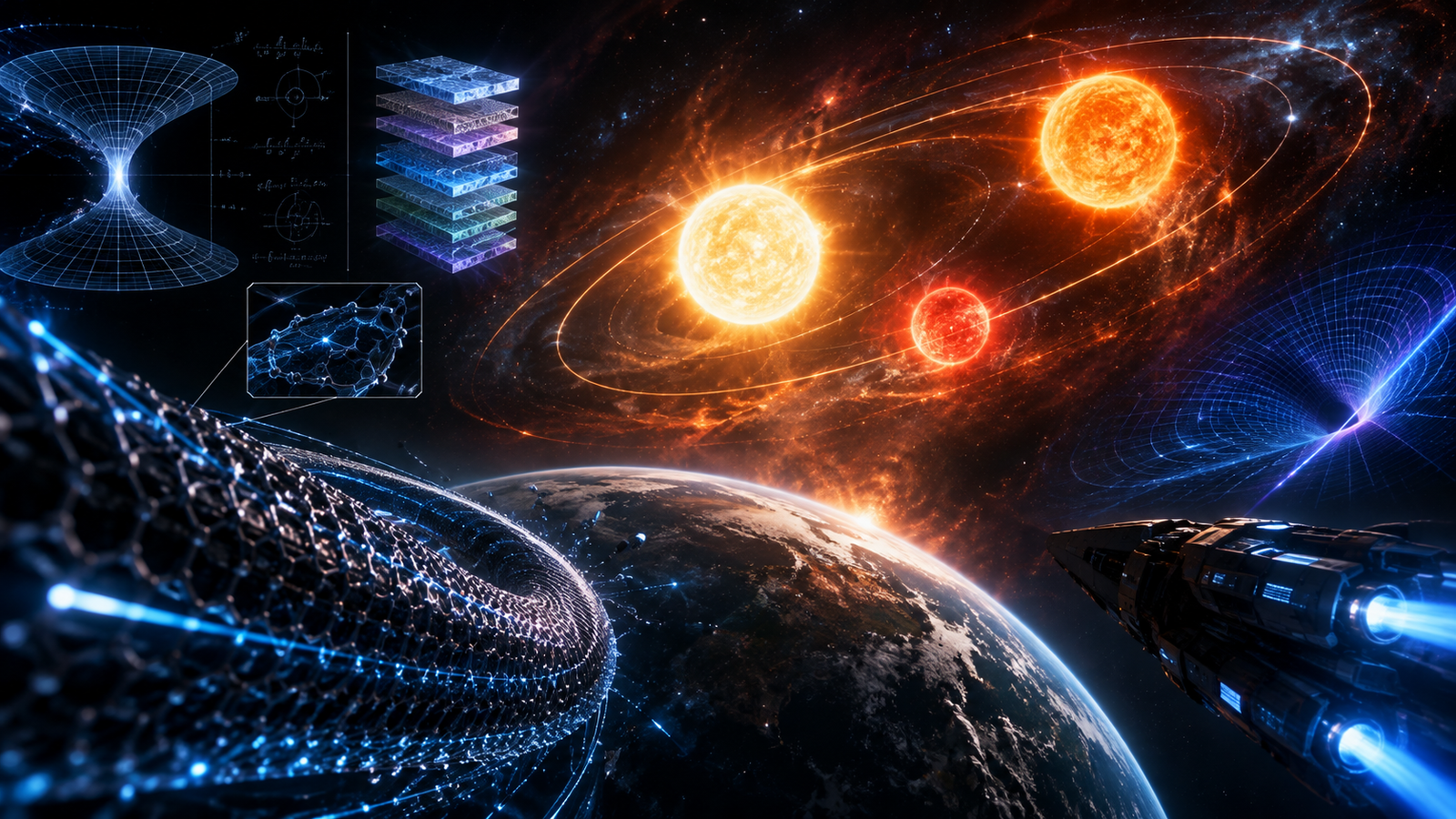
In the history of science fiction literature, few works have challenged human certainty with the intensity of The Three-Body Problem, the seminal masterpiece by Chinese author Liu Cixin that sparked the acclaimed Remembrance of Earth’s Past trilogy and major modern television adaptations. Unlike conventional sci-fi that merely employs cosmic concepts as aesthetic backdrops, Liu Cixin constructs his narrative directly from the foundations of theoretical physics, thermodynamics, and relativistic cosmology. The resulting narrative is uncompromising: the fundamental laws of nature cease to be neutral observables and instead operate as weapons of planetary destruction across interstellar space.
In scenes that have captivated readers and viewers worldwide, we witness astonishing feats of engineering: the surgical slicing of an oil tanker traversing the Panama Canal by invisible, atom-thick filaments; subatomic particles unfolded from eleven dimensions to spy on an entire civilization and paralyze particle accelerators; and interstellar battle fleets propelled by curvature warp drives that bend the metric geometry of spacetime. Yet where does proven laboratory physics end, and where does poetic literary extrapolation begin?
In this comprehensive technical essay, Reach Technocracy dissects the primary scientific pillars underpinning Liu Cixin’s saga. We will investigate the fracture mechanics of carbon nanomaterials, the mathematical frontiers of String Theory across Calabi-Yau and G₂ manifolds, the relativistic feasibility of warp propulsion, and the celestial chaos mathematics that condemned Trisolaris to cyclical extinction.
1. Orbital Chaos: Poincaré’s Mathematics and the Collapse of Trisolaris
The genesis of the entire narrative resides in a classical problem of celestial mechanics formulated at the dawn of universal gravitation. The home world of the Trisolarans orbits a system composed of three stars caught in mutual gravitational interaction. Due to this non-linear arrangement, the alien world alternates between Regular Eras, during which a stable stellar orbit provides predictable warmth, and Chaotic Eras, in which the abrupt approach or retreat of multiple suns freezes the surface, incinerates the atmosphere, or expels the planet into the freezing void.
The Newtonian Limit and Henri Poincaré’s Breakthrough
When Sir Isaac Newton published his Principia in 1687, he mathematically resolved the Two-Body Problem: the mutual gravitational interaction between two celestial bodies (such as the Earth and the Moon or the Sun and the Earth) produces closed conic trajectories governed by exact analytical solutions. However, introducing a third body of comparable mass shatters this predictability.
For more than two centuries, the greatest mathematical minds—including Leonhard Euler and Joseph-Louis Lagrange—sought general analytical equations capable of predicting the exact coordinates of three celestial bodies for any arbitrary moment in the future. The definitive resolution arrived in the late 19th century, when French mathematician Henri Poincaré proved, in work awarded by King Oscar II of Sweden, that the Three-Body Problem possesses no general analytical solution expressible through closed algebraic and transcendental functions.
Poincaré demonstrated that a gravitational system of three bodies is non-integrable. Infinitesimal orbital perturbations produce exponential divergence over time—the foundational insight that birthed modern deterministic Chaos Theory. In analytical mechanics, the stellar orbits of Trisolaris are governed by a strange attractor in phase space characterized by positive Lyapunov exponents. This means that even with planetary-scale quantum computers, predicting the long-term climate of Trisolaris remains physically impossible: any uncertainty in the tenth decimal place of a star’s position rapidly cascades into catastrophic orbital divergence.
The Illusion of Alpha Centauri: Real Stability vs. Fictional Chaos
Here lies the first essential distinction between real astrophysics and fictional narrative. Liu Cixin modeled the Trisolaran home world after the Alpha Centauri system, our closest stellar neighbor located roughly 4.37 light-years from Earth. However, in our real universe, Alpha Centauri is a hierarchical triple-star system that has been dynamically stable for billions of years.
In the real system, stars Alpha Centauri A and B form a close binary pair orbiting each other at an average distance of 23 Astronomical Units (comparable to the distance between the Sun and Uranus), while the red dwarf Proxima Centauri orbits this central binary at an immense distance of approximately 13,000 Astronomical Units (roughly 0.2 light-years). In such a hierarchical architecture, gravitational forces do not produce chaotic instability over human or planetary timescales: exoplanets orbiting Proxima (such as Proxima b) enjoy regular, predictable orbits. To forge his existential drama, Liu Cixin employed a deliberate creative license: he drew the three stars into close, comparable orbital distances, transforming a stable hierarchical system into a chaotic non-hierarchical three-body system where Poincaré’s chaos dictates perpetual planetary destruction.
Special Periodic Solutions in Modern Astrophysics
Despite the impossibility of a general closed formula, computational astrophysics has uncovered specialized families of periodic solutions where three masses coexist in stable resonance. Beyond Euler’s collinear points and the renowned Lagrange Points (L1 through L5) utilized by modern observatories such as the James Webb Space Telescope, numerical simulations have revealed extraordinary dynamical configurations.
In the year 2000, mathematicians Alain Chenciner and Richard Montgomery revolutionized celestial mechanics by proving the existence of a stable, interwoven three-dimensional choreography for three equal masses: a periodic “figure-eight” orbit, as documented in Chenciner and Montgomery’s research on the figure-eight orbit. Had Trisolaris evolved within such a resonance, the civilization would have enjoyed perpetual climatic equilibrium; however, within the vast randomness of the cosmos, such configurations are astronomical rarities, explaining their existential urge to colonize Earth.
2. The Flying Blade: Nanotechnology and Atomic-Scale Shear
One of the most chilling sequences in The Three-Body Problem unfolds during Operation Guzheng. To capture intact the hard drives aboard the rogue vessel Judgment Day in the Panama Canal, human authorities deploy the invention of material scientist Wang Miao: the “Flying Blade” (Feiren), filaments of atom-thick nanomaterials strung across the waterway. As the ship glides through under its own momentum, the thick naval steel hull, bulkheads, decks, and crew are horizontally severed with surgical ease.
Carbon Nanotubes, Diamond Nanothreads, and Carbyne
In modern materials science, Wang Miao’s concept is not mere fantasy, but an extrapolation of carbon allotropes utilizing covalent sp² and sp³ atomic hybridization. Synthesizing nanowires with ultra-high tensile strength represents a vibrant frontier in aerospace engineering:
- Single-Walled Carbon Nanotubes (SWCNTs): Cylindrical lattices composed of rolled graphene sheets. At the molecular scale, pristine nanotubes exhibit an ideal tensile strength between 100 and 130 Gigapascals (GPa) and a Young’s modulus exceeding 1 Terapascal (TPa)—roughly 100 times stronger than structural steel at a fraction of the mass.
- Diamond Nanothreads (DNTs): Synthesized under extreme pressures, these one-dimensional carbon threads feature sp³ tetrahedral bonding analogous to diamond, combining structural flexibility with extraordinary torsional rigidity of up to 850 GPa, as documented in the study on the mechanical properties and strength of diamond nanothreads.
- Linear Acetylenic Carbon (Carbyne): Infinite chains of sp-hybridized carbon atoms linked by alternating single and triple bonds, theorized as the mechanically strongest chemical structure possible, boasting twice the specific stiffness of carbon nanotubes.
The Physics of Cutting: Contact Pressure vs. Material Forensics
Could an atom-thin wire slice through a steel container ship like warm butter? The underlying physics hinges on the fundamental relationship between mechanical tension, contact area, and shear stress.
Pressure is inversely proportional to contact area. If a filament possesses a diameter on the nanometer scale (tens of thousands of times thinner than human hair), the shear area exerted against the steel hull becomes infinitesimal. Even under modest mechanical tension, localized contact pressure reaches tens of Gigapascais, vastly surpassing the yield strength and ultimate shear limit of naval steel (typically between 0.4 and 0.8 GPa). Under such acute mechanical force, the metallic bonds of the iron crystal lattice do not yield elastically; they are mechanically severed at the interatomic level.
Nonetheless, physical reality and computer engineering introduce severe bottlenecks that expose the boundaries of fiction:
The Three Physical Bottlenecks and the Data Recovery Paradox
1. Stone-Wales Crystal Defects: In macroscale carbon filaments spanning hundreds of meters, random structural imperfections (90-degree rotations of carbon-carbon bonds) concentrate tensile stress, degrading real-world macroscopic tensile strength from 130 GPa down to less than 10 GPa.
2. Extreme Friction and Thermal Oxidation: Slicing through thousands of tons of steel at navigational velocity produces tremendous frictional heat, easily exceeding 1,000 °C. In the presence of atmospheric oxygen, pure carbon filaments combust spontaneously above 600 °C.
3. The Impossible Data Recovery: In the novel, hard drives sliced into half-millimeter slivers are microscopically reassembled and deciphered. In real digital forensics, if the drives were spinning magnetic platters (7,200 RPM), the incision would trigger catastrophic centrifugal shattering and thermal demagnetization. If they were modern solid-state drives (NAND Flash), cutting through sub-10-nanometer silicon dies would shear transistors and weld interconnect traces into irrecoverable short circuits, making the forensic reconstruction of encrypted petabytes impossible.
3. Sophons and the 11 Dimensions: Subatomic Computing at the Planck Scale
While nanowires belong to near-future materials science, Sophons represent the most daring theoretical extrapolation in modern hard sci-fi. Facing a four-century transit time for their invasion fleet, the Trisolarans dispatch subatomic quantum supercomputers to Earth with two operational mandates: lock down terrestrial scientific progress by corrupting high-energy particle accelerators and surveil human communications in real time.
Dimensional Unfolding: Calabi-Yau vs. G₂ Manifolds
The construction of a sophon draws upon the mathematical architecture of Superstring Theory and M-Theory. In modern theoretical physics, for quantum gravity equations to eliminate negative probabilities and quantum anomalies, spacetime cannot consist merely of the three spatial dimensions and one temporal dimension of macroscopic experience. It demands 10 dimensions in Superstring Theory or 11 dimensions in Edward Witten’s M-Theory.
Here lies an essential mathematical distinction: in 10-dimensional Superstring Theory, the 6 additional spatial dimensions are compactified into microscopic complex geometries known as Calabi-Yau Manifolds (spaces of real dimension 6 with special SU(3) holonomy). Conversely, in 11-dimensional M-Theory, reducing to 4 spacetime dimensions requires compactifying 7 extra spatial dimensions onto a 7-dimensional Riemannian manifold possessing exceptional holonomy, classified as a G₂ Manifold. In both frameworks, these internal manifolds possess radii of curvature on the order of the Planck Length (roughly 10⁻³⁵ meters)—a scale unimaginably smaller than an atomic nucleus.
In Liu Cixin’s fiction, the Trisolarans execute the inverse operation: they “unfold” the extra dimensions of an individual proton, expanding its geometry from the subatomic realm into a macroscopic two-dimensional sheet that envelops their home planet. Across this atomic mirror, they etch integrated quantum circuits using the Strong Nuclear Force and magnetic manipulation, before folding the particle back into its 11-dimensional Planck-scale volume.
The QCD Barrier and the Solar Radiation Pressure Paradox
Under Quantum Chromodynamics (QCD) and thermodynamics, this concept confronts two insurmountable physical barriers:
First, a proton is not an elastic hollow sphere. It is a highly relativistic dynamical system composed of three valence quarks (two up quarks and one down quark) bound within an energetic sea of gluons and virtual quark-antiquark pairs. The principle of Color Confinement dictates that the strong force between quarks increases linearly as they separate. Attempting to mechanically unfold or stretch a proton would require pumping enormous energy density into the system, causing the quantum vacuum to spontaneously generate new quark-antiquark pairs (meson showers). The proton would disintegrate into a cascade of secondary hadrons rather than expanding into a stable 2D surface.
Second, there is an inescapable astrophysical contradiction: the mass of an individual proton is merely 1.67 × 10⁻²⁷ kilograms. When distributed over a two-dimensional sheet spanning hundreds of millions of square kilometers, its areal mass density drops to roughly 10⁻⁴⁰ kg/m². Exposed to the photon flux of three nearby stars, solar radiation pressure and stellar winds would exert an overwhelming repulsive acceleration, blowing the proton sheet into deep space in fractions of a millisecond. Maintaining an unfolded proton in stable orbit to etch circuits would be impossible without cosmic-scale containment fields.
Quantum Entanglement and the No-Communication Theorem
The third capability attributed to sophons is real-time, instantaneous communication across 4.2 light-years using entangled particle pairs, bypassing the universal cosmic speed limit.
Here, the novel relies on a popular poetic misinterpretation of the Einstein-Podolsky-Rosen (EPR) Paradox, which is strictly prohibited by the Quantum No-Communication Theorem, proven through the work of John Bell and Philippe Eberhard in 1978.
In quantum mechanics, when two particles are entangled and an observable on one is measured, the composite wavefunction collapses instantaneously for both observers. However, the outcome of that measurement is fundamentally probabilistic. An observer on Earth cannot force a proton into a specific spin state to encode a message. To verify whether correlations exist, both parties must compare notes through a conventional classical channel—which remains strictly bound by the speed of light (c) in vacuum. Entanglement provides non-local statistical correlations, but cannot transmit usable data faster than light.
4. Curvature Propulsion: Alcubierre’s Metric and the Wake of Ships
In the later eras of the saga, interstellar transit at fractions of the speed of light is achieved through curvature propulsion (Curvature Propulsion). Rather than expelling reaction mass like chemical rockets or ion engines, the starship manipulates the metric tensor of spacetime itself: compressing space ahead of the vessel and expanding it behind.
Miguel Alcubierre’s Relativistic Warp Drive
This fictional propulsion mechanism finds formal mathematical grounding in Einstein’s General Relativity. In 1994, Mexican theoretical physicist Miguel Alcubierre formulated an exact solution to the Einstein field equations, immortalized as the Alcubierre Metric, published in Miguel Alcubierre’s seminal paper on the warp drive metric.
Alcubierre demonstrated that Special Relativity prohibits objects from accelerating through local spacetime faster than light. However, General Relativity imposes no speed limit on the expansion or contraction of spacetime itself (as observed during cosmic inflation). Within an Alcubierre warp bubble, the ship rests in a flat local inertial frame, experiencing zero G-forces and zero relativistic time dilation. The vessel remains stationary while spacetime itself flows around the bubble.
However, as later demonstrated by physicist Sergei Krasnikov, a superluminal warp bubble generates an event horizon that causally disconnects the ship’s crew from the forward boundary of the bubble. Consequently, travelers inside cannot send signals to steer, decelerate, or deactivate the warp field, rendering autonomous navigation an unsolved physical paradox.
Negative Energy Constraints and Positive-Energy Breakthroughs
The classic barrier to Alcubierre’s drive was thermodynamic: contracting and expanding spacetime requires negative energy density, implying the existence of “exotic matter” that violates the Weak Energy Condition (WEC). While minuscule negative energy densities can be generated in laboratories via the Casimir Effect, powering a macroscopic starship would require an amount of negative mass exceeding the observable universe.
In recent years, theoretical physics has made remarkable strides toward physical feasibility. In 2021, researchers Alexey Bobrick and Gianni Martire published a paradigm shift in Bobrick and Martire’s paper on physical warp drive models in Classical and Quantum Gravity. They demonstrated that any warp drive can be modeled as a shell of physical matter moving inertially, allowing subluminal warp bubble configurations powered entirely by conventional, positive energy.
Liu Cixin’s Curvature Trails: Decelerating the Speed of Light
One of the darkest narrative devices conceived by Liu Cixin is the concept of “curvature trails”: regions where the activation of a curvature drive permanently lowers the speed of light in vacuum (the Black Domain). Civilizations use these slow-light bubbles as cosmic safety declarations—proving they can never leave their home system—or as ultimate weapons of dimensional reduction.
In modern physics, the speed of light in vacuum (c ≈ 299,792,458 m/s) is a fundamental invariant determined by the electric permittivity (ε₀) and magnetic permeability (μ₀) of the quantum vacuum. To permanently alter c in macroscopic space without a dense material medium would require altering the coupling constants of the Standard Model or invoking speculative Variable Speed of Light (VSL) cosmological theories. It stands as one of the author’s most brilliant poetic allegories for cosmic game theory.
5. Comparative Matrix: Real Laboratory Science vs. Liu Cixin’s Fiction
To establish a definitive epistemological boundary between demonstrated laboratory breakthroughs and literary extrapolation, we synthesize the saga’s core technologies below:
| Technological Domain | Real Laboratory Physics | Liu Cixin’s Fictional Extrapolation | Current Scientific Verdict |
|---|---|---|---|
| Three-Body Orbital Chaos | Poincaré’s Theorem (1890); non-integrable systems with positive Lyapunov exponents. | Alien civilization undergoing repeated extinctions within a chaotic Alpha Centauri system. | 100% Real in Non-Hierarchical Systems: Gravitational chaos is mathematically proven, though real Alpha Centauri is stable. |
| Ultra-Strong Nanowires | Carbon nanotubes (130 GPa) and diamond nanothreads with sp³/sp² covalent lattices. | Kilometer-long filaments slicing naval vessels cleanly, followed by microscopic hard drive reconstruction. | Cutting Plausible, Recovery Impossible: Shear pressure can slice steel, but forensic data reconstruction of severed chips is impossible. |
| Extra Dimensions & Sophons | Calabi-Yau 6D manifolds in 10D Superstrings and G₂ 7D manifolds in 11D M-Theory at Planck scale. | Macroscopic 2D unfolding of a single proton and microcircuit etching via nuclear forces. | Double Physical Violation: QCD Color Confinement prevents unfolding, and solar radiation pressure would disperse the sheet. |
| Instant Quantum Signaling | Quantum entanglement and experimental non-locality verified in laboratory tests. | Real-time, zero-latency transmission of actionable intelligence across interstellar light-years. | Prohibited: The Quantum No-Communication Theorem forbids superluminal information transfer. |
| Curvature Propulsion (Warp Drive) | Alcubierre metric (1994) and positive-energy physical warp geometries (Bobrick & Martire 2021). | Relativistic starships generating permanent curvature wakes that decelerate local light speed. | Theoretically Valid in Relativity: Spacetime bending is permitted, but permanent reduction of c remains poetic license. |
6. The Dark Forest and the Epistemological Limits of Civilization
Beyond its mastery of materials science and relativistic equations, the enduring triumph of The Three-Body Problem is philosophical. Liu Cixin utilizes hard science as an unforgiving mirror to construct his famous Dark Forest Theory, the most chilling resolution to the Fermi Paradox formulated in modern literature.
If the speed of light is an absolute cosmic barrier, vast interstellar distances forge what the author terms the Chain of Suspicion: one civilization can never know the ultimate moral intentions of another, and sudden technological explosions can instantaneously overturn the balance of power. In a cosmos where matter is finite and survival is the supreme axiom of life, the only mathematically stable response upon detecting another technological civilization is immediate, preemptive eradication.
When analyzing the real physics behind nanowires, sophons, and warp propulsion, we realize that the true protagonist of Liu Cixin’s work is the physical universe itself. Modern humanity already manipulates atomic bonds and models spacetime curvature in supercomputers; the ultimate question posed by The Three-Body Problem is whether our civilizational wisdom can endure once we master the energies required to answer the silence of the cosmos.
Conclusion: The Fascinating Threshold Between Theory and Cosmic Engineering
The real physics underpinning The Three-Body Problem reveals that theoretical frontiers can be just as awe-inspiring as literary imagination. While macroscopic proton unfolding and instantaneous quantum telegraphy collide with immutable quantum mechanical barriers, high-strength carbon nanotechnology and relativistic warp metrics have graduated from pure fantasy into legitimate subjects of rigorous physical research.
By building bridges between Poincaré’s deterministic chaos, String Theory’s multidimensional geometry, and Alcubierre’s metric curvature, Liu Cixin’s trilogy reminds us that scientific curiosity is humanity’s greatest survival asset. Understanding the laws that govern the cosmos is our ultimate intellectual stillsuit: the vital armor that will ensure our species endures across the silent expanse of the cosmic ocean.
Continue Exploring the Frontier of Science and Technology
If you are captivated by deep-space propulsion, quantum physics, and cosmic mega-engineering, expand your journey with these essential analyses from our library:
- Hub 5: The Definitive Guide to Space Exploration, Advanced Propulsion & Astrophysics — Discover our comprehensive roadmap linking interstellar engines, deep-space optical observatories, and the long-term settlement of the solar system.
- Beyond Chemical Rockets: Ion Thrusters, Solar Sails, and Fusion Propulsion — Explore how advanced plasma and nuclear technologies will compress interplanetary transit from months to mere weeks.
- Hub 4: The Definitive Guide to Frontier Energy — Learn about magnetic confinement fusion and solid-state energy storage engineered to sustain future off-world infrastructure.
Which technology from The Three-Body Problem felt most unsettling to you: the silent blade of carbon nanowires or the omnipresent gaze of subatomic sophons? Share your thoughts in the comments below and join the debate!