
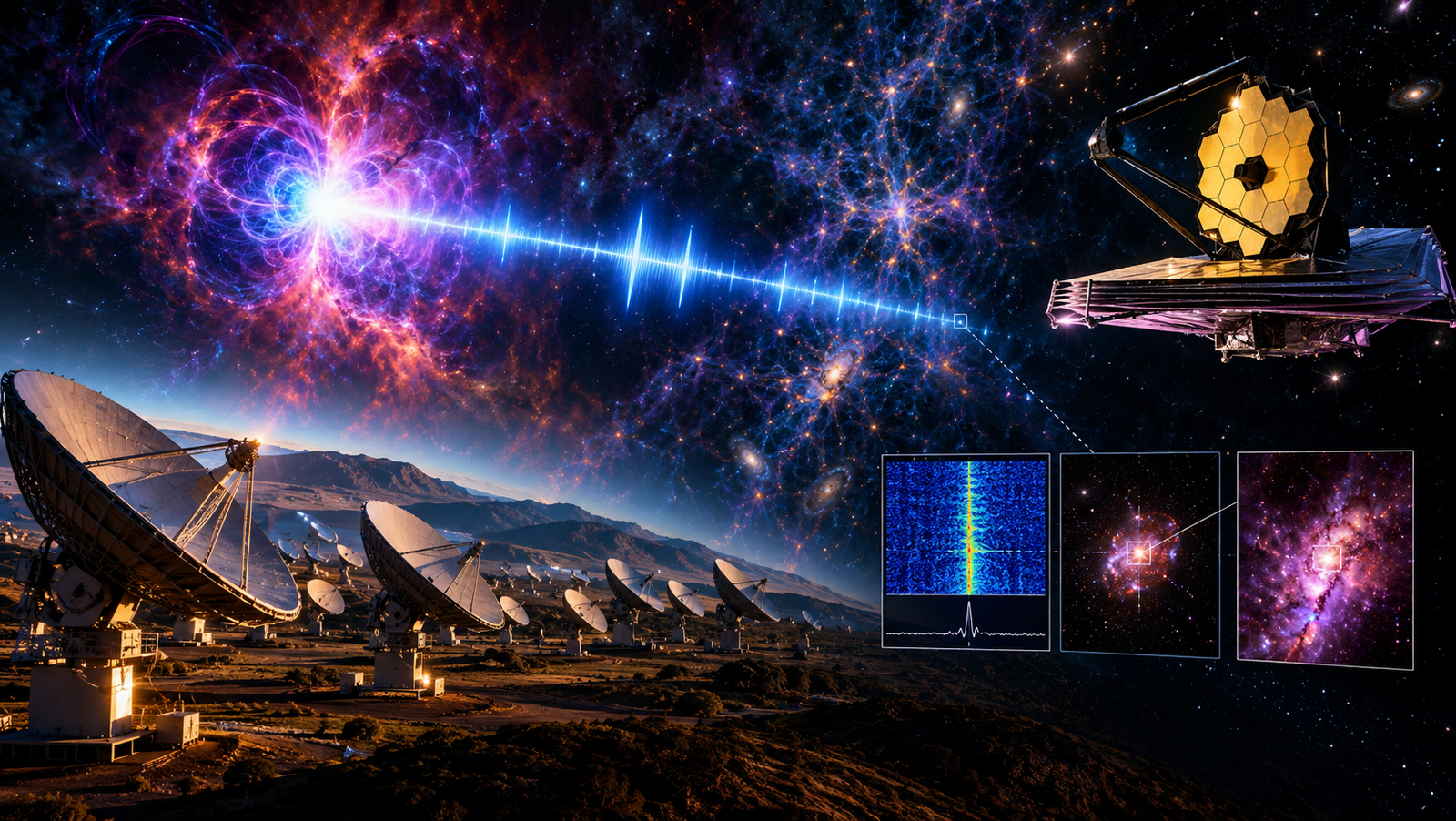
In the classic science fiction film Contact (1997), based on Carl Sagan’s novel and directed by Robert Zemeckis, astrophysicist Ellie Arroway spends nights in the New Mexico desert listening to the static of the cosmos through the dishes of the Very Large Array (VLA). When a periodic radio pulse breaks the silence from the star Vega, humanity faces its greatest question: are we alone in the universe? Conversely, in Liu Cixin’s The Three-Body Problem trilogy, that same quest takes a lethal turn with the Dark Forest Hypothesis — the premise that the cosmos is a silent jungle where any world broadcasting a powerful signal inadvertently exposes its coordinates to interstellar predators.
In contemporary astrophysics, the closest real-world counterpart to these shots in the dark is known as Fast Radio Bursts (FRBs). These fleeting electromagnetic pulses last mere milliseconds, yet release in the blink of an eye as much energy as our Sun radiates over entire days or years.
In October 2026, this cosmic investigation reached a historic milestone. An international team led by astrophysicist Manisha Caleb at the University of Sydney announced in a landmark study published in the journal Science (with open technical data in the arXiv preprint and detailed in the official NASA James Webb mission release) the confirmation of the most distant fast radio burst ever localized by science: FRB 20240304B. Captured by the MeerKAT radio telescope in South Africa and traced back to its home galaxy by the James Webb Space Telescope (JWST), the pulse traveled across space for more than 10.6 billion years — emitted when the universe was only 3 billion years old.
By doubling the localization reach of these events and probing 80% of cosmic history, the discovery pits the extreme astrophysics of primordial magnetars against technosignature hypotheses linked to the Fermi Paradox. In this technical essay, we examine the plasma dispersion physics that decoded this signal’s journey, why the largest ground-based telescopes failed to spot its source, what James Webb’s infrared sensors revealed at “Cosmic Noon,” and how the host galaxy settles the debate between natural cataclysms and alien engineering.
1. The Anatomy of Detection: How MeerKAT Caught a One-Millisecond Pulse
Capturing an event lasting one-thousandth of a second from the edge of the observable universe demands ultra-high-cadence instrumentation. Since the first fast radio burst (the Lorimer Burst) was discovered in 2007, over a thousand FRBs have been cataloged, yet nearly all bursts with identified host galaxies remained confined to the relatively local universe, at redshifts below z = 0.5 (less than 5 billion years ago).
The South African Radio Eye and the MeerTRAP System
On March 4, 2024, at 00:50:12.567 UTC, the MeerKAT interferometer — an array of 64 parabolic dishes, each 13.5 meters across, in South Africa’s Karoo region — was running real-time commensal observations via the MeerTRAP backend. Within a fraction of a second, a brilliant pulse swept across the L-band receivers (between 856 and 1,712 MHz), registering a signal-to-noise ratio (S/N) of 114.7 in the high-time-resolution transient buffer data.
The burst exhibited a peak flux density of 0.49 Jansky (Jy) and a fluence of 2.75 Jy·ms toward the constellation Virgo (right ascension 12h 11m 59.29s, declination +11° 48′ 46.86″). Although its intrinsic duration at the source was approximately 1 millisecond, the wave arrived at Earth stretched to several milliseconds due to interactions along its intergalactic path.
The Physics of Dispersion Measure (DM) and the Macquart Relation
A radio pulse crossing deep space does not travel through a perfect vacuum, but through a tenuous ocean of cold ionized plasma (free electrons and protons) permeating the intergalactic medium. In plasma electrodynamics, higher radio frequencies travel slightly faster than lower frequencies. The arrival time delay (Δt) between two frequencies (ν₁ and ν₂) obeys the fundamental dispersion law:
Δt ∝ DM · (ν₁⁻² − ν₂⁻²)
The quantity known as Dispersion Measure (DM), expressed in parsecs per cubic centimeter (pc cm⁻³), acts as a cosmic matter counter: it measures the integrated column density of free electrons the pulse encountered between its source and the terrestrial receiver.
For FRB 20240304B, after correcting for temporal pulse broadening (scattering of 5.6 ms at 1 GHz), Manisha Caleb’s team obtained a remarkable breakdown:
- Total Dispersion Measure (DM_FRB): 2,458.20 ± 0.01 pc cm⁻³.
- Milky Way Contribution (Disk and Halo): Only ~68 pc cm⁻³ (28 pc cm⁻³ from the local interstellar medium and 40 pc cm⁻³ from the Galactic halo).
- Net Cosmic Contribution (DM_cosmic): Approximately 2,330 pc cm⁻³ accumulated across billions of light-years of the cosmic web.
According to the Macquart Relation — formulated by the late astrophysicist Jean-Pierre Macquart in 2020 to weigh the universe’s missing baryons — a cosmic dispersion exceeding 2,300 pc cm⁻³ pointed to an origin at very high redshift (estimated between z = 1.6 and z = 3.4). Pinning down the exact distance, however, required imaging the galaxy from which the shot was fired.
2. The Terrestrial Limit and James Webb’s Intervention at Lagrange Point L2
Identifying the host galaxy of an FRB more than 10 billion light-years away requires surgical precision. Thanks to MeerKAT’s interferometric baseline, the burst’s sky position was pinned down to a tiny ellipse measuring 0.28″ × 0.48″.
Optical Silence at the Keck Observatory
With precise coordinates locked, the team turned to astrophysicist J. Xavier Prochaska at the University of California, Santa Cruz, to point the 10-meter Keck I telescope atop Mauna Kea in Hawaii, equipped with the LRIS spectrograph, alongside the MMT Observatory in Arizona.
As detailed in the W. M. Keck Observatory report, even after deep exposures reaching 5-sigma limiting magnitudes of R = 26.24 AB in visible light and J = 23.38 AB in the near-infrared, no galaxy appeared at the coordinates. Cosmic expansion had stretched the distant galaxy’s ultraviolet and visible starlight into infrared wavelengths that Earth’s atmosphere blocks and drowns in thermal glow. To find the source, astronomers had to go to space.
Infrared Dissection with NIRCam and NIRSpec
The researchers secured Director’s Discretionary Time (program PID 6779) on the James Webb Space Telescope, operating 1.5 million kilometers from Earth at the Sun-Earth Lagrange point L2. This cryogenic optical engineering — a core pillar of our master guide on The Future in Space: From Advanced Propulsion and Black Holes to Orbital and Naval Mega-Engineering — solved the puzzle using two flagship instruments:
- Near-Infrared Camera (NIRCam): Using the F200W and F322W2 filters, James Webb detected an extraordinarily faint, clumpy galaxy just 0.3 arcseconds from the radio position, shining at magnitudes of 27.82 AB and 28.72 AB. Bayesian probabilistic analysis (the PATH formalism) confirmed a 97.5% probability that this object is the true host galaxy.
- Near-Infrared Spectrograph (NIRSpec IFS): By dispersing the galaxy’s infrared light, the Integral Field Spectrograph clearly identified strong emission lines of Hydrogen-alpha (Hα) and doubly ionized Oxygen ([O III] λ5007). Their wavelength shift pinned down a spectroscopic redshift of z = 2.148 ± 0.001.
In cosmological terms, z = 2.148 corresponds to a luminosity distance of 17.4 Gigaparsecs and a light-travel time between 10.6 and 10.8 billion years. The pulse departed when the universe was only 3 billion years old (roughly 20% of its current age), more than doubling the distance reach of localized fast radio bursts.
3. Cosmic Noon and the Portrait of a Primordial Dwarf Galaxy
FRB 20240304B is the first fast radio burst localized directly to Cosmic Noon (between z = 2 and z = 3) — the most turbulent epoch in universal history, when galactic nurseries forged stars at the highest rate since the Big Bang.
A Young, Clumpy, and Metal-Poor Stellar Factory
Astrophysical modeling led by Themiya Nanayakkara and colleagues revealed that the home of FRB 20240304B is radically different from mature spiral galaxies like the Milky Way:
- Diminutive Stellar Mass: The galaxy contains only about 10⁷ solar masses (log M*/M☉ = 6.89), making it 1,000 times less massive than typical low-redshift FRB hosts and nearly 10,000 times smaller than the Milky Way.
- Intense Starburst Rate: Despite its low mass, it converts gas into stars at a rate of 0.15 to 0.2 solar masses per year, placing it well above the star-forming main sequence.
- A 51.7-Million-Year Formation Timescale: Its stellar assembly timescale (t_form = M* / SFR) indicates that the galaxy assembled virtually its entire stellar population in just 51.7 million years.
- Ultra-Low Metallicity: The gas-phase metallicity is only 10% to 20% of the solar value (Z*/Z☉ ≈ 0.2), confirming a chemically pristine environment barely enriched by heavy elements.
4. Extreme Magnetars vs. Technosignatures: The Verdict for the Fermi Paradox
Confirming a coherent radio pulse with an isotropic-equivalent energy of 10⁴¹ ergs (10³⁴ Joules) from the early universe reignites the debate between extreme neutron star astrophysics and SETI technosignature models.
The Alien Light-Sail Hypothesis and the Dark Forest
In a famous study available in the Harvard theoretical study on extragalactic light sails, astrophysicists Manasvi Lingam and Abraham Loeb demonstrated that the frequency range and flux of FRBs match the physical parameters of collimated beams from planetary-scale transmitters built by advanced civilizations (Kardashev Type II) to propel interstellar light sails. In the narrative of The Three-Body Problem, firing a 10⁴¹-erg pulse would violate the survival laws of the Dark Forest, broadcasting the galaxy’s coordinates across gigaparsecs.
However, the chemical and chronological autopsy performed by James Webb on FRB 20240304B refutes the artificial hypothesis for this burst based on two hard empirical constraints:
- Chemical Scarcity (10% to 20% Solar): Forming terrestrial rocky planets and planetary-scale engineering arrays requires abundant silicon, iron, and heavy metals, which are scarce in a primordial low-metallicity gas cloud.
- Brief Biological Window (51.7 Million Years): The evolution of complex life and technological intelligence on Earth required over 4 billion years. A chaotic, 51.7-million-year-old dwarf galaxy swept by continuous supernova radiation offers no temporal window for Kardashev-scale civilizations to emerge.
The Triumph of Young Prompt-Channel Magnetars
The James Webb data also settle a major astrophysical dispute between two competing natural progenitor channels:
- Delayed Channels (Neutron Star Mergers): The inspiral and merger of binary neutron stars takes billions of years of gravitational-wave decay. In a 51.7-million-year-old galaxy located just 3 billion years after the Big Bang, this slow pathway is ruled out.
- Prompt Channels (Young Magnetars): Massive, low-metallicity stars live only a few million years before collapsing into supernovae and leaving behind Magnetars — newborn neutron stars endowed with magnetic fields between 10¹⁴ and 10¹⁵ Gauss (up to a quadrillion times stronger than Earth’s magnetic field).
When titanic magnetic stresses fracture the magnetar’s solid crust in a “starquake,” or drive relativistic shockwaves into surrounding plasma, magnetic energy is converted into a coherent radio flash via synchrotron maser emission. FRB 20240304B proves that young magnetars were already operating at full power during Cosmic Noon.
Comparative Table: The Three Models for the Origin of FRB 20240304B
The table below contrasts the three theoretical models against the measurements obtained by MeerKAT and James Webb:
| Astrophysical Criterion | Hypothesis 1: Young Magnetar (Prompt Channel) | Hypothesis 2: Neutron Star Merger (Delayed Channel) | Hypothesis 3: Technosignature / Light Sail (Kardashev II) |
|---|---|---|---|
| Physical Emission Mechanism | Crustal starquake and relativistic shock synchrotron maser | Gravitational-wave inspiral collision of compact binaries | Collimated beam from planetary phased-array transmitter |
| Delay Time After Star Formation | Ultra-short (1 to 10 million years) | Long (1 to 5 billion years) | Extremely long (Billions of years of biological evolution) |
| Compatibility with 51.7 Myr Host | Very High (Massive stars collapse rapidly) | Very Low (Insufficient time for orbital inspiral) | Virtually Zero (Insufficient time for complex life) |
| Role of Low Metallicity (10–20% Z☉) | Favors massive stellar progenitors of magnetars | Indifferent or unfavorable | Hostile (Lacks heavy metals for rocky planets) |
| Linear Polarization (49%) & RM (-550 rad m⁻²) | Consistent with dense magnetized supernova remnants | Clean, low-magnetization interstellar medium expected | Would require artificial modulation without supernova plasma |
| Empirical Verdict in FRB 20240304B | Model Confirmed by JWST Data | Disfavored by host galaxy youth | Ruled out by chemical and chronological limits |
5. A Cosmic Flashlight: Tomography of the Intergalactic Web and Magnetic Fields
Beyond revealing its origin, FRB 20240304B acted as a tomographic probe across 80% of universal history, illuminating invisible matter along the cosmic web.
Crossing the Virgo Cluster and an Unknown Galaxy Group
By comparing the redshift z = 2.148 against the Macquart Relation, researchers identified an excess dispersion of ~550 pc cm⁻³ above the cosmic mean. Mapping the sightline revealed that the pulse pierced two massive foreground structures before reaching South Africa:
- A Previously Unknown Galaxy Group at z = 0.31131: Located 3.5 billion light-years from Earth, passing just 240 kiloparsecs from the beam path and adding ~33 pc cm⁻³ to the dispersion.
- The Virgo Cluster: Located 54 million light-years away. The signal passed ~1 Megaparsec from the cluster’s gravitational core, where hot intracluster gas added ~235 pc cm⁻³ of free electrons.
Faraday Rotation and Magnetism Across Gigaparsec Scales
The burst arrived at MeerKAT with 49% linear polarization and 3% circular polarization. As polarized light traverses magnetized plasma, its polarization plane rotates via the Faraday Rotation Effect, quantified by the Rotation Measure (RM).
FRB 20240304B exhibited an observed RM of −55.6 ± 0.5 rad m⁻². Correcting for cosmological frequency dilution by the factor (1 + z)² ≈ 10, the intrinsic rotation measure in the dwarf galaxy’s local environment reaches approximately −550 rad m⁻², confirming a heavily magnetized birthplace. Conversely, the average line-of-sight intergalactic magnetic field remained below ~28 nanogauss, demonstrating that cosmic magnetic fields undergo frequent reversals and cancellations across gigaparsec scales.
6. Critical Analysis, Observational Bottlenecks, and the Future of Radio Cosmology
Locating FRB 20240304B opens the z > 2 universe, yet highlights four severe engineering bottlenecks that explain why science took nearly a decade to breach this frontier.
Physical and Instrumental Bottlenecks: Why Is Breaking z > 2 So Difficult?
Transforming primordial FRBs into routine cosmological probes faces strict physical and instrumental hurdles:
- The Sensitivity Horizon of Radio Telescopes: Arrays such as CHIME (Canada), ASKAP (Australia), and DSA-110 (USA) boast wide fields of view but lose sensitivity above z = 1.6 (where fewer than 3% of their detections occur). Currently, only MeerKAT combines raw sensitivity and interferometric precision so that 6.3% of its detections originate at z > 2, whereas China’s giant FAST dish can detect bursts up to z ~ 10 but lacks the sub-arcsecond angular resolution required to pinpoint host galaxies without auxiliary interferometers.
- The Ground-Based Infrared Barrier: Above z = 2, visible starlight is redshifted into the infrared while surface brightness dims with the fourth power of (1 + z). As proven by the 10-meter Keck telescope’s inability to detect the 27.8 AB magnitude host, relying exclusively on scarce James Webb observing time bottlenecks spectroscopic confirmations.
- Macquart Relation Degeneracy: A high Dispersion Measure (DM > 2,000 pc cm⁻³) can stem either from extreme cosmological distance or from dense plasma haloes in foreground galaxy clusters (such as Virgo), requiring complex sightline tomography.
- K-Correction and Beaming Uncertainties: Incomplete knowledge of the intrinsic spectral index of FRBs at rest-frame frequencies of ~3 to 5 GHz introduces uncertainties into the magnetar’s true beaming angle and total energy budget.
The Next Frontier: The Square Kilometre Array (SKAO)
The definitive solution to these bottlenecks is rising in the deserts of South Africa and Australia with the Square Kilometre Array (SKAO). When SKA-Mid operates alongside James Webb and the next generation of 30-to-39-meter Extremely Large Telescopes (such as the ELT in Chile), astronomy will map thousands of fast radio bursts from Cosmic Noon back to the Epoch of Reionization — when the universe’s very first stars ignited.
While radio signals in Contact and The Three-Body Problem symbolized encounters with distant minds, FRB 20240304B proves that extreme magnetar flashes are equally extraordinary natural messengers: light fossils preserving the material and magnetic memory of 10.6 billion years of cosmic evolution.
Facing a universe that was already firing colossal radio pulses 10.6 billion years ago, which breakthrough do you think deep-space signals will deliver first: a complete map of the Big Bang’s invisible matter, or an anomalous pulse that no natural physics can explain? Share your thoughts in the comments and pass this essay along!
🔭 Continue Exploring the Frontier of Science and Technology:
• The Real Physics of The Three-Body Problem: Nanowires, Sophons, and Warp Drive