
If you have watched the groundbreaking science fiction classic The Matrix (1999), directed by the Wachowskis, you undoubtedly recall the chilling revelation that the dominant artificial intelligence maintained billions of human beings suspended in biological pods, utilizing their neurochemical brain activity and metabolic body heat as a distributed biological computing grid and bio-electric power source.
If your sci-fi compass points toward the desert dunes of Arrakis in Denis Villeneuve’s Dune (2021/2024), the total prohibition of thinking machines following the legendary Butlerian Jihad compelled human civilization to forge the Mentats: human savants whose neurological biology was meticulously conditioned to compute astronomical trajectories, military probabilities, and geopolitical forecasts in fractions of a second, demonstrating that living neural tissue remains the ultimate computational architecture of the cosmos. Or consider Irvin Kershner’s visceral RoboCop 2 (1990), where the preserved brain of the antagonist Cain is surgically transplanted into an armored mechanical chassis, illustrating the long-standing cyberpunk ambition of fusing biological minds with industrial actuators. In the dystopian landscape of Cyberpunk 2077, neural bio-chips and Relic technology commodify organic substrate into commercial, rewritable hardware.
For more than eight decades, modern computer engineering has operated under the unyielding dogma of inorganic silicon: we etch billions of metallic transistors onto crystalline wafers and force trillions of electrons through nanoscale copper interconnects. However, contemporary artificial intelligence has collided with an insurmountable physical, thermal, and energetic wall. Training and operating frontier large language models and deep neural networks now demand gigawatts of electrical power and millions of liters of cooling water, threatening to overwhelm global power grids.
However, behind the cinematic fiction and video games, real-world science is forging the most radical solution to this existential bottleneck: Organoid Intelligence (OI) and Living Biocomputers.
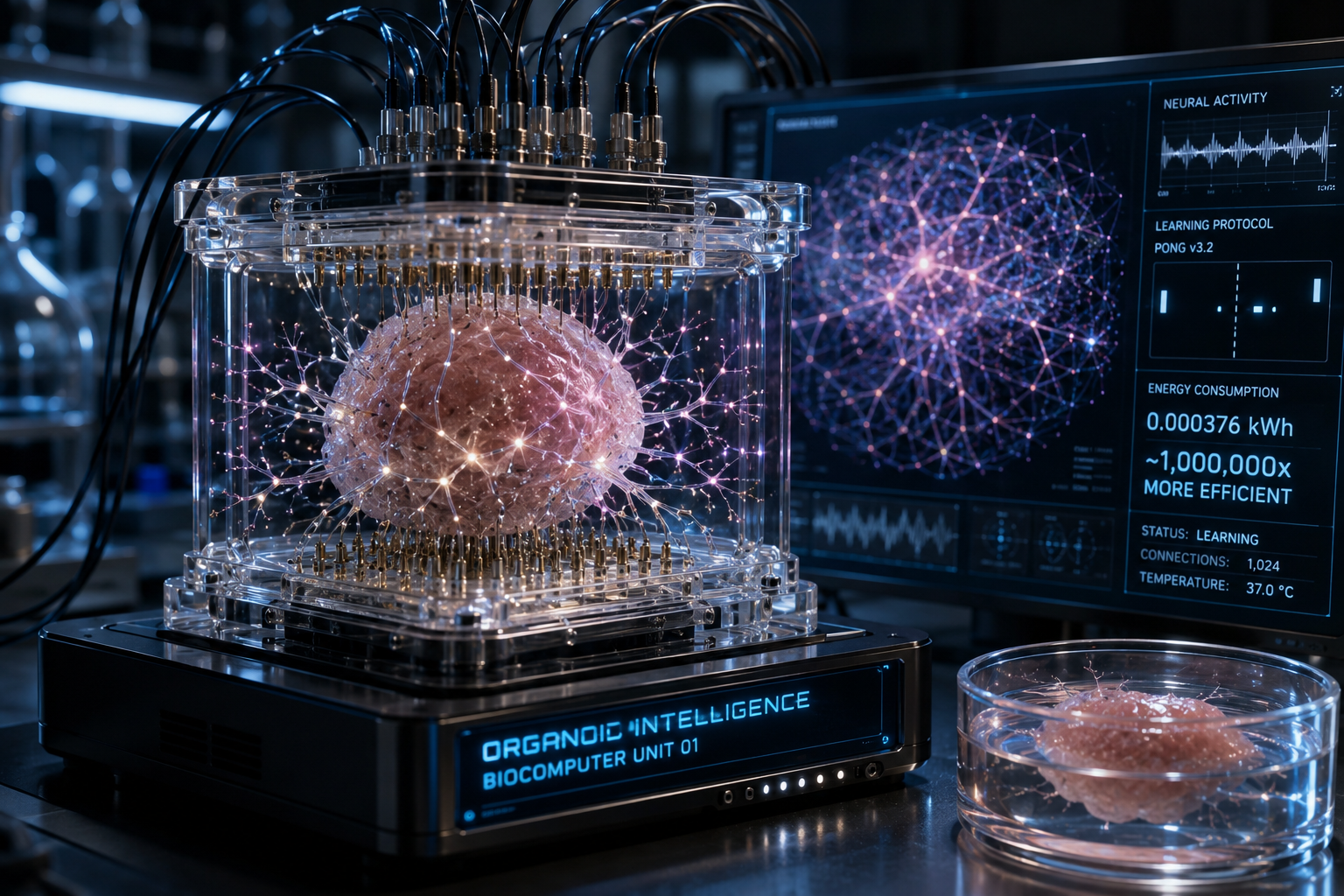
At the vanguard of biotechnology and neural engineering — spearheaded by premier institutions such as Johns Hopkins University, Monash University, Australian startup Cortical Labs, and Swiss pioneer FinalSpark —, scientists have successfully cultured three-dimensional clusters of living human neurons derived from stem cells and integrated them directly onto silicon microelectrode arrays. These biological neural networks do not merely survive on chips; they actively learn dynamic tasks in real time — such as playing the classic arcade game Pong —, physically adapt their synaptic architectures, and perform artificial intelligence calculations while consuming up to one million times less energy than a traditional silicon GPU.
In this comprehensive deep dive from Reach Technocracy, we pull back the curtain on this biocomputational revolution. We will analyze the thermal crisis of silicon versus the thermodynamic miracle of the human brain, examine the biology of 3D brain organoids coupled to high-density microelectrodes, dissect the landmark experiments proving closed-loop biological learning, explore the world’s first commercial cloud biocomputing servers, and confront the profound ethical frontiers surrounding the emergence of synthetic sentience in a Petri dish.
1. The Thermal Limit of Silicon and the 20-Watt Brain
To grasp the monumental urgency driving Organoid Intelligence, one must first quantify the staggering thermodynamic chasm separating inorganic digital computing from evolutionary biology.
The Energy Crisis of Frontier AI Models
The exponential scaling of generative artificial intelligence and dense transformer models has placed global computing infrastructure on a direct collision course with the fundamental laws of thermodynamics. Modern supercomputing clusters packed with tens of thousands of top-tier accelerators — such as the Nvidia H100 and Blackwell B200 — consume tens of megawatts of continuous electrical power.
Training a single frontier multimodal model can consume upwards of 50 gigawatt-hours of electricity, equivalent to the energy required to power a mid-sized city for months. Beyond raw power consumption, ohmic resistance within nanoscale silicon channels dissipates massive quantities of parasitic heat (Joule heating), necessitating industrial-scale liquid cooling infrastructures that evaporate millions of liters of purified water daily. As lithographic nodes push against atomic boundaries at 2 nm and 1.4 nm, transistors suffer from severe quantum tunneling leakage, bringing Dennard scaling and traditional Moore’s Law efficiency gains to an effective halt.
The Thermodynamic Miracle of the Human Brain
In stark contrast to the unsustainable energy appetite of modern data centers, biological evolution has spent hundreds of millions of years perfecting the most dense, sophisticated, and energy-efficient processor in the known universe: the human brain.
- Negligible Operating Power: The adult human brain houses approximately 86 billion neurons and more than 100 trillion synaptic connections, operating continuously on an average power envelope of just 20 Watts — equivalent to the power draw of a dim household LED bulb or the caloric energy provided by a single grain bar.
- Estimated Computational Capacity: Computational neuroscientists estimate that the human brain performs the equivalent of 1 ExaFLOP (10¹⁸ operations per second) of structural, associative, and parallel cognitive processing.
- Extreme Sample Efficiency: While a deep convolutional vision model requires training on hundreds of thousands of labeled images to reliably distinguish a cat from a dog, a human toddler masters the concept from two or three visual exposures, reconfiguring synaptic weights in real time without millions of iterative backpropagation cycles.
This energetic disparity of more than six orders of magnitude (10⁶) has catalyzed an inevitable conclusion among frontier researchers: rather than attempting to crudely emulate neural dynamics through rigid silicon circuits (neuromorphic chips), the most direct pathway toward sustainable supercomputing is to utilize living biological neural tissue directly as computational hardware.
2. How to Grow a Brain on a Chip: Organoid Biology and MEA Electrodes
The feasibility of Organoid Intelligence rests upon the convergence of stem cell biology, microfluidic life support, and high-density semiconductor interfacing.
Induced Pluripotent Stem Cells and 3D Neural Differentiation
Until the early 2010s, harvesting viable human brain tissue for computational research was an ethical and practical impossibility. This barrier was permanently dismantled by the discovery of Induced Pluripotent Stem Cells (iPSCs), the Nobel Prize-winning methodology pioneered by Japanese biologist Shinya Yamanaka:
- Cellular Reprogramming: Ordinary adult human somatic cells (such as dermal skin fibroblasts or peripheral blood mononuclear cells) are genetically reprogrammed using transcription factors (Oct4, Sox2, Klf4, and c-Myc), reverting them to an embryonic-like pluripotent state.
- Three-Dimensional Scaffolding: Suspended within bioreactors utilizing hydrogel extracellular matrices (such as Matrigel), these iPSCs are exposed to precise biochemical gradients of neural growth factors (FGF, EGF, BDNF).
- Spontaneous Structural Self-Organization: Over several weeks, the cells self-assemble into complex three-dimensional spherical bodies known as Brain Organoids. Spanning 0.5 mm to 3 mm in diameter, these organoids contain between 100,000 and several million cells, including cortical pyramidal neurons, GABAergic interneurons, astrocytes, and oligodendrocytes that spontaneously form functional synaptic networks and fire synchronized action potentials.
High-Density Microelectrode Arrays (HD-MEAs)
To transform a living organoid into a functional bioprocessor, engineers must establish a high-fidelity, bidirectional electrophysiological interface.
The organoid is placed onto a High-Density Microelectrode Array (HD-MEA):
- Complementary Metal-Oxide-Semiconductor (CMOS) chips integrate thousands of microscopic platinum or iridium-oxide electrodes spaced just 15 to 30 micrometers apart.
- Reading (Biological Input): The microelectrodes capture extracellular field potentials (on the scale of microvolts) whenever local neurons fire action potentials (spikes). Digital signal processors amplify, filter, and stream these firing patterns into binary data in real time.
- Stimulation (Digital Output): The host computer delivers precisely calibrated, low-voltage electrical pulses through specific electrodes, providing sensory inputs, environmental feedback, and computational payloads directly to the living neural network.
Comparative Table: Traditional Silicon vs. Organoid Biocomputing
The table below summarizes the architectural and operational differences between enterprise silicon accelerators and Organoid Intelligence bioprocessors:
| Evaluation Parameter | Traditional Silicon (Nvidia H100 / B200) | Organoid Intelligence (OI Biocomputing) |
|---|---|---|
| Average Power Consumption | 700 W to 1,200 W per chip / Megawatts per cluster | Less than 0.001 W (< 1 mW per neural organoid) |
| Sample Efficiency / Learning Rate | Low: requires millions of examples for statistical convergence | Extreme: rapid structural adaptation in dozens of iterations |
| Synaptic Plasticity | Static: digital weights stored in external DRAM/HBM | Dynamic: real-time neurogenesis, axonal growth, and pruning |
| Operating Medium | Air cooling or dry dielectric liquid immersion | Microfluidic chambers with oxygenated nutrient media (37 °C) |
| Operational Lifespan | 5 to 10 years (limited by electromigration and thermal wear) | Months (continually extended via vascular perfusion systems) |
| Computational Parallelism | Synchronous deterministic digital tensor operations | Massively parallel, asynchronous, stochastic analog processing |
3. From Pong to AI Inference: How Living Neurons Process Algorithms
The definitive proof that cultured neural networks can execute goal-directed algorithmic tasks arrived through one of the most celebrated neuroengineering experiments of the decade.
The DishBrain Experiment and Virtual Closed-Loop Environments
In October 2022, in a landmark paper published in the prestigious journal Neuron, a multidisciplinary research team led by neuroscientist Brett Kagan at Cortical Labs (in collaboration with Monash University and international partners) unveiled the DishBrain system.
The researchers cultured approximately 800,000 living neurons (both human iPSC-derived and murine cortical cells) over an HD-MEA interface connected in a closed feedback loop to a virtual simulation of the classic video game Pong:
- Sensory Encoding: The spatial position of the virtual ball was converted into electrical stimulation pulses delivered to electrodes on the left or right side of the array. The frequency of the pulses signaled the ball’s distance from the paddle.
- Motor Decoding: Voltage spikes generated by neurons in specific sensorimotor readout zones were decoded in real time as motor commands to move the virtual paddle up or down.
The Free Energy Principle and Synthetic Active Inference
To train the biological neurons to intercept the ball without writing a single line of deterministic code, the team leveraged the Free Energy Principle, formulated by renowned theoretical neuroscientist Karl Friston of University College London (UCL), who co-authored the study.
The Free Energy Principle posits that any self-organizing biological system naturally acts to minimize entropy and unpredictability within its sensory environment:
- Predictable Feedback (Reward): Whenever the neural array successfully positioned the paddle to hit the ball, the system delivered a uniform, predictable electrical stimulus at a fixed frequency and location. Biological neural networks inherently favor predictable sensory states.
- Chaotic Feedback (Punishment): Whenever the paddle missed the ball, the system bombarded the array with a burst of completely random, high-entropy, chaotic electrical pulses across unpredictable electrode coordinates.
The outcome was extraordinary: within less than five minutes of closed-loop active inference, the biological neural network physically reorganized its synaptic connections to consistently hit the ball, systematically reducing environmental chaos. The neurons exhibited goal-directed adaptive intelligence within a synthetic digital reality.
Electrophysiology and Closed-Loop Dopaminergic Reinforcement
Building upon the DishBrain breakthrough, second-generation OI platforms integrate automated micro-dispensers that deliver localized pulses of neuromodulators (such as dopamine and acetylcholine) directly onto active synaptic clusters upon correct task completion.
This targeted chemical reinforcement dramatically accelerates Long-Term Potentiation (LTP), allowing biological neural networks to learn non-linear pattern recognition, anomaly detection, and speech classification tasks far faster than traditional reinforcement learning algorithms on silicon.
4. The FinalSpark Platform and the First Cloud Biocomputing Servers
The transition of Organoid Intelligence from academic laboratory curiosity to commercial cloud computing infrastructure became a tangible reality in Switzerland.
FinalSpark’s Neuroplatform
Founded by researchers Fred Jordan and Martin Kutter, Swiss neuro-technology enterprise FinalSpark launched the Neuroplatform in 2024: the world’s first commercial remote-access biocomputing cloud platform powered by living human brain organoids.
The platform provides global AI researchers and university laboratories with 24/7 API access to living biological neural processing units (Biological NPUs):
- Multi-Organoid Processing Clusters: Each server module houses multiple 3D brain organoids interfaced via multi-electrode arrays and glass capillary micro-sensors.
- Unprecedented Energy Reductions: FinalSpark projects that training neural models on living biological organoids requires up to a million times less energy than running equivalent models on clusters of graphics processing units, democratizing frontier AI research for institutions lacking multimillion-dollar electrical budgets.
Closed-Loop Microfluidics and Organoid Longevity
The primary engineering hurdle in scaling biological data centers has always been maintaining the homeostasis of living tissue. While a silicon processor can sit powered down on a shelf for years, neurons require an unbroken supply of glucose, amino acids, precise temperature regulation (37 °C), physiological pH buffering, and continuous waste metabolite removal.
Modern commercial biocomputing servers solve this through automated life-support systems:
- Nanoscale Peristaltic Perfusion: Automated microfluidic circuits continuously circulate heated nutrient media through the organoid chambers, mimicking the capillaries of the human vascular system.
- Vascularized Organoid Lifespans: Early brain organoids suffered from core necrosis after several days due to the absence of blood vessels. By incorporating endothelial cells and micro-perfusion channels, the operational lifespan of bioprocessors on the Neuroplatform has expanded from a few days to over 100 days of continuous computational uptime.
5. The Moral Frontier: Where Does Cellular Tissue End and Consciousness Begin?
The rapid acceleration of Organoid Intelligence introduces bioethical, philosophical, and legal questions without precedent in human history, challenging the foundational definitions of mind, life, and moral agency.
Sentience in a Petri Dish and Integrated Neuroethics
In February 2023, an international consortium of scientists led by Professor Thomas Hartung at Johns Hopkins University published a seminal manifesto in Frontiers in Science, formally establishing Organoid Intelligence (OI) as an official scientific discipline.
Crucially, the manifesto established an embedded framework of Integrated Neuroethics to proactively investigate urgent moral concerns:
- The Emergence of Rudimentary Sentience: As 3D brain organoids scale in cell count, incorporate sensory feedback loops, and display complex synaptic plasticity, could they cross a threshold into primitive forms of self-awareness, nociception (the capacity to experience pain), or subjective experience?
- Complex Gamma-Band Oscillations: Electrophysiological studies have recorded complex oscillatory firing patterns in advanced cortical organoids resembling the electroencephalographic (EEG) signatures observed in preterm human infants, necessitating rigorous monitoring protocols to ensure no synthetic suffering is induced during computational training.
Neurorights, Genetic Ownership, and Legal Personhood
The intersection of human cellular biology and commercial computing creates novel legal dilemmas:
- Donor Consent and Genetic Sovereignty: Does an individual who donates skin cells for general medical research implicitly consent to having their reprogrammed neural tissue perform computational tasks for commercial cloud providers indefinitely?
- Intellectual Property of Biological Algorithms: If a living human brain organoid generates a novel patentable mathematical theorem or creative work, does ownership belong to the hardware operator, the software engineer, the cell donor, or the biological entity itself?
- Biocomputational Neurorights: Legal scholars and bioethicists are actively formulating new regulatory frameworks to establish when a biological computing substrate must transition from being classified as a mere “laboratory reagent” to a protected entity with defined ethical safeguards.
6. Conclusion: The Era of Biological Computers
Throughout the twentieth century, human civilization operated under the belief that digital computing machines and biological minds belonged to fundamentally irreconcilable domains: the former cold, rigid, deterministic, and inorganic; the latter warm, wet, plastic, and enigmatic.
The rise of Organoid Intelligence and Living Biocomputers reveals that silicon was merely a transitional phase in the evolution of computation. By uniting the immense efficiency, self-organizing plasticity, and parallel processing power of living neural networks with modern microelectronic interfaces, science is unlocking a sustainable post-silicon computational paradigm capable of scaling without consuming the ecological resources of our planet.
We are no longer merely programming machines that mimic the brain; we are inviting biological matter itself into the architectural blueprint of digital technology. The technical hurdles and moral responsibilities ahead are monumental, but the trajectory is unmistakable: the future of intelligent computing is alive.
At Reach Technocracy, we will remain at the absolute front line, analyzing every breakthrough in organoid electrophysiology, every milestone in cloud biocomputing, and every neuroethical framework shaping the convergence of human biology and artificial intelligence.
Would you entrust mission-critical artificial intelligence workloads to a cloud server powered by living human brain cells cultured in a laboratory? Do you believe biocomputers will supersede silicon GPUs in major data centers before the decade ends, or will bioethical regulations restrict their deployment? Share your thoughts and join the discussion in the comments below!
🔭 Continue Exploring the Frontier of Science and Technology: