
If you watched the groundbreaking science fiction classic The Matrix (1999) by the Wachowskis, you undoubtedly remember that unforgettable scene where Neo, played by Keanu Reeves, reclines in a chair, has a mechanical cable plugged directly into the back of his skull, and within seconds downloads terabytes of martial arts training directly into his neocortex, opening his eyes to deliver the legendary line: “I know Kung Fu.”
If your pop culture compass points toward modern video games, the vibrant universe of Cyberpunk 2077 showcases a future where neural cyberware, biomonitors, and cortical processors are as ubiquitous as smartphones are today. Or consider the philosophical masterpiece Ghost in the Shell, where the seamless merging of biological consciousness and digital data networks defines the very identity of Major Motoko Kusanagi.
For decades, this direct symbiosis between biological wetware and silicon machines seemed like the ultimate fantasy of cyberpunk storytelling. After all, how could science ever translate the abstract, fleeting thoughts of a living human brain — a pulsing, soft, biochemical organ — into the rigid binary language of computers?
Yet what once belonged exclusively to cinema and video games is rapidly transforming into clinical reality. Driven by breakthroughs in Brain-Computer Interfaces (BCIs) and the advent of high-density neural devices like Neuralink’s Telepathy chip, humanity has taken its first concrete steps toward establishing high-bandwidth communication between living neurons and integrated circuits. Today, paralyzed individuals are already controlling computer cursors, browsing the web, playing competitive video games, and operating robotic limbs using nothing more than the direct intention of their thoughts.
In this comprehensive deep dive from Reach Technocracy, we take a slow-motion look behind the scenes of this cybernetic revolution. We will explore the bioelectricity of how neurons communicate, dissect the remarkable microengineering behind Neuralink’s N1 implant and R1 surgical robot, examine how advanced artificial intelligence decodes noisy neural spikes into digital actions in real time, explore next-generation horizons like synthetic sensory feedback and vision restoration, and confront the critical bioethical and cybersecurity challenges governing the future of the connected human mind.
1. The Bioelectricity of Thought: How Neurons Communicate with Machines
To understand how a computer can decode human intent, we must recognize that the brain is fundamentally the most sophisticated electrochemical signal processor in the known universe.
Enclosed within your skull are roughly 86 billion neurons, interconnected by more than 100 trillion synaptic junctions. Whenever you formulate a thought, experience a sensory perception, or plan a motor movement — such as wiggling your right thumb —, specific populations of neurons fire electrical impulses known in neuroscience as Action Potentials (or neural spikes).
This firing mechanism is governed by an elegant biochemical process: charged ions (primarily Sodium — Na+, Potassium — K+, and Calcium — Ca2+) rapidly transit through microscopic voltage-gated ion channels across the neuronal cell membrane. This rapid displacement of electrical charge creates a fleeting voltage fluctuation (measured in microvolts) that travels down the axon toward adjacent synapses.
When thousands of neighboring neurons fire synchronously, they generate local electromagnetic fields. The fundamental challenge of biomedical engineering has always been: how do we capture these microscopic electrical signals with pristine clarity and zero signal distortion?
The Spectrum of BCIs: Non-Invasive to Deep Intracortical Implants
Neuroscience categorizes Brain-Computer Interfaces into three distinct technological tiers based on sensor proximity to brain tissue:
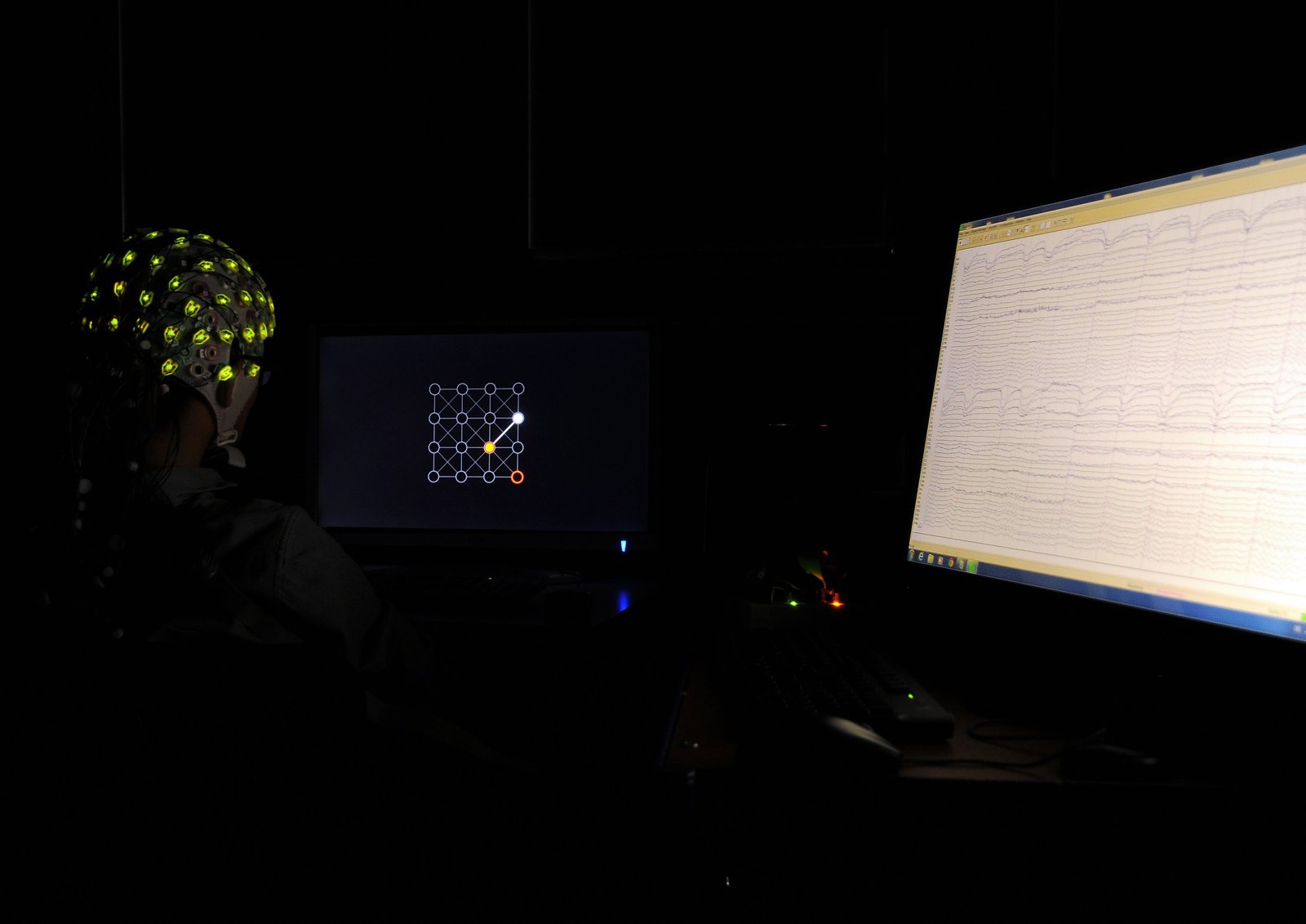
- Non-Invasive BCIs (Electroencephalography — EEG): Utilize external electrode caps placed over the scalp. While completely safe and requiring no surgery, they suffer from exceptionally poor spatial resolution. Because electrical signals must travel through the meninges, skull bone, muscle, and skin, the signals become heavily attenuated and blurred — akin to trying to listen to an orchestra through a soundproof concrete wall.
- Semi-Invasive BCIs (Electrocorticography — ECoG and Endovascular Stentrodes): Electrodes rest on the surface of the cerebral cortex beneath the dura mater, or are navigated endovascularly via catheters through the jugular vein into cortical blood vessels (such as the pioneering approach developed by Synchron). They deliver superior signal quality without penetrating brain parenchyma.
- Fully Invasive BCIs (Intracortical Arrays — Neuralink and Utah Arrays): Microscopic electrode filaments are inserted directly into the deep layers of the Primary Motor Cortex (Layers IV and V), resting micrometers away from individual neuronal soma. This physical proximity allows researchers to record single-unit action potentials with sub-millisecond precision.
2. The Hardware Engineering of Neuralink: The N1 Implant and R1 Surgical Robot
While invasive electrode arrays have existed in clinical research since the late 1990s (most notably the rigid silicon Utah Array, which features 100 micro-needles wired to a bulky transcutaneous pedestal screwed into the patient’s skull), Neuralink introduced a paradigm shift in miniaturization, channel density, and wireless biocompatibility.
The Neuralink ecosystem comprises three core engineering achievements:
The N1 Implant (Biocompatible Silicon on the Skull)
The N1 device is a hermetically sealed, coin-sized circular canister implanted into a precision-milled pocket in the skull, resting flush with the bone and entirely concealed beneath the scalp.
Its internal technical specifications rival specialized microprocessors:
- 1,024 Recording Channels: The implant processes data across 1,024 individual electrode sites distributed across 64 ultra-thin flexible threads.
- On-Chip Signal Processing: Custom Application-Specific Integrated Circuits (ASICs) amplify weak analog neural signals, filter background biological noise, and digitize data locally with a power budget of mere milliwatts to prevent thermal heating of brain tissue.
- Wireless Telemetry and Inductive Charging: The N1 eliminates percutaneous wires entirely. It transmits digitized neural data via low-latency Bluetooth Low Energy to external devices and recharges its custom lithium-ion battery wirelessly via magnetic induction.
Ultra-Flexible Polymeric Neural Threads
Rather than employing rigid silicon needles — which cause continuous shear stress and inflammatory trauma as the brain naturally pulsates within the skull —, Neuralink engineered ultra-flexible threads composed of biocompatible polyimide with thin-film gold and platinum conductive traces.
Each thread measures just 4 to 6 micrometers in thickness — roughly one-tenth the diameter of a human hair and on the same dimensional scale as a single red blood cell. This gossamer flexibility allows the threads to float harmoniously with intracranial vascular pulsations, minimizing tissue scarring.
The R1 Surgical Robot: Sub-Micron Automated Insertion
Because human hands and optical microscopes lack the mechanical dexterity required to insert 64 flexible micrometer-scale threads into pulsating brain tissue without rupturing micro-vessels, Neuralink engineered the R1 Surgical Robot.
Equipped with optical coherence tomography, multi-wavelength illumination, and computer vision guidance, the robot utilizes a microscopic insertion needle thinner than a human hair to grip each thread by a laser-machined loop and insert it individually into the cortex at depths of approximately 1.5 millimeters. The robot’s automated vision system continuously tracks cortical blood vessels, inserting threads exclusively into avascular zones to virtually eliminate micro-hemorrhages.
3. From Spikes to Software: How Artificial Intelligence Decodes Thought
Gathering raw microvolt signals from inside the motor cortex is only half the battle. The true technological breakthrough that transforms biological noise into fluid digital control lies in Machine Learning and Real-Time Signal Processing.
When a human user intends to move their hand to the right, thousands of neurons in the motor cortex change their firing rates in complex, distributed patterns. A single neuron does not encode a full movement command; rather, velocity and direction are collective properties of the entire neural population.
The real-time decoding pipeline executes in fractions of a second:
- 1. Spike Detection and Filtering: The N1 chip filters raw voltage streams, eliminating muscle artifacts and identifying individual action potentials across all 1,024 channels.
- 2. Feature Binning: Firing events are aggregated into discrete 10- to 20-millisecond time bins, generating high-dimensional mathematical activity vectors.
- 3. Neural Decoding Algorithms: Advanced statistical decoders — including Adaptive Kalman Filters, Recurrent Neural Networks (RNNs), and Transformer architectures — map real-time firing dynamics to spatial velocity vectors and click intents.
- 4. Cursor Execution: The external operating system translates these decoded vectors into smooth on-screen cursor trajectories (X, Y coordinates) and click actions with imperceptible latency.
The Landmark Milestone of Noland Arbaugh
In January 2024, Neuralink achieved a historic clinical milestone by implanting its device into its first human participant, Noland Arbaugh, a 29-year-old quadriplegic paralyzed from the shoulders down following a diving accident.
The functional outcomes exceeded all expectations: within days of calibration, Noland learned to control a computer cursor purely by imagining hand movements. He shattered previous world records for BCI cursor control speed (measured in Bits Per Second), regained total autonomy to browse the internet, played online chess matches late into the night, and competed in multi-hour sessions of complex strategy games like Civilization VI and Mario Kart.
Even when a subset of threads experienced mechanical retraction in the early post-surgical weeks due to brain tissue settling, Neuralink demonstrated the power of its adaptive software architecture: by re-engineering the decoding pipeline to extract richer features from remaining channels, Noland’s control velocity was fully restored and subsequently elevated beyond baseline levels.
4. Beyond Motor Control: The Next Frontiers of Neural Interfacing
Motor cursor navigation represents merely the first milestone of neural interface engineering. Advanced neurotechnology laboratories are actively charting transformative subsequent frontiers:
Closed-Loop Bidirectional BCIs: Restoring Synthetic Touch
Contemporary commercial implants operate primarily as “read” devices (extracting signals from the brain to the machine). The next leap is bidirectional interfacing: reading from motor areas while “writing” sensory data back into the brain.
By integrating pressure and shear sensors into the fingertips of advanced prosthetic limbs and routing those signals to the Primary Somatosensory Cortex (S1) via microstimulation pulses, users will not only command a robotic arm with their thoughts, but actually feel the texture, compliance, and temperature of objects, closing the sensorimotor loop.
Project Blindsight: Restoring Visual Perception
Another major initiative underway is Blindsight — the direct electrical stimulation of the Primary Visual Cortex (area V1) in the occipital lobe.
By interfacing a high-resolution digital camera with a visual cortical implant, incoming video feeds can be converted into localized microstimulation patterns that generate conscious points of light known as phosphenes. This architecture bypasses damaged retinas and severed optic nerves, offering the potential to restore visual perception to individuals with complete blindness, while theoretically opening the door to perceiving non-visible spectrums such as infrared and ultraviolet.
High-Speed Brain-to-Text and Speech Restoration
Research teams at Stanford University and UCSF have proven that by recording from cortical regions responsible for vocal tract kinematics (such as the ventral premotor cortex and Broca’s area), artificial intelligence can decode the “silent intent to speak” in patients paralyzed by stroke or ALS, translating thoughts into digital text and synthesized voices at rates exceeding 60 to 70 words per minute — approaching natural conversational cadence.
5. Major Engineering Bottlenecks, Biocompatibility, and Neuroethics
Despite breathtaking clinical progress, permanent intracortical neurotechnology faces formidable biological, thermodynamic, and ethical challenges:
The Foreign Body Response and Reactive Gliosis
The human brain is a hostile electrochemical environment: warm, saline, and guarded by vigilant immune cells (microglia and astrocytes). Over time, these immune cells naturally isolate foreign implants by encapsulating electrode tips in dense fibrous scar tissue (reactive gliosis), which acts as an electrical insulator and degrades signal-to-noise ratios. Developing ultra-compliant bio-coatings that evade immune recognition for decades remains a premier frontier in materials science.
Thermodynamic Constraints and Cybersecurity
Processing broadband neural telemetry consumes electrical energy. However, neural tissue is exceptionally delicate: sustained temperature increases of just 1 °C can induce cellular apoptosis. BCIs must operate under hyper-efficient thermodynamic envelopes.
Furthermore, once a medical device inside the human skull connects wirelessly to computing networks, it presents an unprecedented cybersecurity attack surface. Protecting neural data streams with hardware-level cryptographic isolation and fail-safe firmware architectures is an existential safety requirement.
Neuroethics and Cognitive Liberty
The ability to directly interface with the human central nervous system raises profound societal and legal questions:
- Neural Data Privacy: Who owns raw brainwave telemetry? Could subconscious emotional states, cognitive fatigue, or implicit biases be extracted from commercial BCI logs?
- Agency and Attribution: When an adaptive AI decoder predicts a user’s intent milliseconds before full conscious execution, where does human agency end and algorithmic autonomy begin?
- The Cognitive Divide: If future commercial BCIs enable augmented memory retention or accelerated learning in healthy populations, how will global society prevent an insurmountable socioeconomic divide between “connected” and “unconnected” individuals?
6. Conclusion: The Dawn of the Connected Mind
The trajectory of human civilization has always been defined by the tools we create: from stone handaxes to the printing press, from mechanical engines to pocket supercomputers. Throughout history, the biological barrier between the human organism and the machine remained unbridgeable.
Brain-Computer Interfaces are finally dissolving that barrier. What began as a noble clinical mission to restore movement to the paralyzed and speech to the silent is opening the gateway to an unprecedented era of human evolution.
At Reach Technocracy, we will remain dedicated to analyzing each clinical milestone, silicon architecture, and ethical paradigm where biological consciousness and artificial intelligence converge to define our shared future.
Would you ever consider receiving a neural implant if it restored a lost biological capability or enabled you to interface with technology at the speed of thought? Where do you draw the line between clinical therapy and cybernetic enhancement? Share this article with your network of technology enthusiasts, and leave your thoughts in the comments below!
🔭 Continue Exploring the Frontier of Science and Technology: