
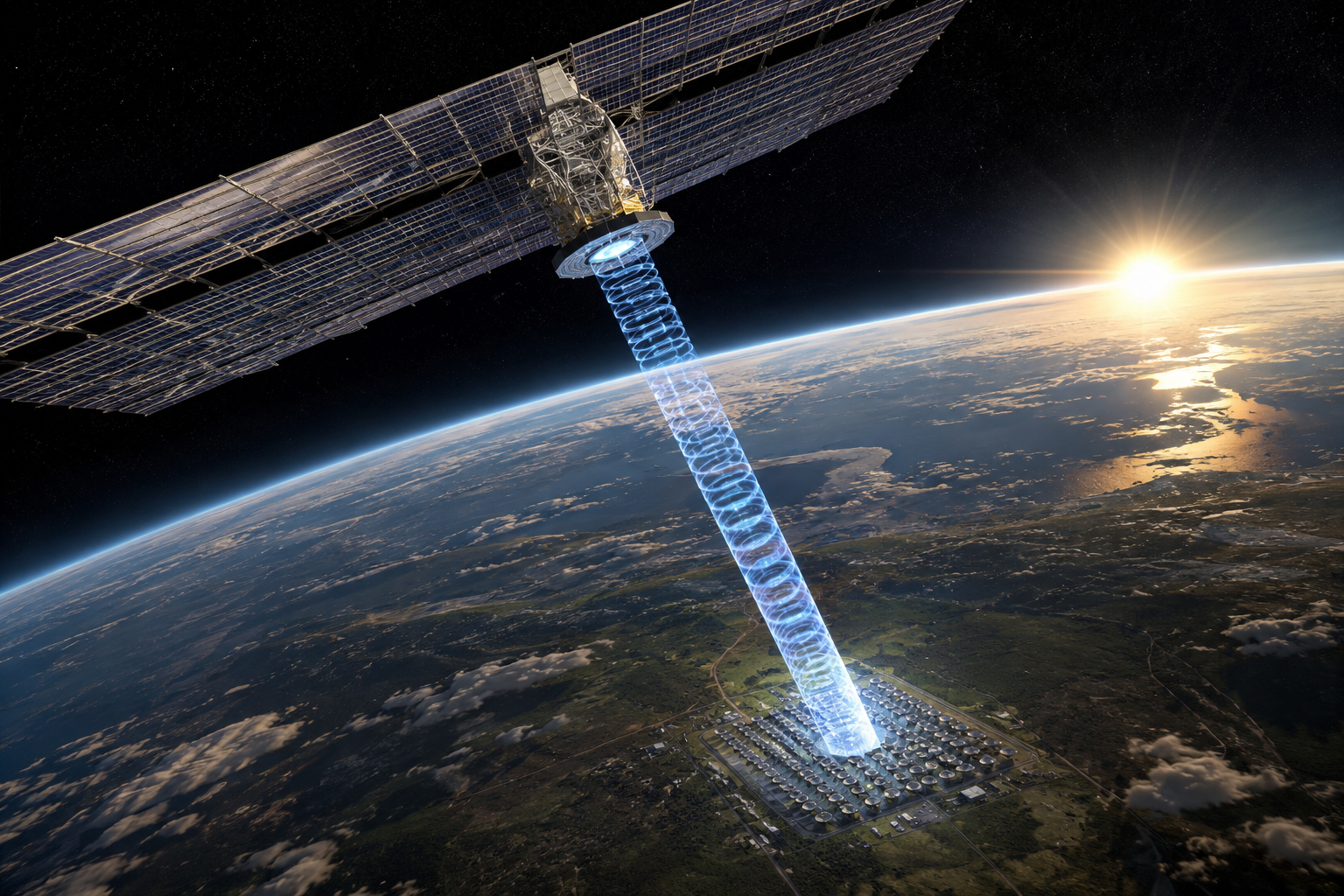
If you spent your childhood or teenage years immersed in SimCity 2000 or SimCity 3000, you undoubtedly remember the crowning jewel of futuristic civic infrastructure: the Microwave Power Plant. For a massive municipal investment, players could deploy an orbital receiving station that captured pristine solar energy beamed directly from space satellites, delivering limitless, zero-emission electricity to power sprawling metropolises. Yet, veteran players also remember the panic when disaster struck: a minor orbital misalignment caused the energy beam to veer off target, scorching suburban neighborhoods and setting city blocks ablaze.
In classic science fiction literature, the foundational vision of wireless orbital energy was articulated with prophetic clarity in Isaac Asimov’s seminal 1941 short story Reason. In Asimov’s narrative, station engineers Powell and Donovan—alongside the inquisitive robot QT-1 (“Cutie”)—supervise a colossal orbital solar station collecting raw radiation in the vacuum of space and focusing it into microwave beams, transmitting uninterrupted power through planetary storms to fuel the industrial grids of Earth and Mars. Decades later, the anime masterpiece Mobile Suit Gundam 00 (2007) envisioned an entire global energy architecture built around orbital space elevators connected to a vast solar collector ring, while mega-stations across the Star Wars galaxy routinely harvest stellar energy to sustain planetary networks.
For more than a century, however, terrestrial humanity has remained bound to a compromised energy paradigm. While the Sun is a natural thermonuclear reactor bathing our solar system in radiant energy, our attempts to harvest this cosmic furnace from Earth’s surface are severely crippled by planetary physics: atmospheric scattering, cloud cover, seasonal variances, and the unavoidable reality of night. When darkness falls or storm fronts stall over landmasses, solar grids collapse, forcing utility operators to fire up fossil fuel turbines or burn natural gas to maintain baseload stability.
However, behind the science fiction lore of video games and space operas, modern aerospace engineering and applied electrodynamics are turning Asimov’s dream into a tangible reality: Space-Based Solar Power (SBSP).
Pioneered by conceptual frameworks from NASA and Dr. Peter Glaser in 1968, SBSP is experiencing a massive global renaissance in 2026. Armed with breakthroughs in ultralight modular phased arrays, high-efficiency gallium arsenide (GaAs) photovoltaics, and megawatt-scale wireless power transmission (WPT), world-class institutions—including the California Institute of Technology (Caltech), the European Space Agency (ESA) under its ambitious SOLARIS initiative, the Japan Aerospace Exploration Agency (JAXA), and China’s Xidian University—are transitioning space solar from theoretical chalkboards to operational orbital hardware.
In this technical deep-dive from Reach Technocracy, we dissect the physics of the solar constant in space, explore how phased array transmitters dynamic-beam microwave radiation across 36,000 kilometers, examine the in-orbit success of Caltech’s MAPLE experiment on the SSPD-1 satellite, analyze how SpaceX’s Starship demolishes economic launch barriers, and evaluate the environmental, spectrum, and geopolitical implications of orbital energy.
1. The Sun That Never Sets: The Physics of Space Solar Harvesting
Harvesting solar power from orbit represents a generational leap over ground installations due to fundamental thermodynamic and radiometric differences between space and Earth’s surface.
The Solar Constant in Vacuum vs. Atmospheric Attenuation
At the top of Earth’s atmosphere, radiant power density is governed by the Solar Constant (G_SC), averaging approximately 1,361 Watts per square meter (W/m²). This photon flux spans the spectrum, unimpeded by matter or atmospheric absorption.
Once solar radiation enters Earth’s atmosphere, it undergoes severe physical attenuation:
- Rayleigh and Mie Scattering: Photons collide with nitrogen, oxygen, dust, and aerosols, scattering a substantial fraction of high-energy wavelengths back into space.
- Molecular Absorption: Ozone (O₃) absorbs ultraviolet radiation, while carbon dioxide (CO₂) and water vapor (H₂O) absorb discrete infrared bands.
- Air Mass (AM) Attenuation: Even on a cloudless day at the equator (Air Mass 1, or AM1), peak solar irradiance reaching the ground rarely exceeds 1,000 W/m². In temperate zones (Air Mass 1.5), peak irradiance drops to 800 W/m² or lower.
In the hard vacuum of Geostationary Earth Orbit (GEO)—at an altitude of 35,786 kilometers—atmospheric absorption is strictly zero. An orbital collector operates under continuous Air Mass Zero (AM0) conditions, receiving an intense flux of 1,361 W/m² without atmospheric loss.
The Tyranny of Terrestrial Intermittency
The true bottleneck of terrestrial solar power is Capacity Factor—the ratio of actual electrical energy generated compared to theoretical maximum output:
- The Day-Night Cycle: Terrestrial solar panels generate zero electricity for over 50% of every 24-hour day.
- Geometric Sun Angles: Morning and afternoon sun angles reduce the effective cross-sectional area of fixed panels.
- Meteorological Obstruction: Cloud cover, rain, and pollution degrade ground-based solar output by 70% to 90%.
Consequently, premier desert solar farms (such as in the Atacama or Mojave Deserts) achieve an annual capacity factor of only 20% to 28%, while European and North American averages frequently drop below 15%.
In Geostationary Orbit, a satellite is shadowed by Earth only during brief eclipse windows around the equinoxes (under 72 minutes per night for roughly 45 days a year). As a result, a space solar satellite collects sunlight for over 99% of the year.
Operating in perpetual sunlight without atmospheric filtering, a single square meter of solar panel in GEO generates between 600% and 800% more total kilowatt-hours per year than the exact same panel installed in a prime terrestrial desert location.
2. The Physics of Microwave Power Beaming: From Phased Arrays to Ground Rectennas
Transporting gigawatts of solar power across 36,000 kilometers of space to the electrical grid below without physical wires is accomplished via Wireless Power Transmission (WPT).
Phased Array Antennas and Dynamic RF Beamforming
Early concepts envisioned massive parabolic dishes to direct energy beams, but mechanical tilting imparts immense angular momentum to the spacecraft, requiring thousands of kilograms of attitude-control propellant.
Modern SBSP architectures utilize Solid-State Active Phased Array Antennas (APAAs):
- The transmitting face consists of millions of microscopic radio-frequency (RF) radiating elements in a planar grid.
- Each element is coupled to a solid-state power amplifier (utilizing wide-bandgap Gallium Nitride on Silicon Carbide — GaN-on-SiC technology) and digital phase shifters.
- By controlling the electrical phase relationship (Δθ) of signals emitted across the aperture, individual waves interfere constructively along a single, highly focused direction and destructively elsewhere.
- This dynamic Electronic Beamforming steers the power beam across thousands of kilometers in microseconds without moving parts, compensating for orbital drift and thermal warping in real time.
The Frequency Choice: 2.45 GHz vs. 5.8 GHz
The transmission frequency is dictated by electrodynamics and atmospheric physics:
- The 2.45 GHz ISM Band: At a wavelength of λ = 12.24 cm, 2.45 GHz provides transparent atmospheric transmission. Attenuation through severe rainstorms, clouds, and fog is under 2%, ensuring true baseload delivery. Diffraction limits require a transmitting antenna ~1 km in diameter and a ground receiving station ~10 km across.
- The 5.8 GHz ISM Band: Operating at a shorter wavelength of λ = 5.17 cm, 5.8 GHz allows the dimensions of both the orbital transmitter and ground receiver to be reduced by over 50%, cutting structural mass and launch costs, despite slightly higher rain attenuation during extreme downpours.
Rectenna Arrays and RF-to-DC Conversion Efficiency
On Earth, the incoming microwave beam is captured by a Rectifying Antenna (Rectenna):
- A rectenna is an array of tuned dipole antennas integrated with high-speed Schottky barrier diodes and low-pass harmonic filters.
- When the electromagnetic field passes over the dipole antenna, it induces high-frequency alternating current (AC), which the Schottky diode rectifies into direct current (DC) electricity.
- Demonstrations by JAXA and the U.S. Naval Research Laboratory (NRL) have achieved RF-to-DC conversion efficiencies exceeding 85% to 90%.
- Because rectennas are semi-transparent mesh structures, they allow over 80% of sunlight to pass through, enabling land beneath to be dual-utilized for agriculture, grazing, or ground-based solar farms.
Comparative Table: Terrestrial Solar vs. Space-Based Solar (SBSP) vs. Nuclear Power
| Evaluation Metric | Terrestrial Solar PV | Space-Based Solar Power (SBSP) | Conventional Nuclear Fission |
|---|---|---|---|
| Annual Capacity Factor | 15% – 28% (Intermittent) | > 99% (Continuous 24/7) | 90% – 95% (Continuous Baseload) |
| Solar Irradiance Flux | Up to 1,000 W/m² (AM1.5) | 1,361 W/m² (AM0, constant) | N/A (Thermal Nuclear Fuel) |
| Vulnerability to Weather | Severe (Clouds, Night, Dust) | Zero (Beams through rain/clouds) | Zero (Internal reactor core) |
| Land Footprint per GWe | 50 – 150 km² (Large acreage) | 20 – 35 km² (Transparent rectenna) | 1 – 4 km² (Compact plant) |
| Storage Requirements | Massive (Battery backup) | Zero (Direct baseload feed) | Zero (Direct baseload feed) |
| Carbon Lifecycle | 20 – 45 g CO₂/kWh | < 15 g CO₂/kWh (Starship launch) | 10 – 15 g CO₂/kWh |
| Waste Generation | None (Recycling issues) | None (100% clean flux) | Long-lived spent fuel rods |
3. In-Orbit Milestones: From Caltech’s MAPLE to ESA’s SOLARIS Program
Space-Based Solar Power has officially transitioned from laboratory simulations to operational in-orbit validation.
The MAPLE Experiment and Caltech’s SSPD-1 Mission
In January 2023, the California Institute of Technology (Caltech) launched the Space Solar Power Demonstrator (SSPD-1) into low Earth orbit aboard a SpaceX Falcon 9 rocket. Backed by a $100 million commitment from Donald Bren, the project was led by co-directors Ali Hajimiri, Harry Atwater, and Sergio Pellegrino.
The centerpiece was the MAPLE (Microwave Array for Power-transfer Low-orbit Experiment) payload:
- MAPLE consisted of a lightweight array of custom silicon integrated circuits and microwave transmitters engineered at the micro-scale.
- In June 2023, the Caltech team achieved an epochal milestone: MAPLE successfully generated, electronically steered, and detected a wireless microwave power beam in space, illuminating a bank of light-emitting diodes (LEDs) on the spacecraft.
- Crucially, MAPLE subsequently steered its phased array beam downward and transmitted detectable microwave energy to Earth, captured by a receiver on the roof of the Moore Laboratory of Engineering on Caltech’s Pasadena campus.
- This marked the first time in human history that wireless power was transmitted from an orbiting spacecraft to the surface of Earth.
ESA’s SOLARIS Initiative, JAXA, and China’s Zhuri Project
The success of early flight demonstrators has ignited a global race across major space agencies:
- ESA’s SOLARIS Programme: Established by the European Space Agency at its 2022 Ministerial Council, SOLARIS is maturing key technologies for commercial-scale SBSP. The European roadmap targets a decision on a full development program, aiming to deploy a sovereign 1 to 2 Gigawatt orbital power station by the late 2030s.
- JAXA’s Decades of Ground Validation: Japan has led wireless power transmission research for over two decades. Under JAXA’s Space Solar Power Systems (SSPS) roadmap, Japanese engineers have demonstrated high-power 5.8 GHz beaming across hundreds of meters with millimeter precision.
- Xidian University and the Zhuri Project: In China, the team led by Academician Duan Baoyan at Xidian University constructed the world’s first full-chain ground verification facility for space solar power, known as the Zhuri (“Chasing the Sun”) Project. Featuring a 75-meter test tower, the facility validated high-power microwave beaming, light concentrating optics, and omnidirectional rectenna tracking.
4. The Starship Revolution: Slashing Launch Costs per Kilogram
Throughout the late 20th century, the bottleneck of Space-Based Solar Power was never electrodynamics; it was the economics of rocketry.
A commercial-scale 1 Gigawatt (GW) space solar power satellite is an absolute megastructure. Even with advanced carbon-composite trusses and thin-film solar cells, a 1-GW orbital station has an estimated mass of 2,000 to 5,000 metric tons—roughly 5 to 10 times the mass of the International Space Station (ISS).
Heavy-Lift Deflation: How $10/kg Unlocks Megastructure Economics
During the Space Shuttle era, launching mass into low Earth orbit cost approximately $54,500 per kilogram. At that price, putting materials for a single solar satellite into orbit would have cost an astronomical $200 billion to $300 billion solely in freight charges.
The advent of commercial reusable rocketry has shattered this economic barrier:
- Falcon 9 and Falcon Heavy: Reduced launch costs to approximately $1,500 to $2,500 per kilogram to LEO.
- SpaceX Starship and Next-Gen Heavy Launchers: The development of fully reusable heavy-lift vehicles designed to lift 100 to 150 metric tons per flight is projected to compress launch costs to $100/kg initially, and ultimately toward $10 to $20 per kilogram at full industrial cadence.
At a launch cost of $50/kg, transportation expenditure for a 3,000-ton space solar plant drops to roughly $150 million. Amortized over a 30-year operational lifespan, the projected LCOE of SBSP converges toward $0.03 to $0.05 per kilowatt-hour ($30 to $50/MWh), placing orbital solar in direct cost parity with natural gas.
Autonomous In-Space Robotic Assembly and Modular Ultralight Tiles
Modern SBSP architectures rely on Modular Distributed Systems:
- The satellite is decomposed into millions of identical “Sandwich Tiles” measuring roughly 10 cm by 10 cm and only a few millimeters thick.
- One side consists of high-efficiency photovoltaic cells; the center houses integrated RF circuitry; and the reverse side forms the phased-array microwave transmitting antenna.
- These tiles are packed into rocket fairings, launched in bulk, and autonomously unfurled in orbit using roll-out carbon-fiber composite booms.
- Autonomous robotic servicer arms and assembly drones weld structural trusses and interconnect modular panels, creating a flexible, damage-tolerant orbital array stretching 1 to 2 kilometers across.
5. Safety, Electromagnetic Spectrum, and the Geopolitics of Orbital Power
As technological and economic barriers fall, the conversation shifts toward planetary safety, spectrum allocation, and geopolitical stability.
Biological Safety of Non-Ionizing Microwave Beams
The most pervasive public misconception regarding Space-Based Solar Power is the fear that an orbital microwave beam could act as a weapon. The laws of electrodynamics make such a scenario physically impossible:
- Non-Ionizing Radiation: Microwaves at 2.45 GHz or 5.8 GHz are non-ionizing radiation. Unlike X-rays, microwave photons possess insufficient quantum energy to break chemical bonds or damage DNA.
- Diffuse Energy Density: Because the beam spreads over a receiver area 5 to 10 kilometers in diameter, peak power density at the center of the beam is capped at approximately 250 to 300 Watts per square meter (W/m²).
- Comparison to Natural Sunlight: Direct midday summer sunlight delivers 1,000 W/m². The microwave energy density at the center of the rectenna is less than one-fourth the intensity of natural sunlight.
- Fail-Safe Pilot Beam Phase-Locking: The orbital phased array cannot transmit a coherent beam without an active Pilot Signal transmitted upward from the ground rectenna. If the satellite loses the pilot signal, the array instantly loses phase coherence, causing the beam to de-focus and scatter harmlessly.
Orbital Slot Allocations, ITU Spectrum Battles, and Dual-Use Fears
Deploying gigawatt-scale orbital power networks introduces profound geopolitical challenges:
- Geostationary Orbital Congestion: The geostationary orbital ring is a finite international resource. Allocating prime orbital slots for power stations will require extensive negotiations within the United Nations International Telecommunication Union (ITU).
- Radio Frequency Interference (RFI): A gigawatt beam must operate with strict spectral purity to prevent out-of-band interference with cellular networks, aviation radar, and radio astronomy.
- Dual-Use Geopolitical Leverage: While an SBSP satellite cannot be weaponized into a death ray, it represents immense geopolitical power. A nation possessing a sovereign orbital solar constellation can dynamically redirect gigawatts of electricity across continents in seconds—providing emergency baseload power to allied nations.
6. Conclusion: The First Rung of the Dyson Swarm
In 1964, Soviet astrophysicist Nikolai Kardashev proposed a cosmic scale to classify the technological maturity of civilizations: a Type I Civilization harnesses the entirety of energy resources on its home planet, while a Type II Civilization harnesses the complete energy output of its host star via mega-structures like a Dyson Sphere.
For millennia, humanity has lingered at Type 0.73—burning fossilized hydrocarbons and scraping together intermittent surface flows while the Sun radiates 3.8 × 10²⁶ Watts of pure thermonuclear energy into space.
Space-Based Solar Power represents humanity’s first concrete engineering step toward climbing the Kardashev scale. By launching modular, self-assembling solar collector arrays into orbit and converting stellar radiation into continuous microwave energy, we are building the embryonic architecture of a Dyson Swarm.
The hurdles ahead are formidable: scaling autonomous in-space manufacturing, establishing international spectrum protocols, and deploying gigawatt-scale rectenna infrastructure across the globe. Yet, the convergence of ultralight semiconductor physics, dynamic RF phased arrays, and radical heavy-lift launch deflation has transformed orbital power from Asimov’s science-fiction canvas into the most consequential clean energy frontier of the 21st century.
At Reach Technocracy, we will continue tracking every orbital deployment, every high-power beamed transmission trial, and every regulatory breakthrough shaping the dawn of space-based energy.
Do you believe Space-Based Solar Power will surpass terrestrial nuclear and fusion power to become Earth’s primary baseload clean energy source by 2045? How should international space agencies and the ITU govern the orbital slots and energy beams of tomorrow? Share your technical perspectives in the comments below and join the conversation at Reach Technocracy!
🔭 Continue Exploring the Frontier of Science and Technology:
- Superhot Rock Geothermal: Millimeter-Wave Drilling
- Beyond Chemical Rockets: Ion Engines, Solar Sails, and Fusion Propulsion
- The Mega-Engineering of the James Webb Space Telescope