
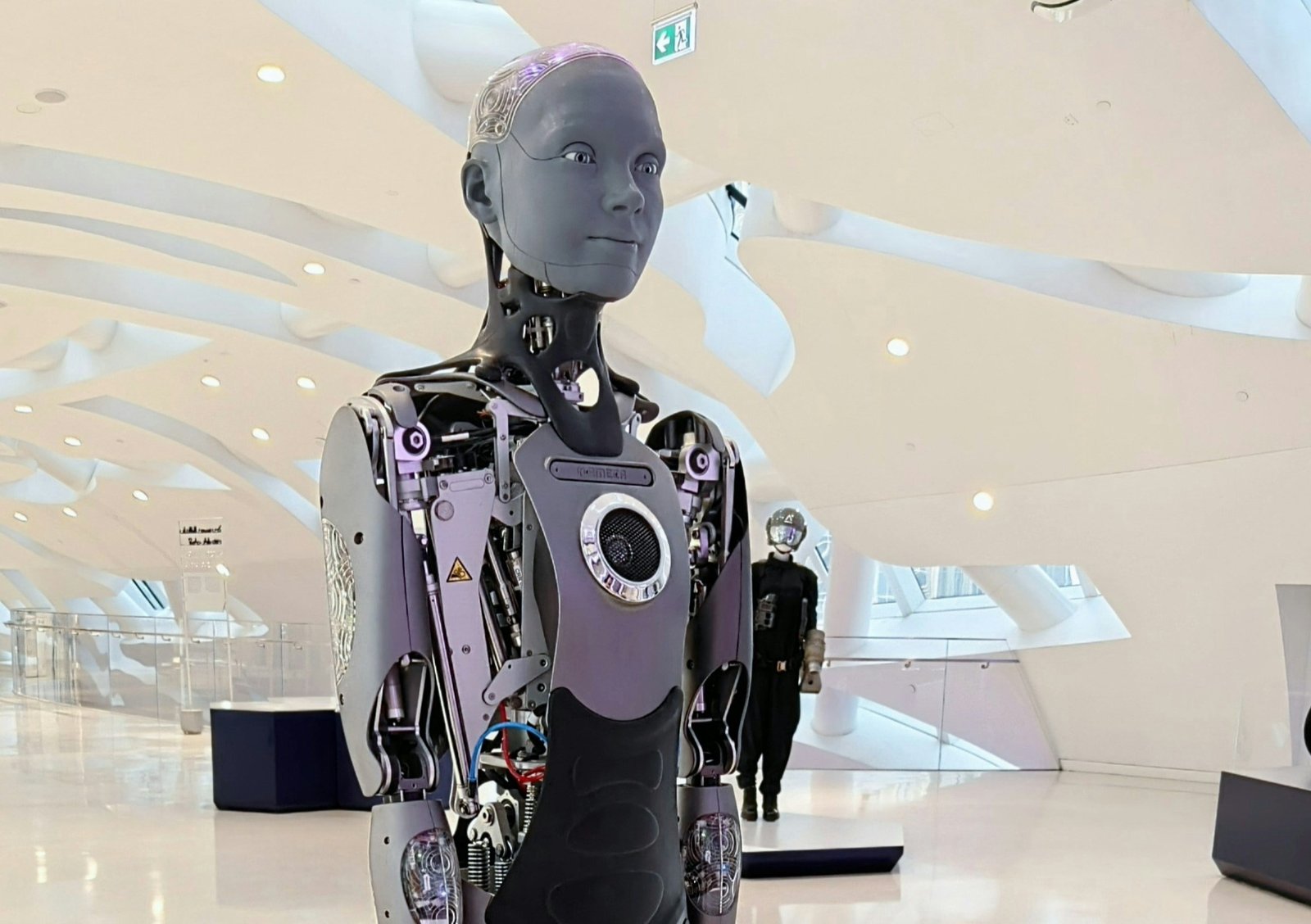
If you watched the acclaimed blockbuster I, Robot (2004), starring Will Smith and loosely inspired by the legendary stories of Isaac Asimov, you undoubtedly remember the iconic NS-5 humanoid robots: agile, elegant, and versatile bipedal machines that walked among humans, carried groceries, cooked meals, and executed complex industrial tasks with flawlessly coordinated movements.
If your cinematic compass points toward the existential masterpiece Ex Machina (2014), the intelligence and biomechanical precision of the android Ava captured humanity’s enduring fascination with fusing synthetic minds with physical chassis that mirror biological anatomy. Or consider the classic sci-fi monument The Terminator (1984), where the relentless bipedal endoskeleton of the T-800 stood as the cultural symbol of an unyielding mechanical organism.
For nearly half a century, however, real-world robotics remained light-years behind Hollywood’s imagination. The most advanced industrial robots were bolted to factory floors inside caged automotive assembly lines — blind, massive mechanical arms executing the exact same spot weld millions of times —, while laboratory bipedal prototypes were rigid, sluggish, and humorously tumbled over at the slightest floor imperfection.
Yet in recent years, the global robotics landscape has experienced its defining “ChatGPT moment.” We are currently witnessing the most explosive convergence of biomechanical engineering and deep learning in human history: The Great Humanoid Robotics Race.
Pioneering deep-tech enterprises including Tesla (with the Optimus Gen 3), Boston Dynamics (with its stunning All-Electric New Atlas), Figure AI (backed by tech titans), and Unitree are taking humanoid robots out of research labs and deploying them onto active industrial factory floors. More than raw electric power, these machines are being endowed with the Holy Grail of modern robotics: Physical AI and World Models — deep multimodal neural networks that do not merely process text, but inherently comprehend gravity, friction, inertia, and 3D spatial dynamics.
In this comprehensive deep dive from Reach Technocracy, we lift the hood on this mechanical revolution. We will examine the unforgiving physics of bipedal balance, contrast the engineering war between hydraulic and electric actuators, analyze why building a human-like dexterous robotic hand is vastly harder than beating a world chess grandmaster, explore how World Models teach neural networks to “think with a physical body,” and evaluate the socioeconomic impact of humanoid automation across global manufacturing.
1. Defying Gravity: The Unforgiving Physics of the Inverted Pendulum
To the average human being, walking on two legs is an act as subconscious and effortless as breathing. Yet from the perspective of classical physics and dynamical control theory, human bipedal locomotion is fundamentally a continuous sequence of controlled forward falls.
Unlike a four-legged table or a wheeled rover — which enjoy static stability and never tip over when stationary —, the human bipedal form is an Unstable Inverted Pendulum. Our center of mass is situated high above the ground (at pelvic height), balanced upon an exceptionally narrow and continuously shifting base of support: the soles of two feet.
With every single stride you take:
- Your center of mass is deliberately pitched forward, initiating a gravitational fall toward the ground.
- In a fraction of a second, your central nervous system commands dozens of antagonistic muscles in the opposite leg to swing forward, absorb the impact of heel strike, and dynamically establish a new base of support.
- Vestibular organs in the inner ear and proprioceptors along tendons calculate angular velocities in real time, micro-adjusting joint stiffness to counteract gravity.
The Zero Moment Point (ZMP) and Model Predictive Control
Throughout the 1990s and 2000s, pioneer roboticists attempted to govern bipedal balance using the rigid Zero Moment Point (ZMP) criterion. This mathematical framework strictly mandated that the resultant vector of all inertial and gravitational forces must remain strictly within the physical perimeter of the foot’s contact patch.
This produced that iconic, awkward, knee-bent, flat-footed robotic walk (typified by Honda’s historic ASIMO), which required perfectly flat laboratory surfaces and moved with excruciating rigidity.
Modern humanoid robotics has completely transcended that constraint. Today, bipedal platforms utilize Model Predictive Control (MPC) coupled with deep Reinforcement Learning. The robot simulates the physics of its next 20 footsteps every single millisecond: if it trips over an obstacle or absorbs a sudden lateral push, neural decoders recalculate foot placement and joint torques instantaneously, enabling dynamic, fluid balance recovery on par with human athletes.
2. The Actuator War: From Heavy Hydraulics to Axial-Flux Electric Motors
An intelligent neural brain is powerless without the mechanical “musculature” required to convert electrical energy into dynamic physical work. This musculature is comprised of mechanical actuators — the motorized joint assemblies that rotate shoulders, flex elbows, actuate hips, and support knees.
Over the past two years, the robotics industry underwent an architectural paradigm shift:
The Hydraulic Legacy: The Original Atlas Era
For over a decade, Boston Dynamics’ original research Atlas was the undisputed king of acrobatic robotics, performing viral backflips, gymnastics routines, and parkour courses. That unprecedented dynamic power was generated by hydraulic actuators: a central pump compressed specialized mineral oil to extreme pressures of over 3,000 psi (approximately 200 atmospheres), driving custom titanium cylinders with unmatched power density.
However, hydraulics proved fundamentally ill-suited for commercial mass deployment:
- Hydraulic power units were loud, energy-inefficient, and generated massive thermal waste heat.
- High-pressure fluid leaks were an inherent operational risk, contaminating industrial environments.
- Precision machining and maintenance of hundreds of miniature hydraulic proportional valves drove unit costs into millions of dollars.
The All-Electric Transformation: Axial-Flux Motors and Cycloidal Drives
In April 2024, Boston Dynamics retired its hydraulic platform to unveil the All-Electric New Atlas, joining the design philosophy spearheaded from day one by Tesla’s Optimus and Figure 02.
Modern electric humanoids leverage state-of-the-art permanent-magnet synchronous motors paired with zero-backlash high-reduction gearboxes (such as Strain Wave Harmonic Gears and Cycloidal Reducers).
Electric actuation provides decisive advantages:
- Superior Energy Efficiency: Unlike hydraulic systems that continuously burn power circulating pressurized fluid, electric motors draw current only when executing active torque.
- Virtual Compliance and Impedance Control: Electric motors measure phase current at kilohertz frequencies to directly estimate applied torque. This enables programmable “compliance”: if the robot inadvertently bumps into a human coworker, its joints yield softly rather than applying destructive mechanical force.
- Superhuman 360-Degree Articulation: The Electric New Atlas proved that humanoid robots need not be constrained by human anatomical limits. Its joints rotate continuously through 360 degrees without mechanical stops: the robot can rise from the floor by swiveling its legs backward and rotate its torso completely without turning its feet, executing warehouse workflows with kinematics impossible for biological bodies.
3. The Enigma of the Robotic Hand: Moravec’s Paradox in Action
In the history of Artificial Intelligence, cognitive scientist Hans Moravec famously formulated Moravec’s Paradox in the 1980s: “It is comparatively easy to make computers exhibit adult-level performance on intelligence tests or playing checkers, and difficult or impossible to give them the skills of a one-year-old when it comes to perception and mobility.”
Nowhere is this paradox more acute than in engineering a Dexterous Humanoid Robotic Hand.
The human hand incorporates 27 individual bones, 34 muscles, over 20 degrees of freedom, and approximately 17,000 specialized mechanoreceptors across the fingertips. It can seamlessly exert crushing grip force to swing a sledgehammer and, seconds later, delicately thread a needle, untie a tangled knot, or hold a fragile raw egg without fracturing its shell.
Mechanical Architecture of Next-Gen Robotic Hands
To operate seamlessly in human-centric infrastructure (manipulating power tools, door handles, keyboard switches, and fragile packaging), humanoid hands require extreme electromechanical density:
- Tendon-Driven Remote Actuation: Platforms like Tesla Optimus Gen 3 and Figure 02 relocate the bulky electric motors from the fingers into the robot’s forearm, utilizing high-tensile synthetic cables (such as Kevlar and Spectra) acting as biological tendons. This maintains gossamer-light fingers with minimal rotational inertia.
- High-Density Tactile Skin: Modern robotic fingertips are clad in flexible silicone elastomers embedded with dense arrays of piezoresistive and optical tactile sensors. These sensors detect shear forces, pressure gradients down to micro-newtons, and slip velocities in real time.
- Sub-Millisecond Reflex Loops: When an object begins to slip from a biological grasp, spinal reflex arcs tighten grip pressure subconsciously. Advanced humanoid hands now utilize hardware-level neural loops operating at sub-5-millisecond latencies, enabling reliable grasping of heavy metallic cylinders and delicate soft fruit alike.
4. Physical AI and World Models: How Neural Networks Learn Physics
For decades, robotic manipulation required thousands of lines of deterministic, hardcoded kinematics: engineers had to hand-craft exact trajectory equations for every motor angle to move a gripper to coordinate (X, Y, Z). If a target component was offset by just two centimeters, the system failed catastrophically.
The true watershed moment making humanoid deployment possible is the unification of robotics with World Models and End-to-End Deep Learning.
Vision-Language-Action (VLA) Foundation Models
Rather than decomposing robotic tasks into fragmented brittle modules (object detection -> 3D coordinate mapping -> trajectory planning -> joint inverse kinematics), cutting-edge humanoids deploy unified Vision-Language-Action (VLA) foundation models.
A single massive neural network ingests:
1. High-framerate RGB-D video streams from multi-camera arrays on the robot’s head and torso.
2. Natural language user instructions (e.g., “Pick up the battery pack from the conveyer and seat it into the chassis fixture”).
3. Proprioceptive telemetry tracking joint angles, velocities, and torques.
The model processes this multimodal context end-to-end, directly predicting continuous torque and velocity commands across all 30+ body actuators.
Hyper-Scale Physics Simulation: The Sim-to-Real Pipeline
Because training deep reinforcement learning models directly on physical hardware would destroy millions of dollars in mechanical prototypes during trial-and-error exploration, robotics teams train inside GPU-accelerated physics engines (such as NVIDIA Isaac Sim).
Inside the digital simulation:
- Thousands of virtual humanoid instances train in parallel at speeds 1,000 times faster than physical reality.
- Physics engines continuously randomize lighting conditions, object masses, friction coefficients, and mechanical latencies (Domain Randomization).
- In mere hours of supercomputer compute, the neural model accumulates centuries of embodied physical experience.
- The trained neural weights are deployed directly onto physical hardware (Sim-to-Real Transfer), enabling the physical robot to execute zero-shot manipulation tasks in dynamic factory conditions.
5. The Economics of the Factory Floor: Batteries, Costs, and Labor Scaling
The commercial rush toward humanoid robotics is driven by monumental economic tailwinds: structural labor shortages across rapidly aging industrial economies (such as Japan, South Korea, Europe, and China) and the demand for continuous manufacturing productivity.
However, widespread enterprise adoption hinges upon conquering three industrial barriers:
Battery Energy Density and Operational Uptime
Driving dozens of high-torque motors on two legs demands significant energy. Modern humanoids integrate custom 48V to 100V lithium-ion battery packs (2 to 3 kWh embedded in the torso), delivering 4 to 8 hours of continuous mixed-duty operation. To enable true 24/7 uptime, humanoids are being designed with autonomous floor-plate induction charging or automated 2-minute battery-swap bays.
Bill of Materials (BOM) and Automotive-Scale Manufacturing
Historically, robotic prototypes cost upwards of hundreds of thousands of dollars. The thesis driving Tesla’s Optimus and Unitree’s G1 is leveraging automotive supply chain economies of scale: mass-producing custom permanent-magnet actuators and stamped structural frames to drive unit manufacturing costs down to the $20,000 to $30,000 range — rivaling the purchase price of an entry-level passenger vehicle.
Functional Safety Certification and Collaborative Workspaces
Traditional industrial robots operated inside locked steel cages because unexpected motion could be fatal to nearby personnel. Humanoid robots are built as Collaborative Robots (Cobots). They require rigorous ISO safety certifications: 360-degree spatial perception systems that anticipate human trajectory paths and software-enforced force limiters that safe-stop actuators upon minimal unexpected contact.
6. Conclusion: The Arrival of the Bipedal Workforce
Throughout history, human civilization constructed the physical world to match our biological dimensions: door handles placed at waist height, staircases with 18-centimeter risers, handheld power tools with contoured grips, and narrow factory corridors.
This is precisely why the humanoid form factor is the ultimate universal automation solution. Building a robot with the physical architecture of a human eliminates the need to spend trillions of dollars retrofitting existing factories, warehouses, hospitals, and residential spaces for specialized wheeled rovers: the humanoid steps directly into infrastructure built for human beings.
What began as the visionary science fiction of Isaac Asimov and Hollywood cinema is becoming the operational backbone of global industry. The fusion of embodied physical intelligence with agile bipedal mechanics will not only reshape global economics, but will challenge humanity to redefine its own creative potential.
At Reach Technocracy, we will remain dedicated to analyzing every actuator breakthrough, World Model architecture, and factory deployment where silicon intelligence and precision steel learn to walk alongside human civilization.
Do you believe bipedal humanoid robots will become a common sight in domestic households and commercial stores before the end of this decade? Would you trust a humanoid robot to handle daily physical tasks in your home? Share this deep dive with your technology network, and let us know your perspective in the comments below!
🔭 Continue Exploring the Frontier of Science and Technology: