
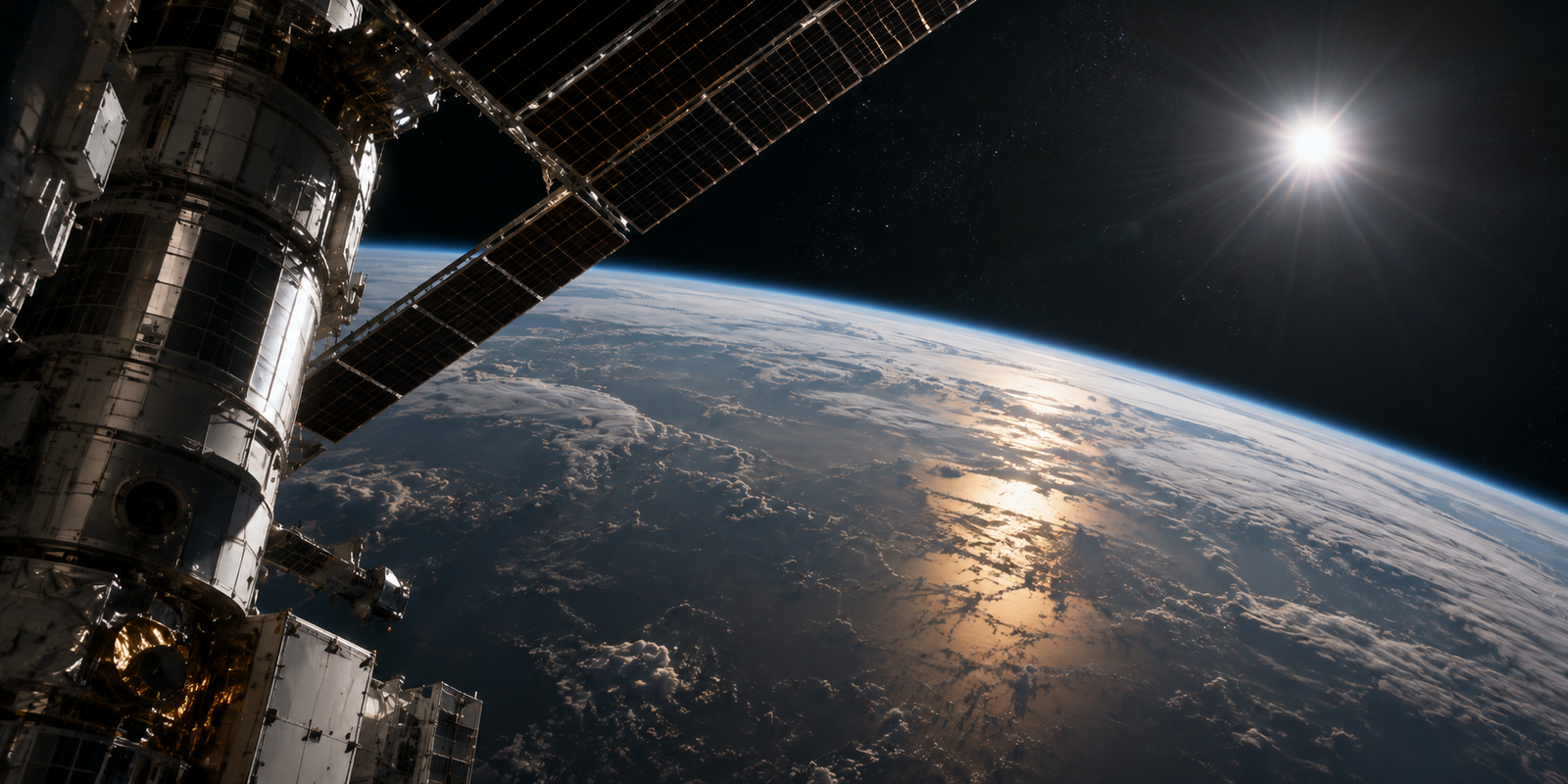
In the most iconic opening sequence in the history of science fiction cinema, in 2001: A Space Odyssey (1968), directed by Stanley Kubrick and co-written with Arthur C. Clarke, a prehistoric hominid discovers that a bleached mammal bone can be wielded as an extension of physical intent. In a surge of evolutionary triumph, the primate hurls the bone spinning into the open sky. In a match cut spanning four million years of technological history in a single frame, the tumbling bone dissolves into the sleek cylindrical silhouette of an orbital military satellite gliding silently through the vacuum of space to the strains of Johann Strauss’s Blue Danube.
In Christopher Nolan’s acclaimed cinematic masterpiece Interstellar (2014), produced with the scientific rigor of theoretical physicist and Nobel laureate Kip Thorne, the biological survival of the human species demands navigating a traversable wormhole into the vicinity of the spinning supermassive black hole Gargantua. On the surface of Miller’s ocean world, extreme gravitational time dilation distorts the spacetime continuum so severely that every single hour spent under the curvature of the gravitational well equals seven full years of aging on Earth.
Across the realistic astronautical expanse of The Expanse (adapted from the novels by James S. A. Corey), human civilization successfully breaks the shackles of Earth’s gravity, establishes subterranean industrial cities on Mars, and mines the Asteroid Belt thanks to a pivotal thermonuclear breakthrough: the Epstein Drive. This continuous-fusion magnetic engine operates with such profound fuel efficiency that spacecraft can accelerate non-stop at 1G (Earth-equivalent gravity) for weeks, compressing grueling multi-year interplanetary voyages into manageable journeys of mere days. In Star Wars, Han Solo immortalized the Millennium Falcon by flying the dangerous Kessel Run in less than 12 parsecs by skimming the edge of the gravitational singularities in the Maw cluster. And in the naval aviation saga Top Gun / Top Gun: Maverick (1986–2022), supersonic combat aircraft launch and recover from the flight deck of a nuclear-powered supercarrier—a fully sovereign, self-contained floating fortress of war energized by atomic fission.
These enduring cultural allegories converge on the most fundamental truth of evolutionary history: Earth is the sacred cradle of human consciousness, but no intelligent species can remain confined to its cradle forever. As rocketry pioneer Konstantin Tsiolkovsky warned over a century ago, planetary expansion into the cosmos is not an aesthetic luxury or a military whim, but a mathematical imperative to ensure civilizational resilience against planetary extinction events, catastrophic asteroid impacts, or resource depletion.
Yet for the past seven decades of the space age, humanity has operated under severe physical and thermodynamic constraints. We remain firmly bound to the tyranny of chemical combustion, where over 90% of a rocket’s launch mass consists of volatile propellants that burn out in minutes. To cross deep space, our astronauts face grueling three-year round-trip missions to Mars, exposed to cumulative galactic cosmic radiation (GCR) doses and severe musculoskeletal degradation under prolonged microgravity.
In 2026, humanity stands at the threshold of the Greatest Scientific Revolution in Space Exploration and Mega-Engineering.
Applied physics, nuclear engineering, and advanced materials have dismantled historical bottlenecks: Nuclear Thermal Propulsion (NTP) reactors and Direct Fusion Drive (DFD) engines are entering active ground and orbital testing to reduce Earth-Mars transit times to a few weeks; relativistic Photonic Sails driven by gigawatt-class laser arrays open the first viable pathway to reach Alpha Centauri at 20% of the speed of light; interferometric astrophysics discovers star S301 orbiting the supermassive black hole Sagittarius A* at an astonishing 25,000 km/s (8.5% the speed of light), testing Einstein’s General Relativity in uncharted gravitational regimes; the cryogenic optics of the James Webb Space Telescope (JWST) operate at 7 Kelvin at the Sun-Earth L2 Lagrange point to uncover cosmic dawn; orbital Space-Based Solar Power (SBSP) arrays prepare to beam continuous clean electricity to terrestrial grids; and Gerald R. Ford-class nuclear supercarriers sail the oceans as operating terrestrial prototypes of self-sustaining atomic fortresses.
This master guide represents the Official Topic Hub (Hub 5) of Reach Technocracy for the Space Exploration, Relativistic Astrophysics, Advanced Propulsion, and Mega-Engineering ecosystem. Here you will find the comprehensive roadmap connecting our frontier investigations: from the orbital kinematics of black hole event horizons to interstellar propulsion physics, cryogenic space observatories, and the naval leviathans projecting human engineering across the oceans and stars.
Curated Reading Paths (Choose Your Track)
To extract maximum strategic value from this comprehensive guide based on your technical background, research goals, and operational focus, select your recommended reading path:
- 🟢 Track 1: The Space Exploration & Clean Tech Enthusiast
Focus: Foundational physics principles, pop-culture conceptual models (2001, Interstellar, The Expanse, Star Wars), demystification of black holes and warp drives, and the humanitarian vision of a multiplanetary civilization.
Suggested Route: Introduction ➜ Prerequisites Glossary ➜ Chapters 1, 3, and 4 ➜ Fact vs. Sci-Fi Matrix ➜ Conclusion. - 🔵 Track 2: The Aerospace Engineer, Physicist & Systems Architect
Focus: Tsiolkovsky equations and Δv velocity budgets, plasma physics in Hall and DFD thrusters, Kerr metric mathematics, Lense-Thirring frame-dragging, GRAVITY+ interferometry, and A1B naval nuclear thermal cycles.
Suggested Route: Executive Key Takeaways across all chapters ➜ Chapters 1 through 5 in full ➜ Access all connected In-Depth Technical Spokes ➜ Epistemological Matrix. - 🟣 Track 3: The Deep-Tech Executive, Policy Maker & Investor
Focus: Space launch economics (sub-$100/kg orbital payload costs via Starship), SBSP orbital energy sovereignty, naval nuclear defense geopolitics, and the 2026–2035 Strategic Space Technology Roadmap.
Suggested Route: Executive Key Takeaways ➜ Chapters 1, 4, and 5 ➜ Chapter 7 (Strategic Roadmap) ➜ Download the Full Executive Dossier (PDF).
Fundamental Prerequisites & Key Concepts
Frontier space exploration, relativistic astrophysics, and mega-engineering operate upon rigorous physical foundations of orbital mechanics, nuclear thermodynamics, and gravitational theory. Below are the six essential conceptual pillars:
- The Tsiolkovsky Rocket Equation and the Delta-V (Δv) Budget: Formulated in 1903 by Konstantin Tsiolkovsky, the governing equation of astronautics establishes that the total velocity increment achievable by a spacecraft is proportional to effective exhaust velocity and the natural logarithm of the wet-to-dry mass ratio:
Δv = ve · ln(m₀ / mf)Because the mass ratio scales logarithmically, doubling a spacecraft’s terminal velocity requires an exponential increase in fuel mass at launch. - Specific Impulse (Isp) and Effective Exhaust Velocity: The universal metric of rocket engine thermodynamic efficiency, measured in seconds. Isp defines how many seconds one kilogram of propellant can produce one kilogram-force of thrust. Chemical rocket engines operate with Isp between 300 and 450 seconds; ion thrusters achieve 3,000 to 5,000 seconds; and nuclear thermal rockets reach 900 to 1,200 seconds.
- Kerr Metric, Lense-Thirring Effect, and Schwarzschild Precession: In Einstein’s General Relativity, ultradense masses warp spacetime geometry. Schwarzschild Precession causes the elliptical orbit of a nearby star to rotate in space over time, tracing a rosette pattern. The Kerr Metric describes a rotating black hole that literally drags the fabric of spacetime into a swirling relativistic vortex—a phenomenon known as Frame-Dragging or the Lense-Thirring Effect.
- Cryogenic Optics at 7 Kelvin and the Sun-Earth L2 Point: The gravitational equilibrium point located 1.5 million kilometers from Earth (L2) allows space observatories like the James Webb to maintain thermal isolation. A five-layer Kapton sunshield radiates away heat, maintaining sensitive infrared instrumentation at ultracold temperatures of 7 to 40 Kelvin (-266 °C) free from Earth’s thermal glow.
- Nuclear Thermal Propulsion (NTP) vs. Direct Fusion Drive (DFD): Non-chemical propulsion systems. Nuclear Thermal Propulsion (NTP) utilizes a compact fission reactor to superheat liquid hydrogen propellant to over 2,500 °C, generating high-thrust exhaust. The Direct Fusion Drive (DFD) employs a Field-Reversed Configuration (FRC) fusion reactor to generate direct plasma thrust and megawatts of auxiliary electrical power simultaneously.
- Space-Based Solar Power (SBSP) and Microwave Power Beaming: The continuous harvesting of raw solar irradiance in geostationary orbit (1,361 W/m² without night cycles or atmospheric attenuation) and its conversion into coherent microwave beams (2.45 GHz or 5.8 GHz) that penetrate clouds and rain with less than 2% loss, converted back into grid electricity by ground-based rectifying antennas (Rectennas).
Dynamic Timeline of Space Conquest and Mega-Engineering
- Phase 1 (1903–1969: From Theoretical Equations to the Moon Landing):
– 1903: Konstantin Tsiolkovsky publishes the foundational rocket equation in Russia.
– 1926: Robert Goddard launches the world’s first liquid-fueled rocket in Massachusetts.
– 1957: The Soviet Union launches Sputnik 1, opening the orbital satellite era.
– 1961: Yuri Gagarin becomes the first human in space aboard Vostok 1.
– 1969: NASA’s Apollo 11 lands astronauts Neil Armstrong and Buzz Aldrin on the Moon propelled by the giant Saturn V rocket. - Phase 2 (1970–2020: Space Shuttle, Orbital Stations, and Great Observatories):
– 1977: Launch of the twin Voyager 1 and 2 probes, the first human artifacts to enter interstellar space.
– 1990: Deployment of the Hubble Space Telescope in low Earth orbit.
– 1998: Modular construction of the International Space Station (ISS) begins in orbit.
– 2017: The US Navy commissions the nuclear supercarrier USS Gerald R. Ford (CVN-78), inaugurating EMALS electromagnetic catapults.
– 2018: ESO’s GRAVITY instrument at the VLT confirms gravitational redshift in star S2 orbiting Sagittarius A*. - Phase 3 (2021–2026: The New Golden Age — James Webb, S301, and Reusable Heavy Launch):
– December 2021: Flawless launch and deployment of the James Webb Space Telescope (JWST) to the L2 point.
– 2023–2024: Caltech’s SSPD-1/MAPLE mission demonstrates the first wireless power transfer from space to Earth.
– 2025: SpaceX executes regular integrated flight tests of Starship with launch tower booster catches.
– August 2026: The GRAVITY+/VLT consortium discovers star S301 orbiting Sagittarius A* at an unprecedented 25,000 km/s (8.5% the speed of light). - Phase 4 (2027–2035: The Frontier of Interplanetary Civilization and Mega-Structures):
– 2027–2029: First in-orbit flight demonstration of NASA/DARPA’s DRACO Nuclear Thermal Propulsion reactor.
– 2030–2032: Permanent crewed lunar base infrastructure with fission surface power and initial crewed Mars transit architecture.
– 2033–2035: Commercial SBSP constellations beaming continuous gigawatts of clean electricity; deployment of first Breakthrough Starshot micro-sail relativistic laser acceleration tests toward Alpha Centauri.
1. The Tyranny of Gravity: The Tsiolkovsky Rocket Equation, Ion Thrusters, and Nuclear Thermal Propulsion
📌 Chapter Key Takeaways:
1. Chemical rocket propulsion has hit an insurmountable thermodynamic ceiling, requiring over 90% of launch mass to consist solely of propellant.
2. Electrostatic and Hall-effect ion thrusters achieve specific impulses exceeding 3,000 seconds, enabling ultra-efficient deep-space orbital transfers with minimal mass.
3. Nuclear Thermal Propulsion (NTP) doubles chemical fuel efficiency and compresses crewed Earth-Mars transit times to under four months.
For more than a century of aerospace engineering, rocketry has been imprisoned by the Tyranny of the Tsiolkovsky Rocket Equation. When igniting liquid or solid propellants (such as liquid hydrogen, methane, or kerosene mixed with liquid oxygen), the energy that accelerates the vehicle is stored exclusively in molecular chemical bonds—a thermodynamic energy scale limited to mere electron-volts (eV) per reaction.
This fundamental constraint establishes an unyielding ceiling: the effective exhaust velocity of expanding hot gas exiting a chemical nozzle rarely surpasses 4.5 kilometers per second (4,500 m/s). To achieve Earth escape velocity (11.2 km/s) and inject into interplanetary trajectories toward Mars or Jupiter, a spacecraft must be constructed almost entirely of massive propellant tanks whose sole physical function is to burn and lift more propellant.
The Thermodynamic Ceiling of Chemical Combustion
In heavy chemical launch vehicles such as NASA’s historic Saturn V or the modern Space Launch System (SLS), between 85% and 92% of the total launch mass on the pad is consumable propellant. Metallic structural dry mass, avionics, and engines occupy 5% to 10%, leaving a razor-thin margin of 1% to 3% for the actual payload (the crew cabin, life support, and scientific hardware).
Under this chemical paradigm, a crewed round-trip mission to Mars utilizing minimum-energy Hohmann transfer orbits requires a mission duration of nearly three full years. Astronauts endure prolonged exposure to cumulative galactic cosmic radiation (GCR) and solar particle events, alongside irreversible bone mineral density loss and muscle atrophy under extended zero-gravity transit.
The Physics of Specific Impulse in Electrostatic and Hall Thrusters
To overcome chemical fuel limits in deep space, aerospace propulsion engineers developed Electric Space Propulsion:
- Electrostatic Ionization and the Hall Effect: Rather than burning combustible chemicals, a Hall thruster ionizes a heavy inert gas (such as Xenon or Krypton) using crossed electric and magnetic fields to generate an energized plasma of positive ions.
- Hyperbolic Exhaust Velocities: The ions are electrostatically accelerated through high-voltage grids and expelled into the vacuum at velocities between 30 and 60 kilometers per second—ten times faster than chemical combustion exhaust.
- Unrivaled Fuel Efficiency: While chemical engines operate with an Isp of ~450 seconds, ion thrusters achieve 3,000 to 5,000 seconds of Isp. Although instantaneous thrust is gentle (measured in millinewtons), the engine can fire continuously for months or years, accumulating massive velocity changes using only a few kilograms of propellant.
The Space Nuclear Renaissance: NTP Reactors and the DRACO Project
For crewed interplanetary missions requiring both high instantaneous thrust and high specific impulse, the primary technological solution is Nuclear Thermal Propulsion (NTP):
- Operating Principle of the NTP Reactor: A compact, high-power-density fission reactor utilizing High-Assay Low-Enriched Uranium (HALEU) fuel superheats pure Liquid Hydrogen to over 2,500 °C without combustion.
- Thermodynamic Advantage of Pure Hydrogen: Exhaust velocity is inversely proportional to the square root of propellant molecular mass (ve ∝ √(T / M)). Because molecular hydrogen (H₂) has the lowest molecular mass in the universe (M = 2 g/mol), NTP engines achieve specific impulses of 900 to 1,200 seconds—more than double the most efficient hydrolox engine ever built (the Space Shuttle RS-25).
- NASA and DARPA’s DRACO Project: The Demonstration Rocket for Agile Cislunar Operations (DRACO) initiative targets in-orbit flight validation of an operational NTP reactor in the late 2020s, designed to cut Earth-Mars transit from nine months down to three to four months.
🔬 IN-DEPTH TECHNICAL ESSAY:
To explore the mathematics of the Tsiolkovsky equation, Hall thruster plasma dynamics, and the engineering specs of the DRACO nuclear engine, read our complete analysis:
👉 Beyond Chemical Rockets: Ion Thrusters, Solar Sails, and Fusion Propulsion to Reach Mars and Beyond
2. Reaching for the Stars: Direct Fusion Drives (DFD), Solar Sails, and Relativistic Spaceflight
📌 Chapter Key Takeaways:
1. The Direct Fusion Drive (DFD) combines aneutronic fusion plasma thrust and auxiliary electric power generation in a single compact core.
2. Photonic solar sails utilize radiation pressure, enabling continuous acceleration with zero onboard propellant consumption.
3. The Breakthrough Starshot initiative plans laser-accelerated micro-probes cruising at 0.2c (20% the speed of light), reaching Alpha Centauri in 20 years.
While nuclear thermal propulsion enables rapid colonization of the inner Solar System, crossing the interstellar ocean toward the outer gas giants (Jupiter, Saturn) and neighboring star systems requires propulsion architectures governed by magnetized fusion physics and relativistic photonics.
The Direct Fusion Drive (DFD): Compact Fusion for Deep Space
Pioneered at the Princeton Plasma Physics Laboratory (PPPL) in partnership with NASA, the Direct Fusion Drive (DFD) represents the closest physical realization of science fiction’s Epstein Drive:
- Field-Reversed Configuration (FRC) Confinement: The DFD utilizes a compact linear fusion reactor based on closed magnetic plasma rings containing an advanced fuel mixture of Deuterium and Helium-3 (³He).
- Clean Aneutronic Fusion: Fusing Deuterium with Helium-3 produces high-energy protons and charged alpha particles (⁴He) rather than destructive fast neutrons, liberating kinetic energy directly controllable via magnetic fields without embrittling reactor shielding.
- Dual Thrust and Megawatt Power: A cool propellant gas blanket flowing around the plasma core is heated to stellar temperatures and channeled through a magnetic nozzle at an Isp of 10,000 seconds, while simultaneously harvesting up to 2 Megawatts of clean electrical power to sustain deep-space life support and scientific arrays for decades.
Photonic Sails and the Radiation Pressure of Light
Quantum electrodynamics establishes that while photons have zero rest mass, they carry linear momentum (p = E / c). When photons reflect off an ultra-specular reflective surface, they transfer twice their momentum as pure physical thrust:
- Passive Solar Sailing: Missions like IKAROS (JAXA) and LightSail 2 (The Planetary Society) demonstrated that radiation pressure from natural sunlight can propel spacecraft indefinitely throughout the inner Solar System with zero fuel tanks.
- The Breakthrough Starshot Initiative: To achieve relativistic interstellar velocities, the Breakthrough Starshot project designs a terrestrial phased array of 100-Gigawatt lasers focused onto ultra-lightweight metamaterial nano-sails (weighing just grams). Concentrated photon pressure will accelerate these probes to 20% the speed of light (0.2c or 60,000 km/s) within minutes, allowing them to traverse the 4.24 light-year gulf to Alpha Centauri and exoplanet Proxima b in roughly 20 years.
Relativistic Flight Equations for Interstellar Journeys
At velocities approaching significant fractions of the speed of light, classical Newtonian mechanics breaks down and Einstein’s Special Relativity governs spaceflight. The Lorentz factor (γ) dictates physical reality:
γ = 1 / √(1 – v² / c²)
For a hypothetical relativistic spacecraft accelerating continuously at a steady 1G, relativistic time dilation allows crew members to traverse the entire 100,000 light-year diameter of the Milky Way galaxy in just a few decades of onboard ship time, while hundreds of millennia elapse on Earth.
3. Astrophysics of Extremes: The Dance of Star S301 Around Sagittarius A*
📌 Chapter Key Takeaways:
1. Star S301, discovered in August 2026 by the GRAVITY+/VLT consortium, is the fastest and closest star ever detected orbiting supermassive black hole Sagittarius A*.
2. Reaching 25,000 km/s (8.5% the speed of light or 0.085c) just 12 AU from the event horizon, S301 completes its orbit in only 8.7 years.
3. Enables precision testing of General Relativity, gravitational redshift, Schwarzschild orbital precession, and the Lense-Thirring frame-dragging effect.
At the exact dynamical center of our galaxy, approximately 26,000 light-years from Earth in the constellation Sagittarius, lies the definitive gravitational anchor of the Milky Way: the supermassive black hole Sagittarius A* (Sgr A*).
Concentrating a massive 4.15 million solar masses inside a Schwarzschild radius of less than 12.3 million kilometers (smaller than Mercury’s orbit around the Sun), Sagittarius A* serves as the universe’s premier natural laboratory for testing Albert Einstein’s Theory of General Relativity under extreme gravity.
The S-Star Cluster and the Search for Relativistic Gravitational Tests
Surrounding this cosmic singularity is a unique cluster of celestial bodies known as the S-Star Cluster (S-Stars)—young, massive, blue main-sequence stars locked in tight, highly eccentric elliptical orbits just light-days from the event horizon.
For over two decades, the flagship star of this cluster was S2. Monitored by the teams of Reinhard Genzel and Andrea Ghez (awarded the 2020 Nobel Prize in Physics for proving the supermassive black hole’s existence), S2 orbits every 16 years, reaching 7,700 km/s (2.6% the speed of light) and confirming Einstein’s gravitational redshift in 2018.
Yet theoretical physicists knew that detecting the spin and frame-dragging of spacetime around Sagittarius A* required finding a star passing far closer and traveling at relativistic velocities. That historic search culminated in the discovery of star S301.
Extreme Kinematics of Star S301: 25,000 km/s and 0.085c
Announced in August 2026 by the Very Large Telescope Interferometer (VLTI) consortium at the European Southern Observatory (ESO) in Chile using the advanced GRAVITY+ optical instrument, star S301 shattered all previous astronomical velocity benchmarks:
- Peak Orbital Velocity: At closest periastron approach, S301 reaches a staggering 25,000 kilometers per second—representing 8.5% of the speed of light in vacuum (0.085c). At this velocity, S301 would travel from the Earth to the Moon in 15 seconds and cross the entire diameter of planet Earth in half a second.
- Ultra-Short Orbital Period: S301 completes a full orbital revolution around Sagittarius A* in only 8.7 Earth years (nearly half the period of star S2).
- Minimum Periastron Distance: Approaches within just 12 Astronomical Units (12 AU) of the black hole’s center (about 1.8 billion kilometers)—a distance comparable to the separation between the Sun and Saturn in our own Solar System.
- Extreme Orbital Eccentricity: With an eccentricity of e > 0.9, the star spends years cruising through outer regions before executing a vertiginous gravitational dive that slingshots it through periastron at relativistic speeds.
Einstein’s Ultimate Tests: Gravitational Redshift and Schwarzschild Precession
The orbital trajectory of S301 subjected Einstein’s field equations to an unprecedented observational stress test:
- Gravitational Redshift: Passing 12 AU from the singularity, photons emitted from S301’s surface lose immense energy climbing out of the gravitational well toward Earth’s telescopes, stretching their wavelengths into the infrared and directly proving gravitational time dilation in a stellar body at 0.085c.
- Schwarzschild Precession (The Rosette Effect): Deviating from static Newtonian ellipses, the spatial curvature of the Schwarzschild metric causes the major axis of S301’s orbit to precess several degrees per revolution, carving a rosette floral pattern in space over time.
The New Frontier: Measuring the Lense-Thirring Effect (Frame-Dragging)
The foremost astrophysical milestone unlocked by S301 is the direct measurement of the spin (angular momentum) of Sagittarius A* as formulated by the Kerr metric:
- The Relativistic Kerr Vortex: A spinning black hole not only attracts matter through gravity, but literally drags the surrounding fabric of spacetime along with its rotation.
- The Lense-Thirring Effect: Frame-dragging intensity decays rapidly with distance (inversely proportional to the cube of the radius, 1 / r³). Because S301 passes within 12 AU, its orbital plane experiences an additional relativistic nodal precession caused directly by Sagittarius A*’s spin, allowing scientists to determine the dimensionless spin parameter (a*) and validate the fundamental No-Hair Theorem of black hole physics.
🔬 IN-DEPTH TECHNICAL ESSAY:
To explore the mathematical physics of the Kerr metric, the near-infrared interferometry of GRAVITY+, and the relativistic orbital dynamics of star S301, read our complete analysis:
4. Orbital Mega-Engineering: The Cryogenic Optics of James Webb and Space-Based Solar Power (SBSP)
📌 Chapter Key Takeaways:
1. The James Webb Space Telescope (JWST) operates 1.5 million km from Earth, utilizing gold-plated beryllium mirrors and a 5-layer Kapton sunshield cooled to 7 Kelvin.
2. Space-Based Solar Power (SBSP) harvests uninterrupted solar irradiance in GEO, beaming clean 24/7 electricity to Earth via safe microwave arrays.
3. Fully reusable heavy-lift launch vehicles reduce orbital transport costs below $100/kg, viabilizing autonomous robotic mega-structure assembly.
Humanity’s transition into space demands deploying optical observatories and orbital energy structures at scales that push the outer boundaries of materials science, robotic assembly, and fluid thermodynamics.
The Mega-Engineering of the James Webb Space Telescope (JWST)
Stationed at the Sun-Earth L2 Lagrange point, 1.5 million kilometers from Earth, the James Webb Space Telescope is the most sophisticated optical machine ever launched into the cosmos:
- Gold-Coated Beryllium Primary Mirrors: Spanning 6.5 meters across 18 hexagonal segments, the mirrors were machined from Optical-Grade Beryllium (O-30)—an ultra-lightweight metal with extreme dimensional stability at cryogenic temperatures. Each segment received a vacuum-deposited 100-nanometer layer of pure Gold topped with protective silica, achieving over 98% infrared reflectivity.
- The Five-Layer Kapton Sunshield: Sized like a tennis court (21 x 14 meters), the sunshield isolates the sun-facing hot side (+85 °C) from the telescope’s cryogenic cold side (-233 °C or 40 Kelvin). Kapton polyimide membranes coated with aluminum and doped silicon dissipate heat across vacuum gaps, sustaining a 300 °C thermal gradient.
- 7-Kelvin Pulse-Tube Cryocooler: To operate the Mid-Infrared Instrument (MIRI) at wavelengths between 5 and 28 micrometers, closed-cycle helium pumps chill arsenic-doped silicon semiconductor detectors down to 6.7 Kelvin (-266.45 °C), suppressing thermal noise to detect the earliest galaxies formed just hundreds of millions of years after the Big Bang.
🔬 IN-DEPTH TECHNICAL ESSAY:
To explore the physics of beryllium cryogenic optics, the thermal modeling of the Kapton sunshield, and the cosmological breakthroughs of JWST, read our complete analysis:
Space-Based Solar Power (SBSP): Harvesting Stellar Energy in Orbit
While space telescopes capture fossil photons for science, Space-Based Solar Power (SBSP) satellites harvest continuous solar flux to power terrestrial civilization:
- Uninterrupted Vacuum Irradiance (1,361 W/m²): In geostationary orbit (GEO) at 36,000 km altitude, satellites operate free of day-night cycles, weather, and atmospheric scattering, generating 8 to 10 times more electricity per square meter than ground panels.
- Coherent Microwave Power Beaming: Direct-current solar power is converted to radiofrequency by Gallium Nitride (GaN) power amplifiers and beamed at 2.45 GHz or 5.8 GHz—an atmospheric window with less than 2% transmission loss through clouds and heavy rain.
- Terrestrial Rectifying Antennas (Rectennas): On the ground, arrays of dipole antennas with Schottky diodes convert microwaves directly back into DC/AC grid power with 85% to 90% efficiency at safe, non-ionizing power densities (~250 W/m²) posing zero thermal hazard to aviation or wildlife.
🔬 IN-DEPTH TECHNICAL ESSAY:
To explore rectenna diode arrays, GaN conversion efficiency, and international programs like ESA’s SOLARIS and Caltech’s SSPD, read our complete analysis:
5. Terrestrial and Naval Mega-Engineering: The Nuclear Titans of the Gerald R. Ford Class
📌 Chapter Key Takeaways:
1. Gerald R. Ford-class nuclear supercarriers represent the zenith of marine, nuclear, mechanical, and aerospace mega-engineering on Earth.
2. Dual Bechtel A1B pressurized water reactors provide propulsion and electric power for 25 consecutive years of continuous deployment without refueling.
3. EMALS electromagnetic catapults and AAG arresting gear replace mechanical steam pistons with millisecond magnetic flux control.
While astronautics plans initial off-world mining outposts, terrestrial engineering has already constructed autonomous floating atomic cities capable of traversing the oceans without ever needing to dock for propulsion fuel: the Gerald R. Ford-class (CVN-78) supercarriers of the United States Navy.
Measuring over 333 meters in length, displacing more than 100,000 metric tons at full load, and standing 25 stories tall with nearly 5,000 crew members, these naval fortresses represent the largest and most complex mobile defense and energy artifacts in human history.
The Atomic Heart: Bechtel A1B Pressurized Water Reactors
The operational endurance of the Ford-class supercarrier stems from its state-of-the-art naval nuclear powerplant:
- Dual Bechtel A1B Pressurized Water Reactors: These compact, heavily armored reactors utilize highly enriched uranium to heat primary coolant water past 300 °C under extreme pressure (over 150 bar) without boiling.
- 25 Years of Unrefueled Cruising: A single nuclear fuel core enables continuous unrefueled transit speeds exceeding 30 knots (over 56 km/h) for a quarter of a century. The ship’s sole operational constraint at sea is food and dry provisions stored for the crew.
- Tripled Electrical Output: A1B reactors generate 300% more electrical power than previous Nimitz-class reactors, feeding a 13.8 kV medium-voltage distribution grid designed to support directed-energy weapons (high-power defense lasers and electromagnetic Railguns).
The Electromagnetic Revolution: EMALS Catapults and AAG Recovery
The defining technological leap of the Ford class was replacing legacy steam-piston catapults with linear induction electromagnetic systems:
- Electromagnetic Aircraft Launch System (EMALS): High-density linear induction motors accelerate 30-ton combat aircraft (such as the F/A-18E Super Hornet and F-35C Lightning II) from 0 to 260 km/h in just 2.5 seconds along a 90-meter track, with precision acceleration profiling that slashes airframe fatigue stress.
- Advanced Arresting Gear (AAG): Water-twister energy absorbers and electric recovery motors capture the tailhooks of returning jets landing at 240 km/h, absorbing gigajoules of kinetic energy with computerized feedback.
- Advanced Weapons Elevators (AWE): Cable-free linear magnetic motors lift tons of precision-guided ordnance from deep armored magazines to the flight deck at 45 meters per minute, accelerating combat sortie generation rates by over 33%.
🔬 IN-DEPTH TECHNICAL ESSAY:
To explore the thermodynamics of Bechtel A1B reactors, EMALS linear motor physics, and the autonomous urban infrastructure of modern supercarriers, read our complete analysis:
👉 The Mega-Engineering of a Nuclear Aircraft Carrier: The Floating Cities of War
6. Fact vs. Hypothesis vs. Science Fiction Matrix
| Technological Domain | 🟢 Proven Fact (State of the Art 2026) | 🟡 Scientific Hypothesis (In Active Research) | 🔴 Science Fiction & Popular Myths |
|---|---|---|---|
| Space Propulsion | Hall-effect ion thrusters operating with Isp > 3,000s; orbital NTP flight test reactors under assembly (DRACO). | Direct Fusion Drive (DFD) generating simultaneous plasma thrust and megawatts of electrical power. | Alcubierre warp drives and hyperdrives operating without requiring exotic negative-energy density. |
| Interstellar Travel | Voyager 1 and 2 cruising in interstellar space; photonic solar sails validated in Earth orbit. | Breakthrough Starshot nano-sails accelerated by ground laser arrays to 0.2c reaching Alpha Centauri in 20 years. | Crewed starships jumping across distant galaxies at faster-than-light speeds like Star Wars. |
| Black Holes & Gravity | Star S301 orbiting Sagittarius A* at 25,000 km/s (0.085c); gravitational redshift and precession confirmed. | Direct measurement of Sagittarius A*’s spin parameter and Lense-Thirring spacetime frame-dragging. | Traversable wormholes allowing human spacetime travel and closed timelike loops violating causality. |
| Orbital Mega-Engineering | JWST operating at 7 Kelvin with gold-beryllium optics; orbital wireless microwave power transmission demonstrated. | Modular 1 GW Space-Based Solar Power stations assembled by autonomous robot swarms powering cities. | Full Dyson Spheres constructed by dismantling entire terrestrial planets in the Solar System. |
| Naval Mega-Engineering | Ford-class nuclear supercarriers with EMALS electromagnetic catapults and 25-year unrefueled endurance. | Fully autonomous unmanned naval carrier strike groups operated by distributed AI command systems. | Impenetrable energy forcefields and matter-disintegrating tactical plasma cannons. |
7. Strategic Space Exploration & Mega-Engineering Roadmap (2026–2035)
Short-Term Horizon (2026–2027): Orbital Validation and First Space Nuclear Reactors
- Continuous Interferometric Tracking of Star S301: ESO’s GRAVITY+ consortium accumulates high-velocity astrometric data on S301, constraining Sagittarius A*’s spin parameters.
- DRACO Nuclear Thermal Propulsion Flight Demonstration: NASA and DARPA execute the first in-orbit firing of a HALEU-fueled nuclear thermal rocket engine.
- Starship Operational Reusability: SpaceX commences routine commercial Starship flights capable of lifting 100+ metric tons to low Earth orbit at unprecedented low cost.
Medium-Term Horizon (2028–2030): Lunar Permanence and Ground Fusion Thruster Trials
- Artemis Base Camp Deployment: Establishing sustained human surface infrastructure on the Moon supported by Fission Surface Power nuclear reactors.
- PPPL/NASA DFD Core Bench Tests: Completing full-scale prototype testing of the Field-Reversed Configuration fusion core for the Direct Fusion Drive.
- First Light of the Extremely Large Telescope (ELT): ESO’s 39-meter ELT begins scientific observations with angular resolution capable of tracking inner S-cluster stars at micro-arcseconds.
Long-Term Horizon (2031–2035): Interplanetary Transit and Relativistic Probes
- Crewed Mars Missions via Nuclear Propulsion: Launch of first human Mars transit missions with flight times compressed to 90–120 days via NTP engines.
- First Megawatt-Scale SBSP Orbital Plants: Deployment of first-generation commercial Space-Based Solar Power modules transmitting continuous microwave energy to remote installations.
- Breakthrough Starshot Laser Array Firing: Launching swarms of relativistic photon-sail probes accelerated by laser arrays toward Alpha Centauri.
Conclusion: Humanity’s Cosmic Destiny
Contemplating the arc of our species—from Kubrick’s prehistoric hominid hurling a bone toward the heavens to astrophysicists tracking star S301 tearing through spacetime at 25,000 kilometers per second—one truth stands clear: engineering and science are the instruments through which the universe understands and transforms itself.
Overcoming chemical combustion through ion thrusters, nuclear thermal rockets, and direct fusion engines, deciphering relativistic physics around black holes, deploying the cryogenic eye of James Webb, harvesting orbital solar energy, and sailing the seas aboard atomic supercarriers are not isolated feats. They form the unified tapestry of humanity’s transition from a planet-bound species to a resilient, multiplanetary civilization.
At Reach Technocracy, we remain dedicated to decoding the deepest frontiers of science, plasma physics, and mega-engineering. The horizon beyond Earth’s atmosphere awaits—and our journey to the stars has only just begun.
Frequently Asked Questions (FAQ Indexable for SEO/GEO)
1. Why are conventional chemical rockets inadequate for interstellar travel or fast crewed Mars missions?
Chemical combustion has an absolute thermodynamic exhaust velocity ceiling (~4.5 km/s). According to Tsiolkovsky’s Rocket Equation, doubling final velocity requires exponential propellant mass increases. Under this paradigm, over 90% of a rocket is fuel and round-trip Mars voyages require nearly three years, exposing astronauts to harmful radiation and severe microgravity bone loss.
2. What is the fundamental difference between Nuclear Thermal Propulsion (NTP) and Direct Fusion Drives (DFD)?
Nuclear Thermal Propulsion (NTP) uses a nuclear fission reactor to superheat liquid hydrogen, doubling specific impulse (Isp ~900s) compared to chemical rockets. Direct Fusion Drives (DFD) use aneutronic fusion to produce both extreme specific impulse plasma thrust (Isp ~10,000s) and continuous megawatts of onboard electrical power for decades.
3. Why is the 2026 discovery of star S301 a milestone for gravitational physics?
Star S301 is the closest and fastest star ever detected orbiting supermassive black hole Sagittarius A*, reaching 25,000 km/s (8.5% the speed of light or 0.085c) just 12 AU from the event horizon. This proximity allows physicists to directly measure the Lense-Thirring frame-dragging effect and calculate the black hole’s rotational spin parameter.
4. Why must the James Webb Space Telescope operate at an ultracold 7 Kelvin?
JWST observes faint infrared light emitted by the universe’s first galaxies. If the telescope were warm, its own optical components would radiate thermal infrared glow, blinding its detectors. The Kapton sunshield and pulse-tube cryocooler maintain near-absolute-zero cold to capture pristine cosmic photons.
5. How does a Gerald R. Ford-class nuclear supercarrier operate for 25 years without refueling?
It is powered by two Bechtel A1B pressurized water reactors fueled with highly enriched uranium. Fission energy density is millions of times higher than fossil fuels, enabling steam turbines and electrical generators to operate non-stop for a quarter-century on a single nuclear core.
Continue Exploring the Reach Technocracy Library
- Beyond Chemical Rockets: Ion Thrusters, Solar Sails, and Fusion Propulsion — Advanced propulsion physics for fast interplanetary transit.
- The Fastest Star in the Galaxy: The Discovery of S301 at 25,000 km/s — Testing General Relativity around Sagittarius A*.
- The Mega-Engineering of the James Webb Space Telescope — Cryogenic beryllium optics peering into cosmic dawn.
- Space-Based Solar Power (SBSP): Harvesting 24/7 Orbital Sunlight — Wireless microwave power transmission from geostationary orbit.
- The Mega-Engineering of a Nuclear Aircraft Carrier: Floating Cities of War — Bechtel A1B reactors and EMALS electromagnetic catapults.
- Hub 1: The Definitive Guide to Artificial Intelligence — From LLMs and Multi-Agent Systems to Physical AI and AGI.
- Hub 2: The Definitive Guide to Quantum Computing — Qubits, Silicon Photonics, and Post-Quantum Cryptography.
- Hub 3: The Definitive Guide to Biotechnology — CRISPR, mRNA Vaccines, Neuralink, and Longevity.
- Hub 4: The Definitive Guide to Frontier Energy — Nuclear Fusion, Superhot Geothermal, and Solid-State Batteries.